Introduction
Email marketing remains one of the highest-ROI channels for e-commerce brands. Many DTC businesses still struggle to turn it into meaningful revenue.
The usual problem is one-size-fits-all promotional blasts instead of strategic, behavior-driven campaigns. The difference between a $5,000 monthly email channel and a $50,000 one often comes down to campaign variety, timing, and personalization.
Brands that treat email as a lifecycle system, not just a broadcast tool, see email attribution climb from 10-15% of total revenue to 30-40% or higher.
This guide breaks down the most effective email campaign types for e-commerce, when to use each one, and how to build a system that turns traffic you've already paid for into repeat revenue.
Key Takeaways
- Coordinated email sequences move subscribers from first opt-in to repeat purchase faster than one-off blasts
- Top brands run welcome, recovery, post-purchase, promo, win-back, and launch campaigns in parallel, not one at a time
- Automated lifecycle flows (welcome, cart recovery, post-purchase) drive 41% of email sales from only 5.3% of sends
- Campaign strategy should align with your business model: high-AOV brands need extended nurture, while consumables require replenishment timing
What Is an Email Marketing Campaign?
An email marketing campaign is a series of targeted emails sent to specific audience segments with the goal of driving a desired action, whether that's making a first purchase, re-engaging with your brand, or buying again.
Campaigns differ from one-off promotional blasts in three key ways:
- Strategic sequencing: Campaigns guide subscribers through a journey rather than delivering isolated messages
- Behavioral targeting: Messages are triggered by actions (signup, cart abandonment, purchase) or sent to specific segments (VIP customers, dormant subscribers)
- Measurable goals: Each campaign type has clear KPIs tied to customer lifecycle stage
Two campaign categories:
- Manual campaigns: Scheduled sends like product launches, seasonal promotions, or weekly newsletters. You control the timing and audience
- Automated campaigns: Trigger-based flows like welcome series, abandoned cart emails, or post-purchase sequences. The customer's behavior controls when they receive each message
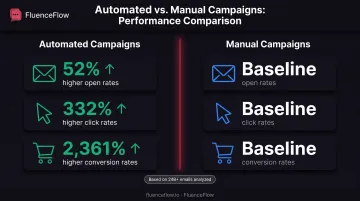
Omnisend's 2024 analysis of over 24 billion emails found that automated campaigns significantly outperform manual sends: 52% higher open rates, 332% higher click rates, and 2,361% higher conversion rates. This performance gap comes down to timing. Automated emails reach customers when intent is highest.
Why Email Marketing Campaigns Are Important for E-commerce
Email campaigns reach customers at the moments when engagement and conversion intent peak:
- Immediately after signup
- During product research
- After adding items to cart
- Following a purchase
Owned channel advantage: Unlike paid ads or social algorithms, you control the message, timing, and targeting. As acquisition costs continue rising, with Litmus reporting retail CAC increased 7% from 2023 to 2024, owned channels become more valuable. Email provides permission-based access to customers without ongoing platform fees.
Revenue efficiency: Klaviyo's 2026 benchmarks show automated flows produced 41% of email revenue from just 5.3% of sends. Omnisend's dataset found flows generated 37% of email sales from only 2% of volume. That gap makes lifecycle automation one of the highest-ROI plays in e-commerce marketing.
Well-optimized e-commerce stores often see email drive 30-40% of total revenue. Some brands clear 40% when campaigns and flows work together across the full customer journey.
Types of Email Marketing Campaigns
Each campaign type serves a specific purpose in the customer lifecycle. The most successful e-commerce brands run multiple campaign types simultaneously to engage customers from first impression through repeat purchase.
Welcome Series Campaigns
What it is: An automated sequence triggered when someone subscribes or creates an account. It introduces your brand, sets expectations, and drives a first purchase.
Why it matters: New subscribers have the highest engagement rates of any audience segment. Omnisend's 2025 benchmarks show welcome emails average 35.53% open rates and $6.16 revenue per email, compared to 30.41% opens and $0.155 per email for standard campaigns.
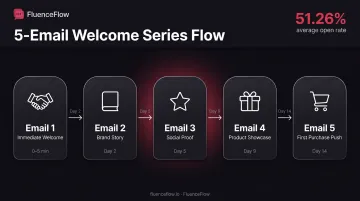
Klaviyo's data shows welcome series average 51.26% opens and 1.97% placed-order rates, making this the best window to convert interest into action.
Key elements to include:
- Brand story and clear value proposition
- Social proof (customer reviews, testimonials, user-generated content)
- First-purchase incentive if aligned with your pricing strategy
- Product recommendations based on signup source or browsing behavior
- Clear next steps and easy navigation to bestsellers
Best practices:
- Send the first email immediately (within minutes of signup)
- Use 3-5 emails over 7-14 days, adjusted to your purchase cycle
- Personalize messaging based on signup source; popup subscribers need different context than checkout accounts
- Test incentive strategies: not every brand needs to lead with a discount
Agencies like FluenceFlow customize welcome sequences around unit economics rather than using generic templates. For high-AOV premium products, extended education builds confidence; for consumables, aggressive first-order conversion sets up profitable repurchases.
Abandoned Cart and Browse Recovery Campaigns
What they are: Automated emails triggered when customers add items to cart or view products but leave without purchasing. Their job is to recapture lost revenue.
Why they matter: Cart abandonment rates average 70.22% across e-commerce, representing significant recoverable revenue. Brands without these campaigns miss recoverable revenue every day.
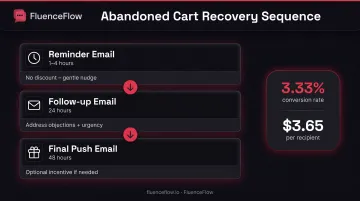
Klaviyo's 2023 analysis of 143,000+ cart flows found average performance of 50.50% opens, 6.25% clicks, and 3.33% placed-order rates, generating $3.65 revenue per recipient. Browse abandonment performs lower but remains valuable: Omnisend reports 44.47% opens and $0.76 per email.
Key elements to include:
- Dynamic product imagery showing abandoned items
- Urgency or scarcity messaging when genuine (low stock, limited-time offers)
- Address common objections: shipping costs, return policy, trust signals
- Progressive incentive strategy: first email reminds without discount; second may offer a small incentive if needed
Best practices:
- Send first email within 1-4 hours while intent is fresh
- Use 2-3 email sequence over 24-72 hours
- Test timing and incentive strategy based on AOV and margin; premium brands may never need discounts
- Consider SMS for high-value carts to increase recovery rate
Klaviyo recommends a three-email sequence: reminder at 2-4 hours, follow-up at 24 hours, final message at 48 hours. Avoid training customers to wait for discounts by testing non-incentive recovery first.
Post-Purchase and Customer Nurture Campaigns
What they are: Automated emails sent after a purchase to confirm orders, provide value, encourage repeat purchases, and build long-term relationships.
Why they matter: Retention is cheaper than acquisition, and repeat buyers usually spend more per order. Post-purchase flows are one of the clearest levers for raising customer lifetime value.
Omnisend's 2025 data shows order follow-up emails average 47.70% opens and $1.75 revenue per email, while cross-sell messages average 42.09% opens and $0.95 per email. Freshly Cosmetics reported 136% more revenue and 153% higher placed-order rates after implementing targeted post-purchase flows.
Key elements to include:
- Order confirmation and shipping updates (transactional baseline)
- Product education, usage tips, or care instructions
- Cross-sell and upsell recommendations based on purchase history
- Review requests or user-generated content collection
- Loyalty program invitations or repeat purchase incentives
Best practices:
- Sequence emails based on delivery and usage cycle; send tips after delivery, replenishment reminders when products run low
- Personalize recommendations using purchase history and browsing behavior
- For consumables, time replenishment flows to actual usage rates, not arbitrary intervals
- For premium products, focus on cross-sells that increase LTV without cheapening brand perception
FluenceFlow structures post-purchase campaigns around business model: high-frequency consumables emphasize replenishment timing and progressive rewards to prevent switching, while premium brands use education and confidence-building to support additional purchases.
Promotional and Sales Campaigns
What they are: Time-sensitive emails built around sales events, seasonal promotions, flash sales, or limited-time offers to create urgency and convert.
Why they matter: Promotional emails are often the highest revenue-generating campaigns in the short term, especially during key shopping periods like holidays, Black Friday, or end-of-season sales.
Omnisend's 2025 data shows promotional campaigns typically account for a large share of email revenue volume, averaging 30.41% opens and $0.155 per email. During BFCM 2023, email opens reached 25.4%, with automated emails generating 29.3% of orders from just 1.75% of sends.
Key elements to include:
- Clear, compelling subject line with urgency or benefit
- Prominent discount or offer details above the fold
- Strong visual hierarchy and scannable design
- Single clear call-to-action (avoid competing CTAs)
- Countdown timers or stock scarcity indicators when appropriate
Best practices:
- Segment audiences based on engagement level and purchase history; don't send identical promotions to new subscribers and VIP customers
- Test send timing for your specific audience (mornings vs. evenings, weekdays vs. weekends)
- Plan email frequency carefully to avoid list fatigue
- Balance promotional campaigns with value-driven content to maintain engagement
Jenni Kayne used browsing behavior, purchase history, and self-selection to segment promotions and grew email revenue 14.5% year-over-year, while Huda Beauty doubled Klaviyo-attributed revenue using engagement-based frequency caps. These are brand-specific cases without controls, but they illustrate segmentation's impact.
Re-engagement and Win-back Campaigns
What they are: Automated or manual emails sent to inactive subscribers who haven't opened emails or made purchases in a set timeframe. Goal: reactivate interest or clean the list.
Why they matter: Inactive subscribers hurt deliverability and engagement metrics, and they represent lost revenue opportunities. Win-back campaigns can recover dormant customers while improving list health.
Omnisend's 2025 benchmarks show customer-reactivation campaigns average 33.11% opens, 1.99% clicks, and $0.51 revenue per email. While lower than active-customer performance, these campaigns provide one last chance to recover relationships before removing non-responders.
Key elements to include:
- Acknowledge the absence authentically ("We miss you" or "It's been a while")
- Offer a compelling reason to return (exclusive discount, new product preview, personalized recommendations)
- Provide easy preference center or unsubscribe option to respect customer choice
- Create genuine urgency (limited-time offer, last chance)
Best practices:
- Define "inactive" based on your purchase cycle: 30-60 days for high-frequency brands, 90-180 days for low-frequency
- Klaviyo recommends timing win-back campaigns when 75-85% of customers would normally repurchase
- Send 2-3 email sequence with escalating incentives
- Remove non-responders from active list to maintain deliverability and focus resources on engaged subscribers
Mailchimp notes that cleaning lists, removing unengaged, invalid, or duplicate contacts, can improve inbox placement and engagement, though specific uplift percentages vary by list health.
Product Launch and Announcement Campaigns
What they are: Emails that announce new products, restocks, features, or brand news to build excitement and drive early sales.
Why they matter: Launch campaigns create concentrated demand and urgency, capitalize on existing audience interest, and can produce sharp revenue spikes for brands with engaged communities.
Unlike other campaign types, product launches lack robust industry benchmarks. Well-executed sequences still produce measurable results for DTC brands.
Key elements to include:
- Teaser emails to build anticipation before launch (2-5 days prior)
- Clear product benefits and differentiation: why this product matters now
- Early access or exclusive offers for email subscribers
- Strong visuals, lifestyle imagery, and social proof if available
- Urgency mechanisms (limited quantity, launch-day pricing, early-bird bonuses)
Best practices:
- Segment audience by interest or past purchase behavior when possible; launch camping gear to outdoor enthusiasts, not your entire list
- Use sequence of 2-4 emails: teaser, launch announcement, reminder, last chance
- Track performance to understand product-market fit and refine future launches
- Consider VIP-only early access to reward engaged customers
FluenceFlow has executed product launches using VIP-exclusive discounts, limited-availability messaging, and benefit-focused positioning. One campaign-focused optimization increased campaign revenue 36x in 30 days, from $364 to over $13,000 monthly (broader campaign strategy, not launch emails alone).
How to Choose the Right Campaign Type for Your Business
The right mix of campaigns depends on your business model, not generic best practices. Three factors determine priority:
1. Purchase frequency and AOV:
- High-AOV/low-frequency (furniture, premium goods, $400+): Extended welcome series, educational nurture, cart recovery, and post-purchase cross-sell. Shoppers often need 8–15 touchpoints, so heavy discount urgency usually backfires.
- Mid-AOV/mid-frequency (fashion, seasonal, tight margins): Bestseller campaigns, browse abandonment, and first-to-second purchase conversion. Thin first-order margins make repeat economics the priority.
- Low-AOV/high-frequency (consumables, CPG, subscriptions): Fast welcome conversion, usage-timed replenishment, progressive loyalty, and lapsed-buyer win-backs. The first order is a gateway; profit comes from repeats.
2. Customer lifecycle stage:
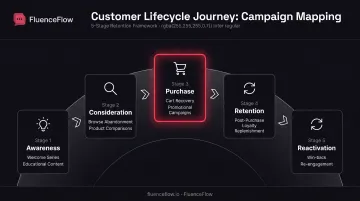
- Awareness: Welcome series, educational content
- Consideration: Browse abandonment, product comparison content
- Purchase: Cart recovery, promotional campaigns
- Retention: Post-purchase nurture, loyalty programs, replenishment
- Reactivation: Win-back campaigns, re-engagement sequences
3. Infrastructure and resources:
Complex unit economics or multiple customer segments usually need custom strategy built on margin, LTV, and purchase behavior, not generic templates.
FluenceFlow, for example, structures campaigns around behavioral data and unit economics instead of one-size-fits-all playbooks.
Best Practices for Email Campaign Success
Prioritize Segmentation and Personalization
Use behavioral data, purchase history, and engagement levels to match each send to the subscriber’s context. Blanket campaigns to entire lists consistently underperform targeted sends.
Segment by:
- Purchase history (first-time vs. repeat customers)
- Engagement level (active vs. dormant subscribers)
- Browsing behavior (product category interest)
- Lifecycle stage (new subscriber vs. loyal customer)
- Geographic location or demographic data when relevant
Optimize for Mobile
Most subscribers read email on their phones. Build every campaign for small screens first:
- Responsive design that adapts to screen size
- Large, tappable buttons (minimum 44x44 pixels)
- Concise copy that works on small screens
- Fast-loading images optimized for mobile bandwidth
- Single-column layouts for easy scrolling
Test and Iterate Continuously
A/B test subject lines, send times, content variations, and CTAs regularly. Analyze performance metrics (open rate, click rate, conversion rate, revenue per email) and use those results to improve future campaigns.
High-impact tests:
- Subject line length and tone (urgency vs. curiosity vs. benefit-driven)
- Send timing (morning vs. evening, weekday vs. weekend)
- Incentive strategy (discount vs. free shipping vs. no offer)
- Email length and visual hierarchy
- CTA copy and placement
Track not just opens and clicks, but revenue attribution and customer behavior changes over time. What drives a click may not drive a purchase.
Conclusion
Email campaigns work best as a system, not a single blast. Brands generating 30-40%+ of revenue from email run multiple campaign types at once, engaging customers from welcome series through post-purchase nurture and win-back sequences.
Success means moving past basic promotional sends to automated campaigns tailored to behavior, lifecycle stage, and unit economics. High-AOV brands need extended nurture and education. Consumables need replenishment timing and loyalty mechanics. Mid-market catalogs need conversion-focused bestseller promotion.
The infrastructure you build today compounds over time: welcome flows, abandonment recovery, post-purchase sequences, and segmentation. Automated lifecycle flows generate 37-41% of email revenue from just 2-5% of sends, making them one of the highest-ROI investments in e-commerce marketing.
Start with the campaigns that close your biggest gaps:
- No welcome series yet? Build that first.
- High cart abandonment? Prioritize recovery flows.
- Low repeat purchase rates? Invest in post-purchase nurture.
Then layer in promotional, launch, and win-back campaigns as your system matures.
Frequently Asked Questions
What is an email campaign?
An email campaign is a coordinated series of emails sent to a targeted audience to hit a specific goal, such as sales, nurture, education, or re-engagement. Unlike one-off promos, campaigns are planned sequences that move recipients through a journey.
Is email marketing still worth it in 2026?
Yes. Email still delivers among the highest ROIs of any channel. Litmus' 2025 survey found most marketers report $10–$50 back per $1 spent. You also own the channel: permission-based access with no ad auction fees or algorithm swings.
What is the most effective email marketing strategy?
Combine lifecycle flows (welcome, cart recovery, post-purchase, win-back) with targeted campaigns, matched to where each customer is in the journey. Segment and personalize on behavior and purchase data, automate high-value flows, and test subject lines and offers on a steady cadence.
What are the best practices for email marketing in 2026?
Segment by behavior and lifecycle stage, personalize from purchase and engagement data, and build every send mobile-first. Automate core flows, A/B test subject lines and timing, keep the list clean, and balance promos with useful content so you stay in the inbox.
How much does it cost to run an email marketing campaign?
Platform fees usually scale with list size, often about $20–$600+ per month. In-house work still needs budget for strategy, creative, and optimization; agencies commonly run $1,500–$10,000+ monthly depending on scope and service level.
How much is a 1,000-email list worth?
Value hinges on engagement, conversion rate, and purchase frequency. Omnisend's 2025 benchmarks show about $0.155 revenue per campaign email and $3.41 per automated email. A healthy 1,000-subscriber list with regular campaigns and flows can drive roughly $5,000–$20,000+ a year for e-commerce brands.