Introduction
HOMAGE, a DTC apparel brand, sent one SMS campaign announcing NFL Starter jackets. In the first hour, it generated 100 orders, an 87% click rate, and $167 revenue per message. That result is exceptional, not the norm, but it shows why SMS remains one of the highest-performing channels for DTC brands.
Most e-commerce brands fall into one of two traps: sending too many texts and burning out their list, or sending too few and leaving revenue on the table. The difference usually comes down to campaign strategy: which messages to send, when to send them, and how to match frequency to your business model.
This guide covers how to build a sustainable SMS campaign strategy: campaign types with real DTC examples, current performance benchmarks, compliance essentials, and how to align frequency with your unit economics so every text drives revenue without list fatigue.
Key Takeaways
- SMS campaigns are one-time broadcasts, distinct from triggered flows; both belong in a full retention strategy
- Postscript’s 2026 DTC benchmark: 2.87%–8.01% CTR and $0.11–$0.55 revenue per message (17,000+ Shopify stores)
- Compliance requires explicit written consent, clear opt-out language, and federal quiet hours (8 a.m.–9 p.m. local)
- Set send frequency by unit economics, not a fixed rule; Attentive sees opt-outs rise only at 10–15 messages/month
- High-performing campaigns pair segmentation, scarcity language, and concise copy with email-coordinated timing
What Is an SMS Marketing Campaign?
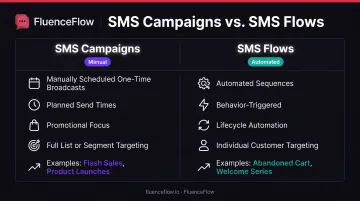
An SMS marketing campaign is a one-time or manually scheduled text broadcast sent to your subscriber list or a specific segment. Klaviyo defines campaigns as messages you plan and send at a chosen time, as opposed to flows, which are automated sequences triggered by customer behavior such as abandoned carts or purchases.
Two main SMS message types:
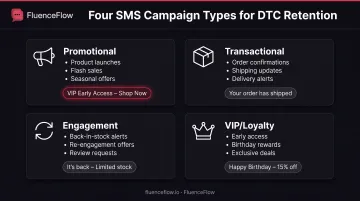
- Promotional: Sales announcements, product launches, limited-time offers, exclusive access, and seasonal promotions meant to drive immediate purchases (typical campaign use)
- Transactional: Order confirmations, shipping updates, delivery notifications, and tracking links that add utility while keeping your brand top-of-mind (often automated)
Consent requirement:
US rules under the TCPA require explicit written consent before you send commercial texts. Subscribers must authorize messages to their specific number, and consent cannot be a condition of purchase. That opt-in bar makes SMS high-intent: people who subscribe choose to hear from you, which is why the channel often beats email and social on engagement when you respect frequency and relevance.
Flows run lifecycle automation (welcome series, post-purchase, replenishment). Campaigns cover one-time moments like flash sales or product drops. Used together, they form a complete retention system.
SMS Campaign Types & Real Examples from DTC Brands
DTC brands run SMS across four main campaign types: promotional, transactional, engagement/retention, and VIP/loyalty. Below are real brand examples and copy patterns you can adapt.
Promotional SMS Campaign Examples
Product launch announcements:
Dana Rebecca Designs gave SMS subscribers early access one day before the public launch of a new jewelry collection. The message used exclusivity language to drive urgency, emphasizing that VIP subscribers could shop first. Early-access campaigns convert high-intent subscribers by pairing scarcity with VIP status.
Copy structure for launch campaigns:
- Hook with exclusivity ("VIP Early Access")
- Product name and key benefit
- Clear CTA with shortened link
- Opt-out language
Flash sales and limited-time offers:
Time-sensitive promotions work well via SMS because of the channel's immediacy. Effective flash-sale campaigns include countdown language ("Ends tonight at midnight"), percentage or dollar-off offers, and a single clear call-to-action. Use link shorteners to preserve character count and track clicks.
Best practice: Send flash sales during peak engagement windows (4–7 p.m. local time) and give subscribers enough time to act. Two to four hours is usually enough for consumable or apparel brands; high-consideration products may need 24–48 hours.
Seasonal and holiday campaigns:
The Peach Truck promoted limited-season Satsumas to its Early Access Community with free shipping for three days. Seasonal campaigns work because they align with natural buying cycles and create urgency around time-bound availability.
Transactional SMS Campaign Examples
Order confirmation and shipping updates:
Transactional messages provide utility first, but they also create subtle upsell opportunities. After confirming an order, you can include a brief line like "Love it? Check out these bestsellers" with a link, but keep the primary focus on the information the customer expects.
Best practice: Keep transactional messages short, lead with the key information (order number, tracking link), and avoid excessive promotional language that could trigger spam filters or erode trust.
Delivery notifications and tracking links:
Delivery alerts should include the tracking link prominently, confirm the expected delivery date, and provide clear next steps if the customer needs support. Personalization beyond first name, such as product name or order total, reinforces the message's relevance.
Engagement and Retention Campaign Examples
Back-in-stock alerts:
Scarcity language lifts conversion rates. Attentive's 2026 analysis found that scarcity and urgency messaging correlated with 12% higher conversion rates and 4% higher click-through rates in offer campaigns.
Example structure:
"[Product Name] is back! Limited quantities available; shop now before it sells out again: [link]"
Keep the message focused on immediacy and include a direct link to the product page, not the homepage.
Re-engagement campaigns for dormant subscribers:
Winning back lapsed subscribers requires a clear value proposition and an incentive strong enough to break inertia. Effective re-engagement campaigns often include:
- A personalized acknowledgment ("We miss you")
- A time-bound offer (15–20% off)
- A benefit reminder ("Exclusive SMS deals you've been missing")
- Simple one-click reactivation
Post-purchase follow-ups and review requests:
Timing matters. Send post-purchase follow-ups 3–5 days after delivery, long enough for the customer to use the product but soon enough that the experience is fresh.
Keep the ask simple: "How's your [product]? Leave a quick review: [link]" and consider a small incentive (giveaway entry or loyalty points).
VIP and Loyalty Campaign Examples
Exclusive early access for top customers:
Segmenting by purchase history or lifetime value (LTV) allows you to reward your best customers with first access to new products, private sales, or exclusive colorways. Cheeky Chickadee used a password-gated SMS audience for early access to its fall collection, creating a sense of insider status.
Segmentation criteria:
- Customers with 3+ purchases in the past 12 months
- Top 10–20% by total revenue
- Customers who've spent above a defined LTV threshold
Birthday and anniversary messages with offers:
Personalized milestone messages drive engagement when they feel genuine. Send birthday texts 3–7 days before the date to give customers time to use the offer, and keep the discount meaningful but sustainable for your margins (10–20% is typical).
Example:
"Happy early birthday, [Name]! Celebrate with 15% off your next order, valid through [date]: [link]"
SMS Campaign Best Practices That Actually Drive Results
Keep Messages Under 160 Characters (and Why That Matters)
Character limits and cost:
Standard SMS supports 160 characters in one segment. Add an emoji or special character, and encoding changes reduce that limit to 70 characters, with additional segments billed separately. MMS allows 1,600 characters but costs more per send.
Formula for concise copy:
Hook (grab attention) + Value (benefit or offer) + CTA (clear action) + Opt-out ("Reply STOP to unsubscribe")
Before (too long, 180 characters):
"We're excited to announce that our best-selling leather jacket is back in stock for a limited time! Shop now and get free shipping on all orders over $100. Don't miss out!"
After (concise, 155 characters):
"Leather jacket back in stock. Limited quantities! Free shipping on $100+. Shop now: [link] Reply STOP to unsub"
Timing and Frequency Guidelines
Best send times:
Attentive's 2026 analysis of 25 billion+ messages found that 4–7 p.m. local time generally drives the highest revenue per send, while 12–3 p.m. favors engagement. Monday and Tuesday tend to generate stronger revenue results, while Tuesday and Thursday favor click-through rates.
However, these are directional trends, not universal rules. Your audience may behave differently depending on product type, demographics, and purchasing patterns.
Federal quiet-hour restrictions:
Commercial texts cannot be sent before 8 a.m. or after 9 p.m. in the recipient's local time zone. Violating this regulation exposes you to TCPA penalties, which can reach $500 per violation (or $1,500 for willful violations).
Frequency recommendations:
Attentive's 2026 platform data suggests 1–2 full-list messages weekly, with revenue per send peaking at 6–8 messages monthly and opt-out rates rising at 10–15 monthly. This is directional guidance, not a product-specific mandate.
How frequency should vary by business model:
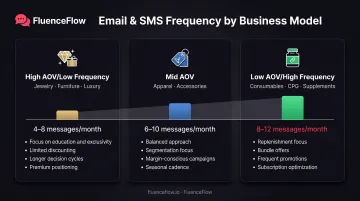
- High AOV / low frequency (premium, jewelry, furniture): 4–8/month, education, exclusivity, VIP access
- Low AOV / high frequency (consumables, CPG): 8–12/month, replenishment, bundles, volume offers
- Mid AOV (apparel, accessories): 6–10/month, mix of promos and engagement
A/B testing send times:
Test send time by splitting your audience and measuring revenue per recipient, click-through rate, and conversion rate. Run tests for at least two weeks to account for weekly variance, and use statistically significant sample sizes (minimum 1,000 recipients per variant).
Segmentation Strategies for Better Performance
Segment by engagement level:
Split the list by recent behavior:
- Active (clicked or purchased in 30–60 days): primary audience for promos
- Dormant (no engagement in 60+ days): re-engagement with stronger incentives
Segment by purchase behavior:
- First-time buyers: Welcome them with product education, usage tips, and a second-purchase incentive
- Repeat customers: Send loyalty rewards, early access, and cross-sell recommendations
- VIPs: Offer exclusive products, higher discounts, or concierge-level service
Geographic and timezone segmentation:
National or international brands should segment by timezone to respect quiet hours and hit optimal local send windows. Quiet-hour compliance and revenue-per-send both improve when messages land in the recipient's afternoon or early evening, not yours.
Personalization Tactics Beyond First Name
Product recommendations:
Use browse or purchase history to send relevant suggestions. For example, if a customer bought running shoes, send a follow-up campaign featuring performance socks or hydration packs. Klaviyo and similar platforms enable dynamic product blocks based on customer data.
Dynamic content by lifecycle stage:
Tailor messaging to where the customer is in their journey:
- New subscribers: education and brand story
- First-time buyers: onboarding and usage tips
- Repeat buyers: loyalty rewards and referral programs
- Lapsed customers: win-back offers and "we miss you" messaging
Location-based offers:
Omnichannel DTC brands can push store events, openings, or in-store-only promos to nearby subscribers. Example: "You're near our [City] location; stop by today for 10% off with this text."
Compliance Essentials Without the Legal Jargon
TCPA requirements simplified:
- Express written consent: Get documented OK to receive marketing texts; consent can't be tied to a purchase
- Clear opt-out: Every message needs an easy unsubscribe (STOP, QUIT, END, CANCEL, and similar keywords)
- Business identification: Name your brand in every message
- Quiet hours: No promos before 8 a.m. or after 9 p.m. local time
Compliant opt-out language:
"Reply STOP to unsubscribe" uses just 26 characters and satisfies federal requirements. You must honor opt-out requests within 10 business days (though immediate suppression is best practice).
Avoiding spam triggers:
- Don't use excessive capitalization or multiple exclamation marks
- Limit links to one per message when possible
- Avoid phrases that sound like phishing ("Click here to claim your prize")
- Maintain accurate consent records and suppress unsubscribes immediately
Carrier filtering is opaque, and no public thresholds exist. Clean consent records, fast opt-out handling, and non-spammy copy are what keep messages deliverable.
How to Build Your SMS Campaign Strategy (Not Just Send Random Texts)
Random SMS blasts burn list trust and margin. A durable campaign strategy starts with how your brand makes money, then sets goals, a calendar, and a test loop so every send has a job.
Align Campaign Strategy with Your Unit Economics
Your average order value (AOV), purchase frequency, and margins determine how often you should send and which messages drive sustainable revenue.
High AOV/Low Frequency brands (such as furniture, jewelry, luxury goods):
These customers take weeks to decide and often research 8–15 touchpoints before buying. They rarely need frequent promotions. Your SMS strategy should focus on:
- Product education and storytelling
- VIP early access to new collections
- Exclusive design previews
- Limited discounting to preserve brand positioning
Low AOV/High Frequency brands (such as consumables, CPG, supplements):
The first order matters mainly because it leads to profitable repurchases. SMS should emphasize:
- Replenishment reminders timed to when the product runs out
- Bundle offers and volume discounts
- Frequent promotional campaigns (8–12 per month)
- Lapsed-buyer winbacks before customers switch to competitors
Mid AOV brands (such as apparel, accessories):
These brands need a balanced approach built on segmentation and margin-conscious campaigns:
- Send 6–10 campaigns monthly
- Use segmentation to target high-margin products to engaged customers
- Focus on repeat-purchase conversion and bestseller promotion
FluenceFlow builds SMS strategies around client unit economics rather than generic playbooks. Send frequency, segmentation, and messaging are customized to how each business makes money, not only which industry label it wears.
Set Clear Campaign Goals and KPIs
Define success upfront:
Every campaign should have a measurable goal tied to one of these metrics:
- Revenue per recipient (RPR): Total attributed revenue divided by number of recipients
- Click-through rate (CTR): Percentage of recipients who clicked the link
- Conversion rate: Percentage of recipients who completed a purchase
Industry benchmarks (2026 data):
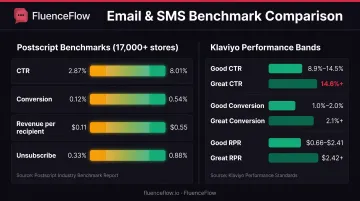
Postscript's report covering 17,000+ Shopify stores shows DTC SMS campaigns performing at:
| Metric | 25th Percentile | 75th Percentile |
|---|---|---|
| CTR | 2.87% | 8.01% |
| Conversion | 0.12% | 0.54% |
| RPR | $0.11 | $0.55 |
| Unsubscribe | 0.33% | 0.88% |
Klaviyo's US performance bands classify campaigns differently:
| Metric | Good | Great |
|---|---|---|
| CTR | 8.9%–14.5% | 14.6%+ |
| Conversion | 1.0%–2.0% | 2.1%+ |
| RPR | $0.66–$2.41 | $2.42+ |
| Unsubscribe | 0.6%–1.4% | Under 0.5% |
Use these as directional guides, not absolutes. Your results will vary based on audience, product, and strategy.
Calculate SMS ROI:
Formula: (SMS-attributed revenue – campaign send cost) / campaign send cost × 100
Send cost: Your platform rate × recipients × message segments
Account for multi-segment messages when copy exceeds 160 characters or includes emojis. If you need true profitability, also factor in discounts, returns, and product costs, not only gross attributed revenue.
Create a Campaign Calendar
Plan around key revenue moments:
- Product launches and restocks
- Seasonal shopping windows (holiday, back-to-school)
- Site-wide sales and clearance events
- Customer milestones (birthdays, anniversaries)
- Replenishment cycles (for consumables)
Balance frequency and message type:
No single promotional-to-transactional ratio fits every brand. A sustainable mix usually includes:
- Core promotional campaigns: 4–8 per month (depending on business model)
- Engagement campaigns: 2–4 per month (back-in-stock, re-engagement)
- VIP campaigns: 1–2 per month (exclusive access, loyalty rewards)
Leave room for reactive campaigns:
Reserve 20–30% of your monthly send capacity for opportunistic moments: flash restocks, weather-based promotions (such as swimwear during a heatwave), trending products, or competitive responses.
Test, Measure, and Optimize
Key metrics to track:
Monitor these in your SMS platform dashboard:
- Revenue per recipient by campaign and segment
- Click-through and conversion rates
- Opt-out rate (watch for increases above 1%)
- List growth rate
- Attributed revenue as a percentage of total store revenue
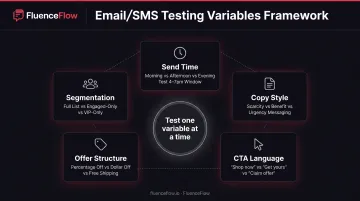
A/B testing variables:
Test one variable at a time over a minimum two-week period:
- Send time: Morning vs afternoon vs evening
- Copy: Scarcity vs benefit-focused vs urgency
- CTA: "Shop now" vs "Get yours" vs "Claim offer"
- Offer structure: Percentage off vs dollar off vs free shipping
- Segmentation: Full list vs engaged-only vs VIP-only
When to iterate:
- Sunset campaign types that stay below-benchmark RPR or push opt-outs above 1%
- Increase frequency and test variations when a structure (such as VIP early access) hits top-quartile RPR
- Rotate copy and offers every 4–6 weeks to limit message fatigue
Common SMS Campaign Mistakes to Avoid
Even strong SMS programs slip when frequency, format, or compliance gets sloppy. Watch for these five mistakes before they drain revenue or get your traffic filtered.
Sending too frequently without testing tolerance
Warning signs include rising opt-out rates (above 1% per campaign), declining click-through rates, and falling revenue per recipient. If you see these trends, cut send frequency by 25–50% and focus on higher-value segments.
Using SMS for content better suited for email
SMS wins on time-sensitive, simple calls-to-action. Email fits long-form content, complex offers, educational articles, and multi-product showcases. Don't cram a full catalog or how-to guide into a text.
Ignoring opt-outs and compliance
You risk carrier filtering (messages stop delivering), platform suspension, and TCPA penalties of $500–$1,500 per violation. Honor opt-outs immediately and keep accurate consent records.
Not segmenting your list
Blasting the same message to everyone wastes budget on low-intent subscribers and drives opt-outs from people who don't want that offer. Segment by engagement, purchase behavior, and lifecycle stage to lift performance and cut list fatigue.
Forgetting a clear CTA or link
Every campaign needs an action, not just an announcement. Include a shortened link and a direct next step, such as "Shop now" or "Claim your offer." Vague messages without a clear path drag down clicks and conversions.
Frequently Asked Questions
Does SMS marketing still work?
Yes; when strategy, audience fit, and list tolerance are solid. Postscript's 2026 benchmark shows DTC campaigns averaging 2.87%–8.01% CTR and $0.11–$0.55 revenue per message across 17,000+ Shopify stores.
Is SMS marketing legal in the USA?
Yes, if you follow TCPA rules: get prior express written consent, include clear opt-out language in every message, honor opt-outs within 10 business days, and stay inside 8 a.m.–9 p.m. local-time quiet hours for promos.
What is an SMS marketing campaign?
An SMS marketing campaign is a one-time broadcast message sent manually to your subscriber list or a specific segment, distinct from automated flows that trigger based on customer behavior like purchases or cart abandonment.
What are some examples of SMS marketing campaigns?
Common campaign types include promotional (product launches, flash sales, seasonal offers), engagement (back-in-stock alerts, re-engagement offers), and VIP (early access, birthday rewards). Order confirmations and shipping updates belong in automated flows, not one-time campaigns.
How often should I send SMS campaigns?
Most DTC brands send 4–12 campaigns per month. Attentive's 2026 analysis points to 1–2 per week for most brands, with revenue per send peaking around 6–8 monthly and opt-outs climbing at 10–15. Match frequency to your purchase cycle and engagement data.
What's the difference between SMS campaigns and SMS flows?
Campaigns are manually scheduled, one-time broadcasts sent to your list or a segment at a chosen time. Flows are automated sequences triggered by customer actions (abandoned cart, purchase, browse behavior). Both are essential for a complete SMS retention strategy.