Introduction
A DTC brand owner logs into their inbox to find three conflicting recommendations: a consultant pushing full omnichannel transformation, an email expert suggesting they perfect multichannel first, and a software vendor promising seamless integration with minimal effort.
The confusion is real. Choose wrong and you waste budget, fragment the customer experience, and lose revenue you already paid to acquire.
The stakes are high because customers already shop across channels. Many B2C buyers use several touchpoints in a single purchase journey and expect those interactions to feel consistent. When brands run email, SMS, and on-site messaging as separate silos, the experience breaks and repeat revenue suffers.
This guide will help you:
- Separate multichannel from omnichannel in plain terms
- Match the right approach to your stage, stack, and resources
- Use a practical framework so spend follows fit, not hype
Key Takeaways
- Multichannel runs separate channels; omnichannel unifies them into one customer experience
- Omnichannel requires more technology and coordination but can drive higher retention and lifetime value
- Pick based on maturity, resources, journey complexity, and revenue goals, not which term sounds advanced
- Most e-commerce brands should master email and SMS multichannel first, then evolve toward omnichannel as they scale
- Email and SMS remain foundational for DTC brands, often contributing 25-40%+ of total revenue when executed well
What is Multichannel Marketing?
Multichannel marketing uses multiple separate channels (email, SMS, social media, paid ads, in-store) to reach customers, with each channel operating independently. Each channel typically has its own goals, messaging, teams, and metrics, with limited or no data sharing between them.
Example: A customer receives a promotional email about a weekend sale featuring specific products. Later that day, they visit the website and see completely different messaging promoting new arrivals.
When they browse Instagram, they see an ad for a flash sale on unrelated items. None of these channels "know" about the others, so the customer gets three disconnected brand interactions in one day.
Key characteristics:
- Channels are managed separately, often by different teams or tools
- Each channel measures success independently (email open rates, SMS clicks, ad impressions)
- Customers may receive duplicate or conflicting messages
- Data collected in one channel isn't automatically shared with others
- Lower coordination requirements and faster to implement
Salesforce reports that marketers use an average of 10 customer-engagement channels, but this proliferation doesn't guarantee integration; it often means more fragmentation when channels operate in silos.
What is Omnichannel Marketing?
Omnichannel marketing creates a seamless, integrated experience across all channels where customer data and interactions flow between touchpoints. It recognizes that customers don't think in channels. They expect consistent, connected experiences whether they're on mobile, on desktop, or in their inbox and texts.
Example: A customer browses skincare products on their phone during lunch but doesn't buy.
That evening, they get a personalized email with those exact products plus complementary items based on browsing behavior. They click through on desktop, and their cart is already populated from the mobile session.
When they abandon the cart, an SMS reminder follows 24 hours later with the same products. Later they see a retargeting ad on Instagram with those items plus social proof. Every touchpoint knows what came before, so the experience feels continuous and personal.
Key characteristics:
- All channels share a unified customer data foundation
- Interactions on one channel inform and trigger actions on others
- Messaging is coordinated across touchpoints with consistent offers
- Customer journey is tracked end-to-end, not by channel
- Requires integrated technology platforms and cross-functional coordination
McKinsey defines omnichannel as a customer-centric approach where all channels are integrated into a unified experience. The real shift is how you organize around the customer. Omnichannel builds around how people actually behave, not how your teams or tools are siloed.
Key Differences Between Omnichannel and Multichannel Marketing
Customer Experience Focus
Multichannel is brand-centric, focused on maximizing reach so your message hits as many people as possible. Omnichannel is customer-centric, built around the customer's journey so every interaction stays continuous.
This difference plays out in real experiences:
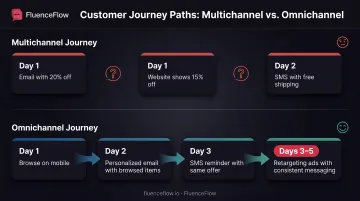
- Multichannel: Email offers 20% off, the site shows 15% off, and SMS pushes free shipping with no discount. Conflicting offers create confusion.
- Omnichannel: Email, on-site banner, and SMS all reference the same 20% offer on the same products. The journey feels continuous.
Salesforce research found that 69% of customers expect consistent interactions across departments, and nearly 60% prefer fewer touchpoints over disconnected ones. Multichannel creates fragmentation; omnichannel ensures continuity.
Data Integration and Usage
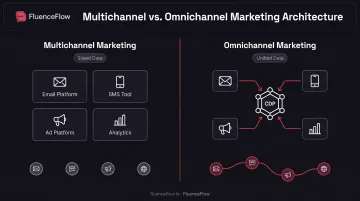
Multichannel operates with siloed data. Each channel collects information independently. Your email platform knows open rates, your SMS tool tracks clicks, and your ad platform measures impressions, but none of them share customer behavior. Personalization stays trapped inside each channel's own data.
Omnichannel uses unified customer data platforms (CDPs) that share information across all touchpoints in real time. A CDP creates a single customer profile that every system can access, allowing cross-channel behavioral personalization.
How this affects personalization:
- Multichannel: A browse-abandonment email still sends after the customer already bought via SMS or saw a retargeting ad. Duplicate messages follow.
- Omnichannel: The CDP sees view → cart → email click → purchase, skips cart recovery, and triggers a post-purchase sequence instead.
Gartner reports 67% CDP adoption in its 2023 Marketing Technology Survey, but adoption alone is not integration maturity. You still need shared identity, consent, event definitions, and orchestration rules to run true omnichannel.
Channel Coordination and Messaging
Multichannel campaigns are planned and executed separately per channel, often with inconsistent messaging. Email sends Tuesday, SMS goes out Wednesday, social posts run Friday; timing is coincidental, not strategic.
Omnichannel campaigns are orchestrated across channels with unified messaging adapted to each format. They also support sequential, triggered messaging that responds to behavior across channels.
Coordinated example:
- Customer abandons cart → automated email sent after 1 hour
- Customer doesn't open email → SMS reminder sent 24 hours later
- Customer clicks SMS but doesn't purchase → retargeting ad shown over next 3 days
- Customer ignores all → different offer sent via email after 5 days
Multichannel rarely coordinates timing this way because the systems don't communicate. Omnichannel makes sequential, cross-channel journeys possible by design.
Technology and Resource Requirements
Multichannel can run on basic, standalone tools, and smaller teams can manage each channel independently:
- Email: Mailchimp, Constant Contact
- SMS: Attentive, Postscript
- Ads: Facebook Ads Manager, Google Ads
Omnichannel requires integrated platforms and cross-functional coordination:
- Marketing automation (Klaviyo, HubSpot, Salesforce Marketing Cloud)
- Customer data platform to unify identity and behavior
- E-commerce platform integration (Shopify, WooCommerce)
- Shared dashboards and cross-channel attribution
- Team members who understand customer journeys, not just channel tactics
Realistic assessment: Omnichannel usually takes 2-3x the technical investment of standalone tools, plus 6-12 months to connect systems, map journeys, and train teams on unified workflows. That does not make it enterprise-only. It does mean you should budget time and resources up front.
Performance Measurement Approach
Multichannel measures success by individual channel performance: email open rates, SMS click rates, ad ROAS, social engagement. Each channel has its own KPIs, and teams optimize for channel-specific metrics.
Omnichannel measures customer journey metrics: customer lifetime value, cross-channel attribution, journey completion rates, retention curves, and how many touchpoints it takes to convert. Success is defined by customer outcomes, not channel outputs.
Example comparison:
| Metric Type | Multichannel | Omnichannel |
|---|---|---|
| Primary KPI | Email revenue, SMS clicks | Customer lifetime value |
| Attribution | Last-click or first-click | Multi-touch, journey-based |
| Success measure | Channel ROI | Customer retention & repeat rate |
| Reporting cadence | Weekly channel reports | Customer cohort analysis |
McKinsey research indicates omnichannel customers shop 1.7x more frequently than single-channel shoppers, and strong omnichannel personalization can lift revenue 5-15%. Those figures are observational, not controlled DTC experiments. Your results still hinge on execution quality and how your customers actually buy.
Benefits and Challenges of Each Approach
Multichannel Benefits
Lower barrier to entry: Easier to implement quickly without complex integrations. You can launch email campaigns, start SMS, and run ads within weeks using separate tools. This suits brands with limited resources or those just starting with multiple channels.
Channel specialization: Teams develop deep expertise on individual platforms. Email specialists master segmentation and deliverability, SMS experts own timing and compliance, and paid media managers focus on ROAS, without juggling full cross-channel orchestration.
Faster execution: When channels operate independently, you can move quickly. No need to wait for data integration, cross-team approval, or journey mapping. Just launch campaigns when ready.
Multichannel Challenges
Customer confusion from inconsistent messaging: When channels don't communicate, customers receive duplicate offers, conflicting promotions, or messages that ignore previous interactions. This damages brand perception and erodes trust.
Example: A customer makes a purchase, then receives an abandoned-cart email three hours later because the email system didn't know about the order. They unsubscribe, annoyed by the irrelevant message.
Missed revenue opportunities: When data isn't shared across channels, you can't optimize the full customer journey:
- Email team doesn't know what SMS subscribers purchased, so they send redundant promotions
- SMS campaigns don't reference email engagement, missing opportunities to re-engage openers who didn't click
- Retargeting ads show products customers already bought because ad platforms don't sync with your store in real time
Limited personalization: Each channel personalizes based only on its own data, not the complete customer picture. You know someone opened five emails but never purchased, yet your SMS program treats them like a cold lead.
Omnichannel Benefits
Higher customer lifetime value and retention: McKinsey reports omnichannel customers shop 1.7x more frequently than single-channel shoppers. Klaviyo's 2024 analysis of 325 billion emails shows automated lifecycle flows generate $3.65 revenue per recipient versus $0.11 for broadcast campaigns (up to 30x more) when messaging responds to behavior across touchpoints.
Stronger loyalty from consistent experiences: When customers get consistent, personalized journeys across channels, they stay longer and buy more. Salesforce research found 69% of customers expect cross-department consistency, and 43% would stop repeat purchasing after poor service.
Improved conversion through coordinated touchpoints: Sequential messaging across email, SMS, and retargeting puts the right message in front of customers at the right time. Channels reinforce each other: email introduces the offer, SMS reminds, and ads add social proof.
Omnichannel Challenges
Significant upfront investment in technology: Omnichannel requires integrated marketing automation, a CDP or unified customer database, analytics infrastructure, and API connections between platforms. This means higher software costs, potential platform migrations, and technical implementation work.
Organizational complexity: True omnichannel demands cross-functional collaboration. Marketing, e-commerce, customer service, and analytics teams must share data, align on KPIs, and coordinate campaigns. Shifting from channel ownership to customer journey ownership is often harder than the technical integration.
Longer time to value: While multichannel can show results in weeks, omnichannel may take 6-12 months to fully implement and optimize. You need time to integrate systems, map journeys, build automated flows, test coordination rules, and train teams.
McKinsey advises that most companies can advance only 2-3 omnichannel initiatives concurrently due to resource constraints. Trying to do everything at once often leads to half-built systems that deliver neither multichannel speed nor omnichannel integration.
Real-World Examples: Omnichannel vs. Multichannel in Action
Multichannel Example: Independent Channel Campaigns
A fashion brand runs separate campaigns across channels with no coordination:
- Instagram ads promote new spring arrivals with 20% off for new customers
- Email newsletter features different bestselling items with a "buy 2, get 1 free" offer
- SMS blast announces a 4-hour flash sale on clearance items
- Website homepage highlights a completely different seasonal collection
A customer on Instagram, email, and SMS gets three conflicting messages in one day. Which offer applies? Can promotions stack? Does the flash sale include new arrivals? The fragmented experience creates friction instead of a purchase.
This is multichannel: Multiple touchpoints, but no coordination or shared strategy.
Omnichannel Example: Integrated Customer Journey
A DTC skincare brand creates a coordinated journey:
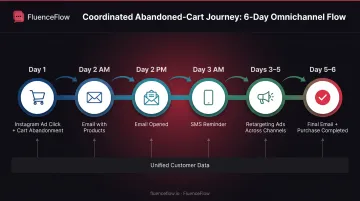
- Day 1: Customer clicks an Instagram ad for a vitamin C serum (UTM-tracked), reads reviews, adds it to cart, then leaves
- Day 2, 9 AM: Abandoned-cart email features the serum, a complementary moisturizer based on browsing, and a 10% code
- Day 2, 2 PM: Customer opens the email but doesn't click (email platform tracks this)
- Day 3, 9 AM: SMS follows up: "Still thinking about [Vitamin C Serum]? Your 10% off expires tomorrow. Complete your order: [link]"
- Day 3–5: Retargeting ads on Instagram and Facebook show the serum with reviews and before/after photos
- Day 5–6: Final email ("Last chance; your cart is waiting") adds social proof (4,500+ 5-star reviews); customer buys on desktop with the Day 1 serum still in cart
This is omnichannel: Every touchpoint shared prior context. The offer stayed consistent, messaging stayed aligned, and the experience felt helpful rather than pushy.
How to Choose the Right Strategy for Your Business
The right choice depends on business stage, resources, customer journey complexity, and growth objectives. Use this framework to see where you are and where to invest.
Assess Your Business Stage and Resources
Early-stage brands ($50K-$250K/month revenue):
Start with strategic multichannel, focusing on 2-3 high-impact channels before attempting full integration:
- Build an email foundation: 5,000+ subscribers, steady send cadence, and core flows (welcome, abandoned cart, post-purchase)
- Add SMS as a complementary channel with basic automation
- Choose one paid channel (Facebook/Instagram or Google) based on where your customers are
Prove channel performance and build customer data before you fund integration. Master deliverability, segmentation, and campaign execution first; those skills carry into omnichannel later.
Growth-stage brands ($250K-$1M+/month revenue):
Invest in omnichannel infrastructure if:
- You have enough customer data to justify integration (10,000+ email subscribers, meaningful repeat purchase rate)
- You see customers crossing channels (email clickers who also engage with ads, SMS subscribers who shop via email links)
- You have resources to support cross-channel orchestration (budget for integrated platforms, time for implementation)
- Customer acquisition costs are rising, making retention economics critical
At this stage, retention gains show up in profitability. A typical omnichannel lift of 10-15% in retention can justify the tech investment when lifetime value is already strong.
Evaluate Your Customer Journey Complexity
Simple, transactional purchases (low consideration, impulse buys):
Multichannel often sufficient when:
- Products are low-cost ($10-$50) consumables or impulse items
- Customer decision cycles are short (same-day or same-session purchases)
- Limited research or comparison needed
- High repeat-purchase frequency (weekly or monthly)
Example: Coffee subscriptions, beauty samples, phone accessories. Customers decide quickly, don't need extensive nurturing, and purchase frequently. A well-executed email + SMS multichannel strategy can drive strong retention without complex journey orchestration.
Complex, high-consideration purchases (higher AOV, longer decision cycles):
Omnichannel becomes critical when:
- Average order values exceed $150-$200
- Customers research across multiple sessions and channels before buying
- Decision cycles span days or weeks
- Purchase requires education, comparison, or significant trust-building
Example: Premium furniture, high-end electronics, luxury fashion, business software. Customers visit your site multiple times, read reviews, compare options, and engage with content across email, social, and ads before converting. Omnichannel coordination ensures every touchpoint builds on the last, guiding customers toward purchase without redundancy or gaps.
Consider Your Unit Economics
Calculate whether omnichannel ROI justifies the investment:
If your customer acquisition cost is $75 and average customer lifetime value is $150, your LTV:CAC ratio is 2:1, barely sustainable. Improving retention by 10-15% through omnichannel coordination could raise LTV to $165-$172, significantly improving profitability.
ROI threshold: If a 10-15% retention lift (a typical omnichannel gain cited in McKinsey research) would change your profitability, the investment can pay for itself. Brands with:
- High CAC ($50-$200+)
- Long payback periods (6+ months to breakeven)
- Strong repeat-purchase potential
benefit most from omnichannel because retention gains compound quickly.
If your CAC is low ($10-$20) and customers repurchase often with little intervention, the extra gain from omnichannel may not justify the complexity.
Start with Email and SMS as Your Foundation
Whatever path you choose, email and SMS should stay your core revenue channels for DTC. They offer:
- Highest ROI compared to paid media
- Direct customer relationships you own (not rented from platforms)
- Flexibility to personalize and automate at scale
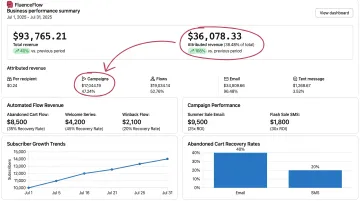
Klaviyo's 2024 analysis of 325 billion emails shows automated flows generate up to 30x more revenue per recipient than broadcast campaigns. Abandoned-cart flows average $3.65 per recipient versus $0.11 for standard campaigns.
Well-executed email and SMS programs typically contribute 25-40% of total DTC revenue. FluenceFlow clients average 41% of store revenue from email and SMS combined.
Start here, lock in performance, then add channels or full omnichannel integration as you scale.
Getting Started: Practical Implementation Steps
If Starting with Multichannel
1. Choose 2-3 channels where your target customers are most active:
Don't try to be everywhere at once. Focus on channels where your customers already engage and where you can keep quality high:
- Email (non-negotiable for DTC)
- SMS (if your customers engage with text-based offers)
- One paid channel (Facebook/Instagram or Google, based on customer demographics)
2. Establish strong performance on individual channels before attempting integration:
- Build email list to 5,000+ engaged subscribers
- Achieve baseline metrics: 25-35% open rates and 2-4% click rates
- Develop SMS subscriber base with clear opt-in value proposition
- Set up core automated flows: welcome, abandoned cart, post-purchase
3. Create brand messaging guidelines to maintain consistency:
Even without technical integration, you can prevent jarring disconnects by documenting:
- Core brand voice and tone
- Key value propositions and messaging pillars
- Current promotions and offer calendar
- Visual identity standards (colors, fonts, imagery style)
Share these guidelines across channel owners so email, SMS, and ads feel cohesive even when managed separately.
If Pursuing Omnichannel
1. Audit your current technology stack and identify integration gaps:
Map your existing tools:
- Email platform (can it integrate with your e-commerce platform?)
- SMS tool (does it share customer data with email?)
- E-commerce platform (Shopify, WooCommerce; what APIs are available?)
- Ad platforms (can you sync customer lists and conversion events?)
- Analytics (can you track customers across channels?)
Identify where data flows break down. If your email platform doesn't know about SMS opt-ins, or your ad platform can't exclude recent purchasers, those are integration gaps to address.
2. Implement a customer data platform or marketing automation solution that unifies touchpoints:
Options by business stage:
- Early omnichannel: Klaviyo, HubSpot (integrate email, SMS, e-commerce, and basic ads)
- Advanced omnichannel: Salesforce Marketing Cloud, Segment + specialized tools (enterprise-grade with full CDP capabilities)
You don't have to wire this together alone. Partners like FluenceFlow build integrated Klaviyo email and SMS systems for DTC brands, covering setup, flow orchestration, and ongoing optimization.
3. Start with one integrated journey before expanding:
Don't attempt a full omnichannel rollout immediately. Pick your highest-value journey and perfect it:
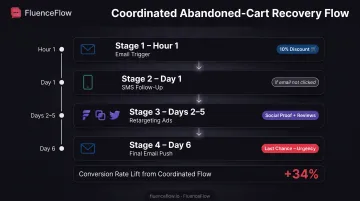
Example: Abandoned-cart sequence across email, SMS, and retargeting
- Hour 1: Automated email with cart contents + 10% discount
- Day 1: SMS reminder if email wasn't clicked
- Days 2-5: Retargeting ads featuring abandoned products + customer reviews
- Day 6: Final email with urgency message ("Last chance")
Build this end-to-end, measure lift versus email-only abandoned cart, then replicate the coordinated approach for other journeys (browse abandonment, post-purchase, replenishment).
Frequently Asked Questions
What is the difference between multichannel and omnichannel marketing?
Multichannel uses multiple separate channels to reach customers, with each operating independently through different teams, tools, and data. Omnichannel integrates all channels into a seamless experience where interactions on one channel inform and connect to the others.
Can you give me an example of multichannel marketing?
A retailer sends promotional emails about a weekend sale, posts different content on social about new arrivals, and runs independent Google Ads for seasonal products. Each channel is tracked separately, so a customer who engages with all three sees disconnected messaging.
What are the four C's of omnichannel?
The four C's define omnichannel execution: Consistency (unified messaging), Connectivity (shared customer data across systems), Customer-centricity (built around journeys, not internal silos), and Continuity (seamless handoffs between channels).
What are the four types of marketing channels?
The four main categories are owned (email, SMS, website, app), earned (reviews, PR, word-of-mouth), paid (ads, sponsored content, influencers), and shared (social platforms where you build presence but don't own the audience).
Which approach is better for small e-commerce businesses?
Most small e-commerce businesses should start with focused multichannel (email, SMS, and 1-2 paid channels) before investing in full omnichannel integration. That path delivers faster execution, proves channel performance, and builds customer data without early integration complexity.
How long does it take to implement an omnichannel strategy?
Basic omnichannel integration typically takes 3-6 months, covering technology setup, data integration, and initial campaign orchestration. Mature capabilities like full journey mapping, advanced personalization, and cross-channel attribution often take 12-18 months to develop.