Inactive subscribers harm more than vanity metrics. Gmail requires spam complaints below 0.10% and warns senders who hit 0.30%, while Yahoo explicitly states that repeatedly mailing unengaged recipients damages sender reputation and delivery metrics. When your list includes 20-30% inactive profiles, every campaign you send drags down your sender score.
This guide covers the complete sunset flow setup process in Klaviyo: when these flows are essential, the six-step configuration process, critical variables that determine success, common mistakes that hurt deliverability instead of helping it, and how to measure performance.
Key Takeaways
- Sunset flows remove 90–180+ day inactive subscribers to protect sender reputation and open rates
- Build with exclusion-heavy segments, 2–3 re-engagement emails, engagement filters, then suppress
- Match inactivity threshold, incentive size, and suppression timing to your send frequency
- Avoid rushing suppression, over-emailing, generic copy, and weak visitor/buyer exclusions
How to Build a Sunset Flow in Klaviyo (Step-by-Step)
Build the segment, trigger, emails, and suppression path in six steps. Work in order so inactive profiles get a fair re-engagement window before you suppress them.
Step 1: Create Your Sunset Segment in Klaviyo
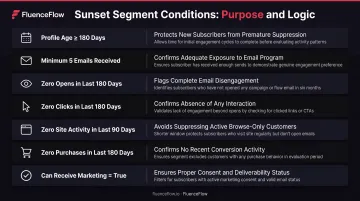
Navigate to Lists & Segments in Klaviyo and create a new segment. Add these conditions:
- Can receive marketing = true
- Created at least 180 days ago
- Received at least 5 emails in last 90 days
- 0 opens in last 180 days
- 0 clicks in last 180 days
- 0 site activity in last 90 days
- 0 purchases in last 180 days
Each condition serves a specific purpose:
- Profile age (180 days): Skips brand-new subscribers who haven't had time to engage
- Five-email minimum: Confirms they received enough messages to judge interest
- Zero opens and clicks (180 days): Flags true email disengagement
- Zero site activity (90 days): Avoids suppressing shoppers who browse without using email links
- Zero purchases (180 days): Confirms they haven't converted recently either
Adjust the timeframe based on your business model:
- Daily senders or consumables: 60-90 days may be appropriate
- Weekly senders or mid-frequency brands: 90-180 days works well
- Monthly senders or high-ticket items: 180-365 days gives customers enough time
Name your segment clearly: "Sunset - Email - 180 Days Inactive" makes it easy to identify later.
Step 2: Set Up the Flow Trigger and Filters
Create a new flow in Klaviyo. Set the trigger to "When someone enters/exits a segment" and select your sunset segment.
Add two critical flow filters at the flow level (not just within individual emails):
- Has not opened email since starting this flow
- Has not clicked email since starting this flow
These filters ensure anyone who opens or clicks any email, not just your sunset emails, exits immediately. That protects engaged subscribers from accidental suppression.
If a subscriber enters your sunset flow on Monday but opens a promotional campaign on Wednesday, they've proven they're still interested. The filters remove them from the sequence automatically.
Configure the flow to not skip anyone currently in the segment. You want to process existing inactive subscribers, not just new ones.
Step 3: Build Your Email Sequence (2-3 Emails)
Klaviyo recommends 1-3 emails maximum because repeatedly contacting unengaged subscribers can hurt deliverability.
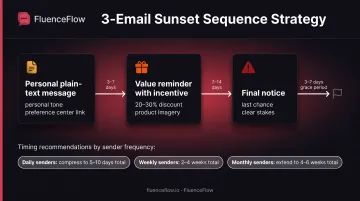
Email 1 (Day 0): Personal Plain-Text Message
- Plain text format, no fancy design
- Personal tone from founder or team member
- Subject line: "Did we lose you?" or "{{first_name}}, are you still there?"
- Single clear CTA: link to preference center or special offer
- Brief explanation of why they're receiving this
Email 2 (Day 3-7): Value Reminder with Incentive
- Design-based email with product imagery
- Highlight what they're missing: new products, best-sellers, exclusive offers
- Include 20-30% discount or loyalty points bonus
- Clear preference update and unsubscribe links
- Social proof or customer testimonials if available
Email 3 (Day 7-14): Final Notice
- Direct language: "This is your last email from us unless you take action"
- Include both "Yes, keep me subscribed" button and easy unsubscribe option
- Add emotional appeal: "We'll miss you" combined with FOMO about upcoming launches or sales
- Make the stakes clear without being manipulative
Space emails based on your normal sending frequency. Daily senders should use 3-5 days between emails; weekly senders should use 7-10 days.
Step 4: Add Final Time Delay and Profile Update
After Email 3, add a time delay of 3-7 days. Klaviyo recommends this grace period to give recipients time to open the final email, especially if they check email infrequently.
Insert an "Update Profile Property" action that sets a custom property like Unengaged = True for anyone who reaches this step without opening or clicking.
This property flags subscribers for suppression without suppressing them yet. You'll handle that in the next step. Anyone who engages earlier exits through your flow filters and never gets tagged.
Step 5: Create Suppression Segment and Process
Build a new segment with the condition Properties about someone > Unengaged = True.
Go to Lists & Segments, click the three-dot menu next to this segment, and select "Suppress current members".
Set a recurring calendar reminder to suppress this segment every 30-60 days, or set up a webhook for automatic suppression using Klaviyo's API if you have developer resources.
Suppression is permanent unless the subscriber opts back in through a form, so this should be the final step after all re-engagement attempts. Suppressed profiles are skipped from marketing sends even if they later browse or buy.
Step 6: Add Historical Profiles and Set Flow Live
Before setting the flow live, ensure all emails are in "Manual" or "Live" status, not Draft.
Click "Manage Flow" and select "Add Past Profiles" to include subscribers who already meet the sunset criteria. This processes your existing backlog of inactive subscribers.
Review flow metrics after 7-14 days to assess re-engagement rates and adjust email content or timing if needed.
Set up a dashboard or report to track:
- Sunset flow open rate
- Click rate
- Suppression volume
- Re-engagement rate (what percentage opened at least one email)
When Should You Use a Sunset Flow
Sunset flows become essential when list health starts slipping. Watch for these triggers:
- Declining overall open rates
- Rising spam complaints
- Inactive subscribers making up more than 15–20% of your list
High List Growth with Low Engagement
Brands acquiring subscribers through giveaways, contests, or broad lead magnets often see rapid list growth but poor engagement. These subscribers may have joined for a prize rather than genuine interest in your products.
According to Validity's list hygiene guidance, continuously sending to unengaged recipients damages sender reputation. Inbox providers track engagement patterns. Consistently low open rates signal that your emails may not be wanted, even when recipients never hit "spam."
FluenceFlow's free Klaviyo audits frequently identify this pattern: brands with 20,000+ subscribers but only 8-12% engaged in the last 90 days. A sunset flow removes the deadweight dragging down every campaign's performance.
Match Sunset Timing to Your Business Model
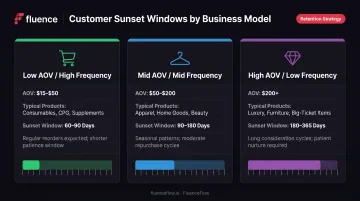
High AOV / Low Frequency (luxury items, big-ticket products):
- Set longer inactivity windows: 180–365 days
- Expect longer purchase cycles by default
- Allow months of research before treating silence as disengagement
- Avoid mistaking slow consideration for a dead subscriber
Mid AOV / Mid Frequency (apparel, home goods):
- Use a standard 90–180 day inactivity window
- Account for seasonal gaps in buying patterns
- Balance list hygiene against legitimate seasonal shoppers
Low AOV / High Frequency (consumables, CPG):
- Shorten the window to 60–90 days
- Expect regular reorders from healthy customers
- Treat longer inactivity as a real disinterest signal
FluenceFlow tailors sunset timing to each brand's unit economics, average order value, and margins instead of generic templates. A consumable with 30-day replenishment cycles needs different logic than a $500 furniture piece.
When NOT to Use Sunset Flows
Don't sunset subscribers who:
- Browsed your site in the last 30 days
- Added to cart in the last 14 days
- Contacted support recently
- Are VIP customers or high lifetime value segments
Some customers prefer to visit your site directly and don't need email prompts to purchase. Suppressing them based solely on email engagement damages customer relationships and revenue.
What You Need Before Building Your Sunset Flow
Proper preparation ensures your sunset flow improves deliverability rather than just shrinking your list for no reason.
Klaviyo Account Requirements
You need meaningful data to define "inactive" accurately:
- Minimum 6 months of sending history
- At least 1,000 subscribers (several thousand is better for cleaner signals)
- Properly configured domain authentication (SPF, DKIM, DMARC)
Gmail requires SPF and DKIM for bulk senders, plus DMARC if you send more than 5,000 messages daily. Outlook and other major providers enforce similar standards. If authentication is broken, sunset emails may never reach the inbox, so subscribers never get a chance to re-engage.
Email Content and Design Assets
Gather these before starting:
- Founder or team member photo and signature for plain-text email
- Updated product imagery highlighting new arrivals or best-sellers
- Pre-determined discount or incentive offer
- Copy that references what's changed since they last engaged
Strategic Decisions Made in Advance
Define before building:
- Your "inactive" threshold in days (based on sending frequency and business model)
- Whether you'll suppress immediately after sunset flow or give one more chance during major sales
- Whether you'll use a preference center so subscribers can choose frequency or content types
Key Variables That Affect Sunset Flow Performance
Small changes in these three variables can swing both re-engagement rates and deliverability.
Inactivity Threshold (Days Without Engagement)
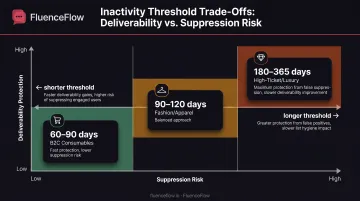
Set the window too short and you suppress customers in natural buying lulls. Set it too long and you harm deliverability for months before acting.
Klaviyo's 2026 guidance scales engagement windows from 30-180 days for daily senders to 275 days for monthly senders. Align your sunset threshold with these cadence-based recommendations.
Recommended thresholds by vertical:
- B2C consumables: 60-90 days
- Fashion/apparel: 90-120 days
- High-ticket/luxury: 180-365 days
Longer thresholds mean fewer people enter the sunset flow, but those who do are less likely to re-engage. Shorter thresholds protect deliverability faster, at the cost of suppressing customers who would have purchased in their next natural buying cycle.
Email Sequence Length and Timing
Too few emails and you miss re-engagement opportunities. Too many and you train customers to ignore you or mark messages as spam.
Klaviyo explicitly recommends 1-3 emails maximum. Repeated contact with unengaged recipients can hurt deliverability.
Space emails 3-7 days apart based on your normal sending frequency. Daily senders can use shorter intervals; weekly senders should space them further apart.
The third email typically sees 50% lower open rates than the first. Decide whether that incremental re-engagement justifies sending it at all.
Incentive Size and Type
Generic 10% discounts rarely move the needle for truly disengaged subscribers. You need a compelling offer to break through.
Effective incentive options:
- 20-30% discount (more compelling than a standard 10%)
- Free shipping paired with a discount
- Loyalty points bonus
- Exclusive early access to sales or new products
Larger incentives lift re-engagement rates but can attract discount-seekers who won't stick around. Test offers until you find the balance between immediate response and sustainable engagement.
Common Mistakes When Building Sunset Flows
Using the Wrong Segment Definition
A frequent miss is folding in people who are site-active but email-inactive, skipping a buffer for recent subscribers, or leaving recent purchasers in the sunset pool.
Suppress those profiles and you cut off people who still engage with your brand on other channels, damaging relationships and revenue.
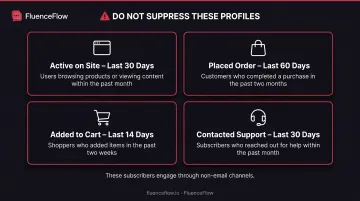
Exclude anyone who meets these conditions from the segment:
- Active on Site in the last 30 days
- Placed Order in the last 60 days
- Added to Cart in the last 14 days
- Contacted support in the last 30 days
Sending Too Many Sunset Emails or Too Frequently
Some brands send 5–7 emails over 30+ days trying to "save" every subscriber. That usually hurts deliverability more than it helps: you keep mailing unengaged people and raise spam-complaint risk. Klaviyo explicitly warns that repeated contact with unengaged profiles damages sender reputation.
Stick to 2–3 emails max, spaced at least 3–7 days apart. Suppress anyone who still doesn't engage after that sequence.
Failing to Personalize or Add Value
Generic "We miss you!" notes with no reason to come back produce weak re-engagement and burn the win-back window on people who might still care.
Make the emails specific:
- Reference past purchase history or browsing behavior
- Highlight new product launches or improvements since they last engaged
- Use founder voice for authenticity
- Recommend products tied to their past interests
Troubleshooting Your Sunset Flow in Klaviyo
Even a solid sunset flow can underperform. Use this checklist when open rates tank, unsubscribes spike, or re-engaged subscribers go quiet again.
Problem: Very Low Open Rates on Sunset Emails (Below 10%)
Likely cause: Deliverability issues were already severe before the sunset flow began, or subject lines aren't compelling enough to break through inbox clutter.
What to check:
- Review Klaviyo's deliverability dashboard for bounce rates and spam complaints
- Test different subject lines with A/B tests
- Send a campaign to engaged segments first to rebuild reputation before sunset sends
- Verify SPF, DKIM, and DMARC are configured correctly
Problem: High Unsubscribe Rate During Sunset Flow (Above 5%)
Likely cause: Email frequency or content mismatch with subscriber expectations, or you're targeting subscribers who opted in but never wanted ongoing emails.
What to check:
- Review opt-in sources to identify high-unsubscribe segments
- Make the preference center more prominent so people can reduce frequency instead of unsubscribing
- Check whether your inactivity threshold is too short
- Audit opt-in copy to confirm expectations are set correctly
Problem: Many Subscribers Re-engage Then Become Inactive Again
Likely cause: Subscribers only opened for the discount and aren't interested in the brand, or your regular campaigns don't hold attention after the sunset sequence ends.
What to check:
- Review post-sunset engagement at 30/60/90 days
- Segment sunset re-engagers and test different content strategies
- Check whether your sunset incentive attracts deal-seekers over real customers
- Evaluate whether regular campaign content needs a stronger hook
Alternatives to Standard Sunset Flows
Sunset flows aren't the only list health strategy. If you need preference control or serve seasonal buyers, these alternatives may fit better.
Preference Center Before Suppression
When it's better: Your brand sends multiple content types (promotional, educational, new arrivals) that appeal to different segments.
Key considerations:
- Harder to set up and manage than a standard sunset flow
- May retain people who update preferences but still never open
- Improves satisfaction by letting subscribers control what they get
- Must still include a full unsubscribe option; hiding it can drive spam complaints
Seasonal Subscriber Segments
When it's better: You have clear seasonal buying patterns (holiday decor, back-to-school, summer apparel) where customers naturally go quiet off-season.
Key considerations:
- Needs more sophisticated segmentation and flow logic
- Protects valuable seasonal buyers from premature suppression
- Keeps technically "inactive" subscribers on the list for months
- Requires monitoring to confirm they re-engage in-season
Frequently Asked Questions
What is a sunset flow in Klaviyo?
A sunset flow is an automated email sequence for subscribers who haven't opened or clicked in a set window, typically 90–180 days. It gives them one last chance to re-engage before you suppress them to protect deliverability.
How long should subscribers be inactive before entering a sunset flow?
Klaviyo recommends 90-180 days as standard, but this should be adjusted based on your sending frequency and business model. Consumable/CPG brands may use 60-90 days, while luxury/high-ticket brands might use 180-365 days.
How many emails should be in a sunset flow?
2–3 emails is optimal. Klaviyo states that fewer than 2 may not catch attention, but more than 3 keeps mailing unengaged subscribers and can hurt deliverability. Space emails 3–7 days apart based on your normal sending frequency.
Should I offer a discount in sunset emails?
Yes, for at least one email in the sequence. A generous 20–30% offer usually outperforms a standard 10% code when you're trying to reach truly disengaged subscribers.
What's the difference between a sunset flow and a winback flow?
Winback flows target customers who haven't purchased recently but may still be opening emails, while sunset flows target subscribers who haven't engaged with emails at all (no opens or clicks) regardless of purchase history. Sunset flows are about list health and deliverability, while winback flows are about revenue recovery.
Can suppressed subscribers come back?
Yes. Klaviyo allows resubscription to lift non-deliverability suppression. If a subscriber fills out a form on your site or opts back in through another method, they can rejoin your list. However, deliverability suppressions such as hard bounces remain because of sender-reputation risk.
Sunset flows protect sender reputation and deliverability for established brands. You need to remove truly disengaged subscribers, still give real customers a fair chance to re-engage, and keep a list size that can drive revenue.
Review the flow every 90 days against performance, business changes, and seasonality. A consumable brand mailing daily will not use the same timing as a luxury brand mailing monthly.
FluenceFlow builds custom sunset flows inside its retention systems for DTC brands, matched to each client's unit economics instead of generic templates. If open rates are sliding or inactives top 15–20% of your list, a well-built sunset flow protects reputation while offering one last path back in.