Email capture is the foundation of profitable retention marketing, not just a vanity metric. When done strategically, it transforms anonymous traffic into identifiable subscribers who enter automated flows, receive personalized campaigns, and generate repeat revenue. This guide covers the strategic approach to email capture, practical tool selection for Shopify stores, and DTC-specific best practices that turn list growth into revenue growth.
Key Takeaways
- Email capture turns anonymous visitors into subscribers who feed retention systems that drive measurable revenue
- Balance conversion rate with list quality using segmentation and zero-party data from day one
- DTC brands need native Shopify and Klaviyo integrations for automation and flow activation
- Go beyond popups with timing, offers, mobile optimization, and continuous testing
What is Email Capture and Why It Matters for DTC Brands
Email capture is the process of collecting email addresses from website visitors through opt-in forms, popups, embedded signup fields, and incentive offers. For DTC brands, it is the first step in building a permission-based audience you can market to repeatedly, without paying for every impression.
The Retention Economics Case
Retention marketing generates higher ROI than paid acquisition because you are marketing to people who already expressed interest in your brand. According to Klaviyo's 2026 benchmark data covering more than 183,000 customers, automated flows (which new email captures feed directly into) were only 5.3% of total email sends but generated nearly 41% of email revenue. Flows also achieved a 13x higher placed-order rate and nearly 18x higher revenue per recipient than campaigns. For context, FluenceFlow's DTC clients average 41% of total store revenue from combined email and SMS, with an average 10.6x ROI in the first 90 days. One brand lifted email's share of revenue from 6% to 24% in 30 days after tightening its popup and campaign setup.
Quality vs. Quantity: Building a Retention-Ready List
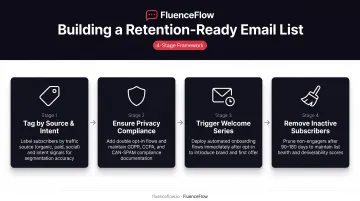
Not all email lists are created equal. A retention-ready list prioritizes engaged subscribers who open, click, and buy, not raw subscriber counts. According to Mailchimp, poor list quality hurts deliverability because inbox providers watch engagement signals like opens, clicks, and spam reports. The difference between building any list and building a retention-ready list comes down to:
- Tag subscribers by traffic source, product interest, or intent from day one
- Follow CCPA and other applicable privacy rules (including GDPR for international customers) to protect list integrity
- Trigger a welcome series within minutes of signup to build sender reputation
- Remove inactive subscribers and bounced addresses on a regular cadence Done well, email capture turns paid traffic you already bought into an owned list that compounds through automated flows, not one-off campaigns.
Email Capture Fundamentals: Types and Methods
Popup Forms
Popup forms are the most common email capture method for DTC brands. When properly timed and designed, they deliver the highest conversion rates by interrupting the browsing experience with a compelling value proposition.
Types of popups include:
- Entry popups - Display immediately when a visitor lands on your site
- Exit-intent popups - Trigger when a visitor moves their cursor toward the browser's back button or address bar
- Scroll-triggered popups - Appear after a visitor scrolls a certain percentage of the page
- Time-delayed popups - Show after a visitor has been on the site for a set duration (such as 10-30 seconds)
- Behavior-based popups - Trigger based on specific actions like viewing multiple products or adding items to cart
Best practices for popup design:
- Make forms mobile-responsive with thumb-friendly buttons and minimal required fields
- Lead with a clear value proposition - tell visitors exactly what they'll receive
- Use compelling copy that speaks to your audience's pain points or desires
- Test headline variations, offer types, and button text through A/B testing
- Avoid showing the same popup repeatedly to visitors who've already dismissed it
Embedded Forms
Embedded forms are persistent, always-visible signup options placed within your page content. They don't interrupt the browsing experience and work well for visitors who prefer less aggressive capture methods.
Ideal placement locations:
- Homepage - Above or below the fold, often in hero sections
- Blog posts - Mid-article or at the end of valuable content
- Product pages - Below product descriptions or in the sidebar
- About page - Where brand-curious visitors are already engaged
- Footer - Site-wide persistent option for low-friction signup
Embedded forms work better than popups for certain audience segments, particularly returning visitors who've already dismissed a popup, readers consuming long-form content, or visitors arriving from organic search who are actively seeking information.
Floating Bars and Slide-ins
Floating bars appear at the top or bottom of your page and remain visible as visitors scroll. Slide-in forms appear from the side or bottom corner after a trigger event.
Use cases where these formats outperform full-screen popups:
- Visitors who've already dismissed your main popup
- Mobile users who find full-screen popups disruptive
- Pages where a full popup would interfere with critical user actions (such as checkout)
- Campaigns promoting time-sensitive offers like flash sales or product launches
Lead Magnets and Incentive Offers
Lead magnets are valuable content or offers provided in exchange for an email address. They answer the visitor's question: "What's in it for me?"
DTC-specific lead magnet ideas:
- Discount codes - 10-20% off first purchase or dollar-amount discounts for high-AOV brands
- Free shipping - Particularly effective when average order value exceeds your shipping cost
- Early access to sales - VIP treatment for new subscribers
- Product guides - Buying guides, sizing charts, or how-to content
- Exclusive content - Behind-the-scenes stories, recipes, or educational resources
- Waitlist access - For sold-out items or upcoming launches
Matching lead magnets to business models:
- High-AOV/low-frequency brands (such as luxury goods, furniture) - Favor education-driven content, product guides, or higher-value discounts ($50-$100+) over small percentage off on $400+ purchases
- Mid-AOV/mid-frequency brands (such as apparel, home goods) - Standard 10-15% discounts, free shipping thresholds, or seasonal lookbooks work well
- Low-AOV/high-frequency brands (such as consumables, CPG) - Lead with aggressive incentives (10-20% off), then shift to replenishment reminders and subscription offers
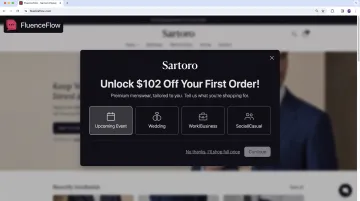
FluenceFlow's Sartoro popup offered $102 off while collecting zero-party data by asking visitors to identify their shopping occasion (Upcoming Event, Wedding, Work/Business, or Social/Casual). That pairs the incentive with immediate segmentation.
Post-Purchase Email Capture
Many brands overlook the opportunity to capture emails from customers who check out as guests. These buyers have already demonstrated purchase intent and represent high-value capture opportunities.
Strategies for post-purchase email capture:
- Order confirmation page - Offer order tracking, shipping updates, or exclusive post-purchase content in exchange for creating an account
- Shipping updates - Prompt guest customers to opt in for delivery notifications
- Account creation incentives - Offer a discount on the next purchase or loyalty points for creating an account after checkout
Email Capture Best Practices for E-commerce
Strong capture rates come from timing, mobile UX, segmentation, testing, and compliance, not from a single popup template. Use the practices below to grow a cleaner list and feed higher-revenue flows.
Optimal Timing Triggers
Show a popup too early and visitors bounce. Wait too long and they leave before they see the offer. Timing affects both conversion rate and experience.
Timing best practices:
- Delay 10–30 seconds so visitors can orient before you interrupt
- Use exit-intent to recover visitors who are about to leave
- Trigger on scroll depth (such as 50% of the page) once engagement is clear
- Fire on behavior signals (such as viewing 3+ products) when intent is higher
Current benchmark: Klaviyo recommends targeting a 3%+ form submit rate, though this metric doesn't specify device mix, industry, or visitor type. Top-performing brands often exceed 5% through multi-layered capture strategies.
Mobile-First Design Requirements
Adobe forecasts that mobile accounted for 53% of online sales during the 2024 holiday season. Mobile-first capture design is required.
Mobile optimization essentials:
- Use thumb-friendly tap targets (minimum 44×44 pixels)
- Keep forms to email only; add SMS as an optional second field
- Keep popups off critical nav and product details
- Test load times; slow mobile popups kill conversion
- Prefer slide-ins or floating bars over full-screen takeovers
- Preview on real devices, not only desktop emulators
Segmentation at the Point of Capture
An email address alone is not enough. Context at signup is what makes follow-up personal and revenue-relevant.
Segmentation strategies:
- Tag traffic source automatically (organic, paid, social, referral)
- Ask which product category or use case brought them in
- Separate first-time visitors, returning browsers, and cart abandoners
- Collect zero-party data, such as preferences, occasions, or goals, via multi-step forms
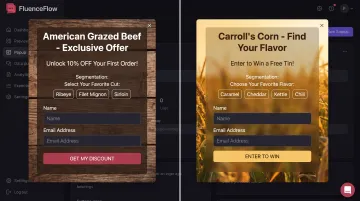
Client examples show how this works in practice. American Grazed Beef’s popup offered 10% off first orders, while Carroll’s Corn asked visitors to pick flavor preferences, creating segments FluenceFlow could use immediately in follow-up flows.
A/B Testing Priorities
Testing is the only way to improve capture rates systematically. Focus your tests on variables with the highest potential impact.
Test these elements in priority order:
- Offer and popup strategy: value props swing results the most
- Headline copy: benefit-driven vs. curiosity-driven vs. direct offer
- Form structure: single-step vs. multi-step; email-only vs. email + SMS
- Timing triggers: entry vs. exit-intent vs. scroll vs. time delay
- CTA button text: “Get My Discount” vs. “Shop Now” vs. “Unlock Offer”
In one FluenceFlow Klaviyo popup test, a baseline strategy hit a 0.72% submit rate and $17,000 in revenue; the optimized version reached a 10.03% submit rate and $141,000 in revenue. Klaviyo recommends testing one variable at a time so you can isolate what actually moved the number.
Compliance Essentials
Capturing emails comes with legal responsibilities that vary by geography and audience.
GDPR (European Union): The European Commission requires consent to be freely given, informed, and for a specific purpose. Pre-checked boxes don't qualify. Your popup must clearly state what subscribers will receive and include a link to your privacy policy.
CCPA (California): California's Attorney General requires a notice at or before collection that identifies categories of personal information collected and purposes for using them. This is a disclosure requirement, not an opt-in mandate.
Double opt-in considerations: Mailchimp notes that double opt-in adds verification, maintains higher list quality, and reduces spam signups. However, it also reduces initial list growth by requiring an extra confirmation step.
Best practice: Use single opt-in for U.S. audiences to maximize capture rates, and implement double opt-in for EU audiences to ensure GDPR compliance. Include a clear privacy policy link on all forms.
Top Email Capture Tools for Shopify and DTC Brands
Most DTC brands run on Shopify with Klaviyo as the email hub, so native compatibility should drive your shortlist. From there, stack fit, budget, testing needs, and how cleanly data passes into your flows decide the winner.
Selection Criteria
Evaluate tools based on:
- Native Shopify and Klaviyo integration for clean data flow into your email platform
- Mobile-responsive forms that perform well on phones and tablets
- Built-in A/B testing so you can improve capture rates over time
- Subscriber tagging or segmentation at the point of capture
- Transparent pricing that scales with traffic or revenue
Tool Comparison
| Tool | Key Features | Current Pricing | Best For |
|---|---|---|---|
| Shopify Forms | Free native Shopify product; basic popup and embedded forms; automation integration | Free | Brands just starting with email capture or those with tight budgets |
| Klaviyo Native Forms | Built into Klaviyo platform; one-variable-at-a-time A/B testing; seamless flow integration | Free plan: 250 active profiles, 500 monthly sends | Brands already using Klaviyo who want simple, native forms |
| Privy | One-click Shopify setup; spin-to-win wheels; exit-intent; landing pages | From $24/month, up to 10,000 pageviews | Brands wanting advanced gamification and exit-intent features |
| Justuno | A/B and multivariate testing; Klaviyo integration; behavior-based targeting | From $59/month, up to 10,000 visitors | Brands prioritizing testing and advanced targeting |
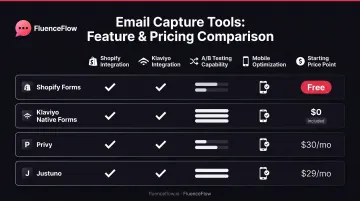
Important: No standardized test has compared mobile responsiveness or conversion performance across all platforms. Trial each tool on your actual Shopify theme and traffic mix rather than assuming one universal winner.
Building a Retention-Ready Email List from Day One
List size matters, but list quality matters more. Engaged subscribers drive revenue; unengaged subscribers hurt deliverability and cost money.
Why List Quality Beats List Size
Omnisend's 2025 report analyzed 24 billion emails sent in 2024 and found that automated messages, fed by new email captures, exceeded manual campaigns by 52% in opens, 332% in clicks, and 2,361% in conversions. Engaged subscribers entering timely automation are what produce that gap.
Quality indicators include:
- Open rates above your industry benchmark
- Click-through rates that demonstrate genuine interest
- Conversion rates that justify the cost of email sends
- Low spam complaint and unsubscribe rates
One FluenceFlow client recovered from $0 in email revenue caused by spam-folder placement to $97,000 per month after deliverability work. Poor list quality can wipe out an entire channel.
Strategic Segmentation Starting at Capture
Segmentation shouldn't wait until after capture. The best time to collect context about a subscriber is the moment they sign up.
Segmentation strategies:
- Traffic source: Automatically tag by UTM parameters or referrer
- Behavior: Tag based on pages viewed, time on site, or products browsed before signup
- Product interest: Ask which category or use case brought them to your site
- Customer journey stage: Differentiate first-time visitors from cart abandoners from repeat browsers
FluenceFlow segments subscribers by purchase behavior, browsing activity, engagement level, and lifecycle stage from day one. For example, high-AOV brands receive occasion-based segmentation (weddings, business, social events), while consumable brands focus on replenishment timing and frequency.
The First 30 Days After Capture
The welcome series is your highest-leverage email automation. It sets expectations, builds trust, and drives first purchases.
Welcome series structure:
- Email 1 (immediate): Deliver the promised incentive and set expectations for future emails
- Email 2 (day 1-2): Share your brand story, mission, or customer testimonials
- Email 3 (day 3-5): Highlight bestsellers or product education content
- Email 4+ (days 7-30): Continue nurturing with social proof, reviews, and category-specific content
Engagement tracking: Monitor who opens, clicks, and purchases during the first 30 days. Those early signals are strong predictors of long-term subscriber value.
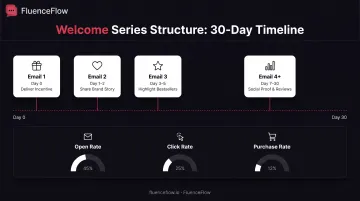
FluenceFlow delivers popup implementation and welcome-flow integration within the first week of engagement, with the first performance report delivered by day 30. Capture, welcome flows, and early reporting work best as one system so new subscribers convert faster without eroding brand trust.
Frequently Asked Questions
What is email capture?
Email capture is the process of collecting email addresses from website visitors through opt-in forms, popups, and incentive offers in exchange for valuable content, discounts, or exclusive access.
What is the best way to capture emails?
The best method varies by business and audience, but multi-layered approaches win. Combine popups with embedded signup forms and a strong lead magnet, then keep testing timing, offers, and form design.
What is a lead capture form and what is its purpose?
A lead capture form is a web form designed to collect visitor contact information. Its purpose is to convert anonymous website traffic into identifiable leads you can follow up with through email marketing, SMS, and other channels.
How much is a 1,000 email list worth?
Value varies by industry, engagement, and average order value. For DTC brands, list worth tracks product price, purchase frequency, and how well you run automation and campaigns, not raw subscriber count alone.
What's a good email capture rate for e-commerce websites?
Klaviyo's current guidance targets a 3%+ form submit rate. Top-performing brands often achieve 5-10% through optimized strategies combining multiple capture methods, compelling offers, and continuous testing. Benchmarks vary significantly by industry, average order value, traffic source, and device mix.
Should I use a discount or free content as my lead magnet?
Discounts usually convert faster and drive quicker first purchases, but can attract deal-seekers. Content magnets (guides, exclusive access) often bring more engaged subscribers at lower initial rates. Test both and judge by long-term subscriber value, not capture rate alone.
Email capture builds a permission-based audience you can market to repeatedly, nurture into customers, and turn into repeat buyers. Brands that win at retention treat capture as the first step in a system, not a one-time checkbox.
Start by auditing your current setup: submit rate, segmentation at capture, and welcome series performance. Small gains in capture rate and subscriber quality compound into real revenue over time.
FluenceFlow has helped DTC brands lift popup submit rates from 0.72% to 10.03% while driving six-figure revenue increases. Strategic email capture remains one of the highest-leverage moves in retention marketing.