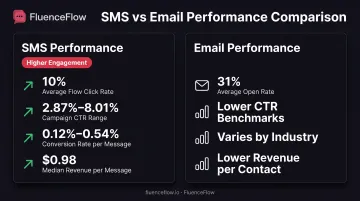
Unlike email open rates, which Klaviyo pegs at 31% on average, SMS cuts through the noise. But engagement alone won't justify your investment. Your SMS subscriber base must convert, stick around, and generate revenue. The challenge? Growing that list without breaking compliance rules, burning subscriber trust, or wasting acquisition budget.
This guide covers proven SMS acquisition methods across website forms, email conversion, social media, checkout, in-store, and post-purchase touchpoints, plus the compliance foundation, conversion tactics, optimization strategies, and metrics that separate high-performing lists from bloated ones.
Key Takeaways
- SMS campaigns average 2.87%–8.01% CTR, far above most email segments
- TCPA requires explicit written consent before any commercial texts
- Optimized website popups convert at a 3.6% median (higher with strong offers)
- Capture SMS across website, email, social, checkout, and in-store
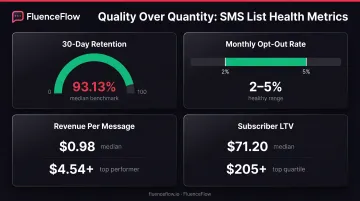
- Healthy lists retain 93.13% of subscribers at 30 days; quality beats quantity
Why Growing Your SMS Subscriber List Matters
SMS subscribers represent your highest-intent audience segment. These customers have explicitly granted permission for the most direct form of commercial communication, signaling deeper engagement than email-only contacts.
SMS also delivers measurable revenue impact. Postscript's 2026 benchmark study of 17,000+ Shopify stores reports a median subscriber lifetime value of $71.20, with top-performing brands exceeding $553 per subscriber.
Revenue per message sits at a median of $0.98, ranging from $0.41 at the 25th percentile to $4.54 at the 90th.
For DTC brands with comprehensive email and SMS retention programs, like those FluenceFlow builds for clients, combined channels often drive 35-45% of total store revenue. SMS captures a growing share of that mix as brands refine targeting, frequency, and message quality.
Engagement metrics explain why that share keeps climbing:
- SMS flows average nearly 10% click rate across Klaviyo customers, with top performers exceeding 16%
- Campaigns deliver 2.87%-8.01% CTR at the 25th-to-75th percentile range
- Conversion rates range from 0.12%-0.54% per message
Paid acquisition rents attention for a single session. SMS subscribers are owned contacts whose value compounds with every replenishment, winback, and post-purchase send, if you grow the list with clean opt-ins and clear expectations from day one.
Understanding SMS Compliance Requirements
SMS marketing in the United States operates under strict federal regulation. Violating these rules exposes your brand to steep fines, platform bans, and legal liability.
TCPA Requirements for Explicit Opt-In Consent
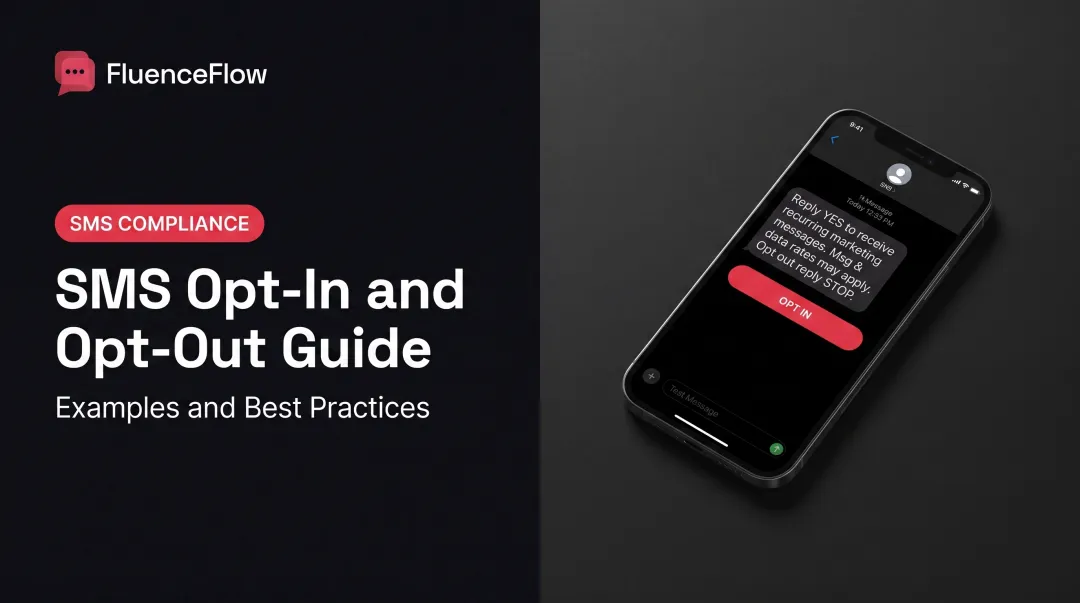
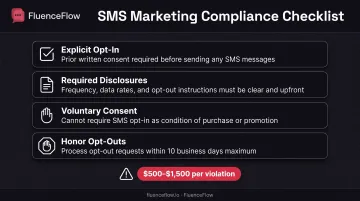
The Telephone Consumer Protection Act (TCPA) requires prior written consent before sending any commercial marketing text. Electronic consent (including website forms) is acceptable, but the consent must be:
- Informed: Clearly explains what the customer is agreeing to receive
- Sender-specific: Identifies your brand by name
- Subject-specific: States the purpose (marketing messages, promotional offers, etc.)
- Signed or confirmed: Requires explicit checkbox, button click, or text reply
Federal regulations prohibit requiring SMS opt-in as a condition of purchase. Consent must be voluntary and separate from completing a transaction.
One non-promotional confirmation text is permitted after opt-in. If you send it within five minutes, it is presumed to stay within the prior consent.
Required Disclosures at Point of Opt-In
Your SMS signup form must include specific operational disclosures. Klaviyo's US compliance template includes:
- Consent is not required to make a purchase
- Message and data rates may apply (standard carrier charges)
- Message frequency (or "varies" if frequency is flexible)
- Opt-out instructions: HELP for help, STOP to cancel
These disclosures should appear directly at the point of opt-in, not buried in linked terms and conditions.
Opt-Out Requirements and Best Practices
The FCC's 2024 revocation rule requires brands to honor opt-out requests within 10 business days. Consumers can revoke consent using any reasonable method.
Recognized opt-out keywords include:
- STOP, QUIT, END, CANCEL, UNSUBSCRIBE
- REVOKE, OPT OUT
- Any other phrasing a reasonable person would understand as a request to stop
Restrict opt-out to only "STOP" at your own risk. Natural-language requests like "please remove me" or "no more texts" must also be honored.
Compliance Consequences
TCPA violations carry statutory damages of $500 per violation. Courts may award up to 3x damages for willful or knowing violations. At scale, class actions can turn per-message penalties into seven-figure exposure.
Beyond legal exposure, non-compliant practices damage deliverability. Twilio's messaging policy prohibits buying, selling, renting, or transferring consent, even between affiliates. Violating platform policies can result in account suspension.
Every list-growth tactic in this guide depends on clean consent. Skip compliance and the subscribers you win will not stay deliverable, or defensible.
7+ Proven Methods to Grow Your SMS Subscriber List
No single channel will grow your SMS list forever. Stack several of these methods so signups keep coming when one source slows down.
Method 1: Website Pop-ups and Embedded Forms
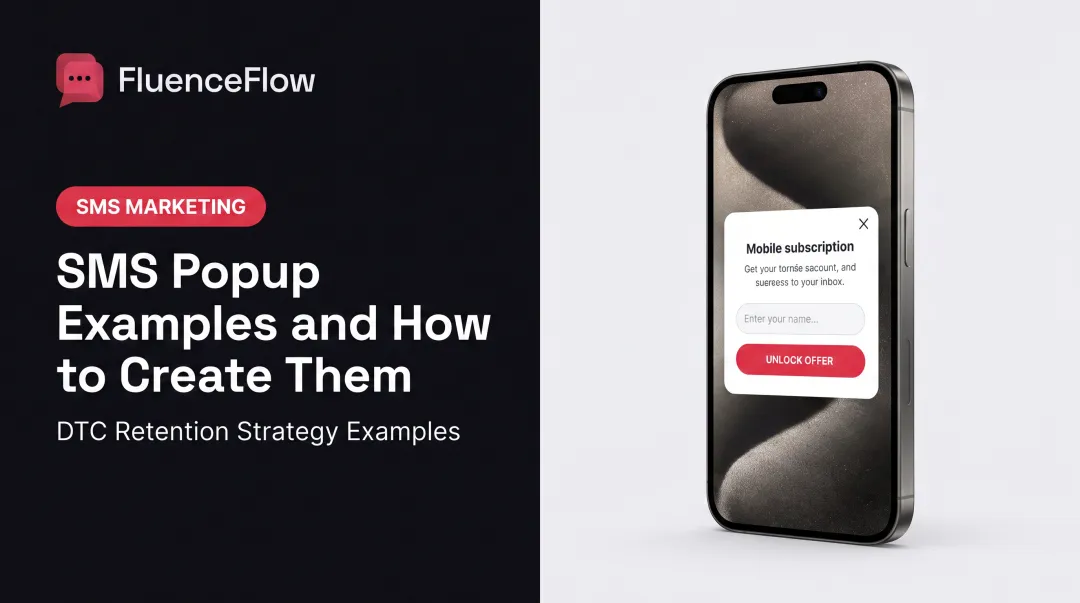
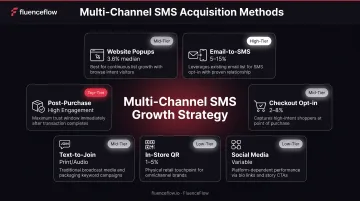
Website forms remain the highest-volume SMS acquisition channel for most DTC brands. Postscript's 2026 benchmark study reports median phone-number popup conversion of 3.6%, with top performers hitting 8.6%.
Placement strategies for highest conversion:
- Exit-intent: Triggers when cursor moves toward browser close button
- Scroll-triggered: Appears after visitor scrolls 50-70% down page
- Time-delayed: Shows after 30-60 seconds on site
- Page-specific: Different popups for homepage, product pages, blog content
Mobile and desktop experiences require different approaches. Mobile visitors see the popup immediately or after minimal scroll, while desktop users tolerate slightly longer delays.
Multi-step form approach:
Capture email first, then present SMS opt-in on the second step. You still grow the email list if they bail early, and you capture SMS from the visitors engaged enough to finish both steps.
Use tap-to-text functionality on mobile. Klaviyo's tap-to-text feature pre-populates a text message with your opt-in keyword, reducing friction to a single tap.
Method 2: Email-to-SMS Conversion Campaigns
Your existing email subscribers already know your brand and have shown interest. Attentive's 2026 survey found 85% of email subscribers are open to joining SMS when asked properly.
Campaign structure for maximum conversion:
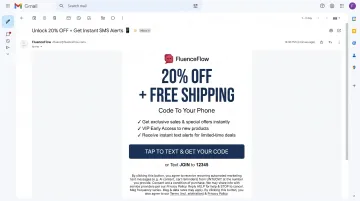
- Subject line: Focus on benefits, not the ask ("Get instant access to VIP deals")
- Body copy: Lead with value proposition: what they'll receive via text that email won't deliver
- CTA placement: Primary button above fold, secondary CTA in footer
- Signup mechanism: One-click enrollment or tap-to-text link
Example messaging approach:
"Our best deals don't last long enough for email. Get instant alerts on flash sales, restocks, and VIP-only discounts, straight to your phone. Text VIP to 12345 or [click here to join]."
Target your highest-value segments first: frequent purchasers, customers with AOV above your average, engaged subscribers with recent opens. Test messaging with a small segment before broadcasting to your full list.
Run 2-3 dedicated SMS promotion campaigns per year, spaced quarterly. Include persistent header or footer CTAs in regular promotional emails to capture ongoing opt-ins.
Method 3: Social Media Promotion
Social platforms provide high-visibility touchpoints for SMS signup promotion. Your followers have already expressed interest in your brand; SMS offers a more direct connection.
- Instagram Stories: Add a link sticker to your SMS signup page. Stories feel native and don't clutter the main feed
- TikTok: Short clips on program perks, plus keyword or link-in-bio CTAs. Creator/UGC-style posts often beat polished brand ads
- Facebook: Pin a post with a clear value prop and simple join steps
- Profile bios: Put an SMS signup link in every bio; use UTM-tagged or link-in-bio tools to see which platform converts
Influencer and affiliate partners can extend reach when each creator gets a unique text-to-join keyword for tracking.
Method 4: Checkout Opt-in Integration
Checkout represents peak engagement. Customers are already providing contact information and have clear purchase intent.
Add a compliant SMS opt-in checkbox during checkout, separate from email opt-in. The checkbox must be:
- Unchecked by default (pre-checked boxes don't constitute valid consent)
- Clearly labeled with your brand name and message purpose
- Accompanied by required disclosures (frequency, data rates, opt-out)
Effective value proposition messaging:
"Get shipping updates, restock alerts, and exclusive member perks via text. Not required to complete purchase."
Position SMS as a convenience and value-add, not just marketing. Shopify and most major eCommerce platforms support compliant checkout opt-in fields.
Method 5: In-Store Signage and QR Codes
For brands with physical retail presence, in-store signage converts foot traffic into SMS subscribers.
Strategic placement locations:
- Checkout counter displays
- Window clings visible from outside
- Shelf signage near popular products
- Printed on receipts
- Table tents (restaurants/cafes)
Use QR codes that direct to mobile-optimized signup forms. Include clear CTAs communicating immediate value: "Scan for instant 10% off your next order."
Text-to-join keywords work well in-store when paired with visible signage. Choose memorable keywords tied to your brand name or a specific promotion.
Method 6: Text-to-Join Keywords
Text-to-join lets customers text a specific keyword to your dedicated short code to subscribe. This method works best when you can't include a clickable link or QR code.
When text-to-join excels:
- Print advertising
- Product packaging
- Radio or podcast ads
- Event marketing
- Business cards
Choosing effective keywords:
- Keep it short and memorable (5-8 characters)
- Tie to your brand name or current campaign
- Avoid easily misspelled words
- Test pronunciation if promoting via audio
Promote your text-to-join keyword wherever your brand appears. The friction is slightly higher than form-based signup, but it works across any medium.
Method 7: Post-Purchase Follow-up
New customers are highly engaged immediately after purchase. Use this window to prompt SMS opt-in.
Include SMS signup CTAs in:
- Order confirmation emails
- Shipping notification emails
- First transactional message after purchase
Messaging approach:
Position SMS as a way to receive shipping updates, restock alerts for out-of-stock items they browsed, or exclusive perks for repeat customers. The value proposition should extend beyond promotions to include utility and convenience.
Example: "Want real-time shipping updates sent straight to your phone? [Join our SMS program] to track your order and get early access to new releases."
Post-purchase timing works because customers just spent money with you. They're receptive to deeper engagement.
Converting Email Subscribers to SMS Subscribers
Your email list represents the single highest-intent audience for SMS conversion. These subscribers already know your brand, have opted into communications, and have demonstrated interest in your products.
Email-to-SMS conversion can hit 15-30% opt-in rates among targeted segments, far higher than cold website traffic.
Why Email Subscribers Convert
They've already trusted you with their inbox, and often a purchase, so SMS is a natural next step for faster, more direct updates.
Attentive's 2026 consumer research found 85% of email/SMS subscribers are open to joining both channels when asked. The key is asking effectively.
Campaign Structure for Dedicated SMS Promotion
Build dedicated email campaigns around SMS signup, separate from your regular promotional sends.
Subject line examples:
- "Get our best deals before they sell out"
- "VIP access: Join our text club"
- "Never miss a restock again"
Lead with benefits, not the channel. Subscribers don't care about SMS; they care about faster access, exclusive offers, or convenient updates.
Body copy structure:
- Open with the problem: "Our flash sales sell out in hours, too fast for email"
- Present SMS as the solution: "Get instant alerts so you never miss a deal"
- List specific benefits: Early sale access, restocks, VIP-only discounts, shipping updates
- Clear CTA: "Text JOIN to 12345" or one-click enrollment button
Include a simple signup mechanism. The fewer steps between reading your email and completing signup, the higher your conversion rate.
Segmentation Strategies for Highest ROI
Don't blast your entire email list simultaneously. Target high-value segments first:
- Frequent purchasers (2+ orders in past 90 days): Strongest SMS engagers and fastest path to post-subscribe revenue
- High AOV customers (above your store average): Respond well to exclusive access and VIP framing
- Recently engaged subscribers (opened or clicked within 14 days): Active email habits signal openness to another channel
Test messaging with your best segment first. Refine based on results before expanding to broader audiences.
Frequency and Timing Guidance
Run 2-4 dedicated SMS promotion campaigns per year, roughly quarterly. Space them around key selling seasons or product launches to tie signup to immediate value.
In addition to standalone campaigns, include persistent SMS signup CTAs in:
- Email header or navigation bar
- Footer of every promotional send
- Welcome series for new email subscribers
- Post-purchase follow-up sequences
Persistent placement captures ongoing opt-ins from subscribers who weren't ready during dedicated campaigns.
Optimizing Signup Forms and Call-to-Actions
High-converting SMS opt-in forms balance persuasive messaging with compliance requirements and minimal friction.
Critical Elements of High-Converting Forms
Clear value proposition: Generic "get updates" messaging underperforms specific benefit statements by 40%+. Tell subscribers exactly what they'll receive:
❌ "Stay connected with us via text" ✅ "Get instant alerts on flash sales and restocks before they sell out"
CTA button copy: Generic "Sign Up" loses to offer-specific language. "Get 10% Off" or "Text Me the Deal" beats vague CTAs.
Compliance disclaimers: Required disclosures don't have to kill conversion. Place them below the submit button in smaller text so the offer stays primary and you remain compliant.
Minimal friction: Every additional form field drops conversion. Collect only the phone number: no name, birthday, or address fields unless absolutely necessary.
Use single-tap submission on mobile. Pre-populate country codes and validate formatting automatically.
Incentive Strategies That Boost Opt-In Rates
Welcome offers lift SMS signup rates. Attentive's 2026 research found 85% of text subscribers say a welcome incentive influences signup decisions.
Effective incentive types:
- Percentage discounts: 10-20% off first order
- Dollar-off offers: $10-25 off minimum purchase
- Free shipping: No minimum or reduced threshold
- Early access: First look at sales or new releases
- VIP perks: Exclusive member benefits, priority support
Postscript's analysis of high-converting popups found 64% of top performers used exactly 10% off. That figure is observational, not proof that 10% is optimal for every brand.
Test incentive amounts against your margins and customer acquisition cost. A brand with $200 AOV can afford more aggressive offers than one with $40 AOV.
Mobile-First Design Requirements
Most SMS signups happen on mobile devices. Your forms must be thumb-friendly and load instantly.
Mobile optimization checklist:
- Large, tappable buttons (minimum 44x44 pixels)
- Single-column layout
- Phone number field auto-focused on load
- Tap-to-text functionality on mobile (Klaviyo's implementation opens messaging app with prefilled keyword)
- Fast load time (under 2 seconds)
Desktop forms can use phone number entry fields. Mobile forms benefit from tap-to-text, which verifies the number through a two-step process while feeling frictionless.
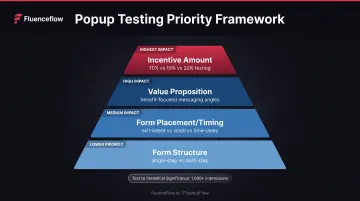
A/B Testing Priorities
Optimize systematically rather than guessing. Test these variables in order of impact:
1. Incentive amount (10% vs 15% vs 20%) Biggest potential impact on conversion rate. Test in 5% increments to find the optimal balance between conversion lift and margin erosion.
2. Value proposition messaging Test benefit-focused headlines against different angles (urgency, exclusivity, convenience, savings).
3. Form placement and timing Exit-intent vs scroll-trigger vs time-delay. Desktop vs mobile timing thresholds.
4. Single-step vs multi-step Klaviyo recommends multi-step (email first, SMS second), but your audience may respond differently. Test with a portion of traffic before committing.
Run tests to statistical significance before declaring winners. Most forms need 1,000+ impressions per variant to reach meaningful conclusions.
Common Mistakes When Growing SMS Lists
Bad list-growth tactics tank quality, burn trust, and create real compliance risk. Steer clear of these mistakes.
Purchasing or Importing Lists Without Consent
Buying SMS lists or importing phone numbers from external sources violates TCPA consent requirements and Twilio's messaging policy. Consent is sender-specific and subject-specific; it cannot be transferred, even between affiliates.
Purchased lists produce:
- High opt-out rates (often 20%+ immediately)
- Spam complaints that damage sender reputation
- Platform account suspension
- Legal liability ($500-$1,500 per violation in TCPA cases)
There are no legitimate shortcuts to list building. Every subscriber must explicitly opt in to receive texts from your specific brand.
Making Opt-In Consent Unclear
Burying SMS consent in general terms and conditions or using pre-checked boxes doesn't constitute valid consent. The FCC requires clear, conspicuous authorization that a reasonable person would understand grants permission for marketing texts.
Non-compliant examples:
- Pre-checked opt-in boxes
- Consent language hidden in linked terms
- Generic "I agree to receive communications" without specifying SMS
- Requiring SMS signup to complete purchase
Make opt-in explicit, voluntary, and separate from other actions.
Over-Promising in Acquisition, Under-Delivering in Content
Promoting "exclusive VIP deals" during signup, then sending generic promotional blasts, erodes trust and spikes unsubscribe rates.
Attentive's research found 25% of recent unsubscribers cited joining only for the welcome offer among reasons for leaving. Another 36% reported too many messages.
Deliver on your promises. If you position SMS as exclusive, ensure content is genuinely differentiated from email. If you promise shipping updates, send them.
Neglecting Mobile Optimization
SMS subscribers are mobile users by definition. Forms that don't load properly on mobile, require excessive typing, or use tiny buttons destroy conversion rates.
Test your signup experience on actual devices, iOS and Android, different screen sizes, not just desktop browser simulators.
Focusing on List Size Over Subscriber Quality
A smaller, engaged list usually beats a bigger, cold one. For example, 50,000 subscribers at 85% retention and $0.75 per message outperform 100,000 at 70% retention and $0.30 per message.
Postscript reports median 30-day retention of 93.13% for new subscribers. Above 90% signals healthy acquisition; below 85% points to weak targeting, mismatched expectations, or thin content.
Judge list health on more than headcount:
- Engagement rate
- Purchase rate
- Revenue per subscriber
- 30-day retention vs. the ~93% benchmark
Optimize for subscribers who buy, not contacts who only inflate your total.
Measuring SMS List Growth Success
Track acquisition volume and subscriber quality together. Raw list size alone tells an incomplete story.
Key Metrics to Track
Acquisition volume:
- Gross opt-ins per week/month
- Opt-in rate by channel (website, email, social, checkout, in-store)
- Opt-in confirmation rate (percentage who complete any double opt-in process)
Postscript's benchmarks define acquisition rate as net-new SMS subscribers divided by new orders over 30 days. Percentiles are 0.45% / 1.06% / 2.32% / 5.22% at the 25th/50th/75th/90th marks.
List health:
- Opt-out rate per campaign and monthly aggregate
- 30-day retention for new subscriber cohorts (median 93.13%)
- Net list growth (gross opt-ins minus opt-outs)
Subscriber quality:
- Click-through rate (campaign median 2.87%-8.01%)
- Conversion rate per message (0.12%-0.54% at 25th-75th percentile)
- Revenue per message (median $0.98, top performers $4.54+)
- Subscriber lifetime value (median $71.20, top quartile $205+)
Benchmark Performance by Channel
Compare opt-in rates across acquisition channels to identify your highest-performing sources:
- Website popups: Median 3.6%, top performers 8.6%+
- Email-to-SMS campaigns: Typically 5-15% of targeted segment
- Checkout opt-in: Varies widely; 2-8% is common
- Social media: Highly variable; track by platform and post type
- In-store QR codes: 1-5% of foot traffic (difficult to measure precisely)
Put more budget and testing into channels beating these benchmarks, and fix or cut sources that lag.
Tracking Subscriber Quality Beyond List Size
Gross list size is a vanity metric. Focus on quality signals instead:
- Engagement rate: Share of the list that clicks within 30 days; healthy programs hit 40-60% monthly engagement, below 30% points to targeting or content issues
- Purchase rate: Share of subscribers with an SMS-attributed purchase in 60-90 days; top programs convert 15-25%+ in the first quarter
- Revenue per subscriber: SMS-attributed revenue divided by list size; normalizes results across list sizes and shows monetization efficiency
Compare cohorts over time (January vs. February vs. March signups) to spot seasonality and which acquisition sources bring higher-quality subscribers.
Frequently Asked Questions
What is an SMS subscriber?
An SMS subscriber is a customer who has explicitly opted in to receive text message marketing from your brand. They've granted written consent for commercial texts, making them part of your owned SMS audience rather than rented advertising reach.
Is SMS marketing legal in the USA?
Yes, SMS marketing is legal when compliant with TCPA regulations. You must obtain explicit opt-in consent before sending commercial texts, provide required disclosures (frequency, data rates, opt-out), and honor unsubscribe requests within 10 business days.
What is the average SMS unsubscribe rate?
Healthy SMS programs typically see 2-5% monthly opt-out rates. Postscript's benchmarks put per-campaign unsubscribes at 0.33%–0.88% (25th–75th percentile); rates above 5% monthly usually point to frequency, content, or targeting problems.
Is there a free SMS subscription available?
Consumers don't pay to receive marketing texts beyond standard carrier rates. Brands pay the bill: most platforms charge $0.01–$0.03 per message plus $100–$1,000+ monthly, depending on list size.
How quickly can I expect to grow my SMS list?
Growth depends on traffic, offer strength, and how many capture points you run. Most DTC brands add SMS subscribers at 2–5% of monthly order volume (about 20–50 new subs per 1,000 orders); strong multi-channel setups can clear 5%.
Should I collect SMS opt-ins separately from email?
Yes. Capture email first, then offer SMS on a second step so consent stays separate and explicit for each channel. Klaviyo recommends this multi-step approach; you grow email faster and still convert highly engaged visitors to SMS.
Start with website popups and email-to-SMS conversion (your highest-volume opportunities), then add checkout, social, and in-store capture as you scale.
Prioritize retention and revenue per subscriber over raw list size. Track 30-day retention above 90%, keep monthly opt-outs under 5%, and optimize for subscriber LTV instead of vanity metrics.
For DTC brands that want SMS capture, compliance setup, and send logic coordinated with email flows, FluenceFlow builds done-for-you programs around your unit economics and customer behavior. Clients average 41% of total store revenue from combined email and SMS.