This guide walks DTC brands through SMS opt-in and opt-out fundamentals, covering definitions, legal requirements, collection methods, and actionable best practices that protect your business while building a valuable, engaged subscriber list.
Key Takeaways
- Explicit written consent is mandatory before sending promotional SMS; no exceptions
- Double opt-in confirmation adds legal protection and validates genuine subscriber interest
- TCPA, CTIA guidelines, and state laws govern compliance, with fines reaching $1,500 per text
- Seven proven collection methods exist, from checkout checkboxes to QR codes and keyword campaigns
- Opt-outs must be immediate, simple, and honored without friction or delay
Understanding SMS Opt-Ins and Opt-Outs
Opt-in and opt-out rules decide who you can text, how you got permission, and how fast you must stop. Get these definitions right before you build flows or compliance copy.
What Is an SMS Opt-In?
An SMS opt-in is explicit written consent from a customer to receive marketing messages on their mobile phone. Under the Telephone Consumer Protection Act (TCPA), you must obtain a signed written agreement (electronic signatures qualify) that clearly authorizes your business to send promotional texts to the specified number.
Transactional vs. promotional messages matter:
- Transactional messages (order confirmations, shipping alerts, password resets) generally don't require marketing consent
- Promotional messages (sales, discounts, product launches, general brand updates) require prior express written consent under TCPA
Single opt-in vs. double opt-in:
- Single opt-in: Customer enters their phone number and checks a consent box; they're immediately added to your SMS list
- Double opt-in: After signup, the customer gets a confirmation text and replies with a keyword (such as "YES"). The extra step documents intent and improves list quality
What Is an SMS Opt-Out?
An SMS opt-out is a customer's request to stop receiving messages from your brand. Federal regulations require you to honor opt-out requests using any reasonable method.
Standard opt-out keywords you must recognize:
- STOP
- QUIT
- END
- REVOKE
- OPT OUT
- CANCEL
- UNSUBSCRIBE
You must also honor natural-language requests such as "please opt me out" or "remove me from this list."
Federal law caps opt-out processing at 10 business days, but best practice is immediate suppression, ideally within minutes. Fast handling cuts legal risk and protects customer goodwill.
Why the Distinction Matters for DTC Brands
Consent quality shows up in places DTC brands already watch closely:
- Deliverability: Carriers monitor complaint and opt-out rates and can filter or block risky senders. Clean opt-ins protect your sender reputation
- Customer lifetime value: People who chose your texts engage more and drive more repeat revenue. Forced or tricky list growth breeds opt-outs and weakens the channel
- Brand perception: Clear consent and easy unsubscribes signal respect. Friction or shady tactics leave a lasting negative mark
7 SMS Opt-In Methods with Examples
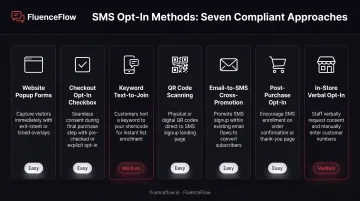
All seven methods below are compliant when properly executed. Your choice should depend on where customers naturally interact with your brand and what fits your business model and customer journey.
Method 1: Website Popup Forms
Use exit-intent or timed popups to capture phone numbers with clear consent language before visitors leave your site.
Example template:
Get 15% off your first order
Join our SMS list for exclusive deals and early access.
[Phone number field]
By entering your number, you agree to receive up to 4 marketing texts per month from [Brand Name] at the number provided. Message and data rates may apply. Reply STOP to unsubscribe. [Privacy Policy] | [Terms]
Best practices:
- Offer a tangible incentive (discount, early access, free shipping)
- Keep form fields minimal; phone number only, no unnecessary fields
- Mobile-optimize the popup for thumb-friendly input
- Use exit-intent triggers to avoid interrupting active browsing
Method 2: Checkout Opt-In Checkbox
Add SMS consent during the purchase process, but never make it mandatory or pre-check the box.
TCPA-compliant checkbox example:
☐ Send me order updates and exclusive offers via text
By checking this box, you consent to receive promotional texts from [Brand Name]. Consent is not required to complete your purchase. Up to 4 msgs/month. Reply STOP to opt out. [Terms]
Optimal placement:
- After email collection, before payment
- Clearly separated from required purchase fields
- Unchecked by default (pre-checked boxes violate TCPA)
Checkout opt-ins convert well because customers are already engaged and providing contact information.
Method 3: Keyword Text-to-Join Campaigns
Customers text a keyword (such as "SAVE") to your shortcode or phone number to subscribe.
Example promotional copy:
Text SAVE to 12345 for 15% off your next order
Automated double opt-in response:
Thanks for joining [Brand Name]! Reply YES to confirm and get your 15% discount code. Msg frequency varies. Reply STOP to cancel, HELP for help. Msg & data rates may apply.
Technical considerations:
- Promote keywords on social media, product packaging, in-store signage, receipts
- Ensure your SMS platform recognizes confirmation replies (YES, Y, CONFIRM)
- Send the promised incentive immediately after confirmation
Method 4: QR Code Scanning
QR codes can link to an opt-in form or trigger a pre-filled text message.
Example placement:
- Product packaging inserts
- Receipts at point of sale
- Store displays and signage
- Print ads and catalogs
Compliance language near the QR code:
Scan to join our SMS list and get 10% off. Up to 4 msgs/month. Reply STOP to unsubscribe. [Privacy Policy]
QR codes work well for brands with physical products or retail locations, connecting in-person moments to digital signup.
Method 5: Email-to-SMS Cross-Promotion
Use your existing email list to build your SMS audience with clear opt-in requests.
Example email copy:
Subject: Want faster access to our best deals?
Our email subscribers get great offers, but our SMS subscribers get them first, plus exclusive text-only discounts.
[Join Our SMS List Button]
You'll receive up to 4 texts per month with early sale access, product drops, and special promotions. Reply STOP anytime to unsubscribe.
Segmentation strategy:
Send to your most engaged email subscribers first; customers who open frequently and have purchased recently are more likely to opt in and stay engaged on SMS.
Method 6: Post-Purchase Opt-In
Capture opt-in on order confirmation or thank-you pages by offering practical value.
Example messaging:
Want real-time shipping updates?
Get order tracking alerts sent directly to your phone.
[Phone number field]
By providing your number, you agree to receive order updates and occasional promotional offers from [Brand Name] (up to 4/month). Reply STOP to opt out. [Terms]
Key distinction:
- Transactional opt-in (shipping alerts) can be separate from promotional consent
- Promotional opt-in (discounts, product launches) requires explicit marketing consent
Frame the initial value around transactional benefits, then clearly disclose promotional messaging.
Method 7: In-Store or Verbal Opt-In
Collect phone numbers at point of sale with trained staff and proper documentation.
Staff script example:
"Would you like to join our SMS list for exclusive offers and early access? We send about 4 texts per month, and you can reply STOP anytime to unsubscribe. What's the best mobile number for you?"
Documentation requirements:
- Record date and time of consent
- Capture method of consent (verbal at POS)
- Store customer phone number and consent status
- Retain records for 4-5 years
- Train staff on required disclosures and proper consent language
Record-keeping best practices:
Use your SMS platform or CRM to automatically log consent details, including staff member, location, timestamp, and exact language disclosed to the customer.
SMS Opt-Out Guidelines and Examples
How to Make Opt-Out Simple and Clear
Every promotional message must include opt-out instructions, typically in the message footer.
Example opt-out language:
Reply STOP to unsubscribe from [Brand Name] SMS. Msg & data rates may apply.
Variations:
Text STOP to opt out | Reply STOP to cancel | STOP to unsubscribe
Confirmation is mandatory:
After a customer opts out, send one final message that confirms the request and explains how to re-subscribe later.
Example opt-out confirmation:
You're unsubscribed from [Brand Name] SMS. You won't receive any more promotional texts. Text START anytime to rejoin. Need help? Email support@yourbrand.com.
What Happens After an Opt-Out
Opt-out does not end at the confirmation text. You still have to keep that number out of every future send.
Data retention and suppression:
- Maintain a suppression list of opted-out numbers
- Never delete opted-out contacts entirely. Keep the record so they are not re-added by mistake
- Respect opt-outs indefinitely unless the customer explicitly re-subscribes
Common Opt-Out Mistakes to Avoid
Violations that trigger fines and carrier filtering:
- Making opt-out difficult (requiring account login, website visit, or customer service call)
- Charging for opt-out
- Ignoring opt-out requests or continuing to send messages
- Adding marketing content to opt-out confirmation messages
- Failing to suppress opted-out numbers from future campaigns
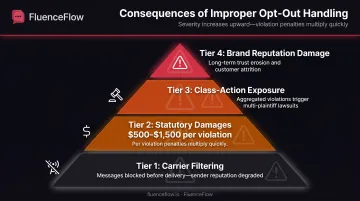
Consequences of improper opt-out handling:
- $500–$1,500 statutory damages per violation
- Class-action lawsuit exposure
- Carrier filtering that blocks all your messages
- Long-term brand reputation damage
Legal Compliance Requirements for SMS Marketing
TCPA (Telephone Consumer Protection Act) Requirements
Core requirement: Prior express written consent for all marketing messages.
What consent must include:
- Business identity (your brand name)
- Purpose (marketing/promotional messages)
- Clear opt-out method (reply STOP)
- Statement that consent is not required to purchase
Penalties:
The TCPA authorizes $500 per violation (actual loss or $500, whichever is greater), with courts empowered to triple damages to $1,500 for willful or knowing violations. These are private statutory damages awarded in lawsuits, not government fines.
CAN-SPAM Act and SMS
Limited application: CAN-SPAM primarily governs email, but it applies to commercial email-to-text messages sent to carrier-assigned internet-domain addresses (such as 5551234567@vtext.com).
Requirements when applicable:
- Identify message as an advertisement
- Include sender identity
- Provide clear opt-out mechanism
Important: CAN-SPAM does not cover standard phone-to-phone SMS routed through carrier networks. TCPA and FCC rules remain the primary federal framework for promotional texts.
CTIA Best Practices and Guidelines
CTIA's role: The wireless industry association publishes voluntary best practices that carriers and platforms expect senders to follow.
Key guidelines:
- Use double opt-in or send an enrollment confirmation before additional messages
- Disclose message frequency (e.g., "up to 4 msgs/month")
- Support HELP keyword for customer assistance
- Recognize standard opt-out keywords and natural-language requests
- Send one opt-out confirmation only, with no promotional content
Why it matters: Following CTIA guidelines reduces the risk of carrier filtering. Wireless providers can filter or block messages from senders who generate high complaint rates or violate industry norms.
State-Specific Regulations and Considerations
California (CCPA): Under the California Consumer Privacy Act, phone numbers linked to identifiable consumers are personal information. CCPA-covered businesses must:
- Provide privacy notices at or before collection
- Disclose data categories and purposes
- Support access, deletion, correction, and sale/share opt-out rights
- Retain data only as long as reasonably necessary for disclosed purposes
Florida: Section 501.059 requires prior express written consent for sales-solicitation texts. Once a customer replies STOP, senders have 15 days to cease contact. Texts sent without consent can result in $500 or actual damages, trebled for willful violations.
Washington: RCW 19.190.060 prohibits commercial texts to Washington residents without consent, actionable under the state Consumer Protection Act.
Multi-state operations: Consult legal counsel to ensure your program complies with federal law and all applicable state regulations.
Record-Keeping and Documentation Requirements
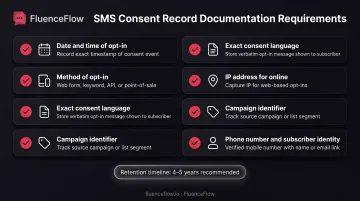
What to document for every subscriber:
- Date and time of opt-in
- Method of opt-in (website popup, checkout, keyword, QR code, in-store)
- Exact consent language shown to customer
- IP address (for online opt-ins)
- Campaign identifier
- Phone number and subscriber identity
Retention period: While no universal FCC rule mandates a specific retention period for all SMS consent records, best practice is 4-5 years to cover applicable litigation statutes of limitations.
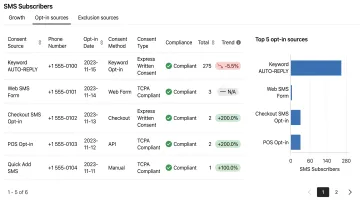
Platform support: SMS platforms like Klaviyo, Attentive, and Postscript can automatically capture and store consent metadata, but verify that your implementation records all required fields, especially for integrations and imported lists.
Best Practices for Compliant SMS Programs
Set Clear Expectations During Opt-In
Spell out frequency and content at opt-in so subscribers know what they're signing up for:
- Frequency: "You'll receive up to 4 promotional texts per month, plus occasional time-sensitive alerts."
- Content: "Get exclusive offers, early product drops, and subscriber-only discounts."
"Msg frequency varies" meets the bare minimum. "Up to 4 msgs/month" sets clearer expectations and cuts surprise opt-outs later. Avoid overpromising or staying so vague that customers feel misled.
Make Compliance Part of Your Brand Experience
Compliance copy doesn't have to sound robotic. Match your brand's tone while still including required disclosures.
Treat the welcome SMS as a relationship-building moment: deliver the promised incentive, preview what they'll get, and repeat the opt-out path. For example:
Welcome to [Brand Name]! Here's your 15% code: WELCOME15. You're now on the VIP list for early sales and exclusive drops. Reply STOP anytime to opt out.
Strong SMS programs also stay coordinated with email and on-brand in every flow. That's the approach FluenceFlow takes for DTC brands: custom SMS that matches voice, ties into the rest of retention, and stays compliant without feeling purely transactional.
Monitor Deliverability and Subscriber Engagement
Treat engagement data as an early-warning system, not a vanity report:
- Opt-out spikes: Often point to message fatigue, weak targeting, or sending too often; review recent campaigns when rates jump.
- Deliverability dips: Falling open rates, weaker click-through, or rising bounces can signal carrier filtering or list-quality problems.
- Carrier filtering risk: Carriers watch clicks, opt-outs, and spam reports. Low engagement raises the odds your messages get filtered or blocked.
Catch these trends early and adjust frequency, creative, or list hygiene before inbox placement suffers.
Frequently Asked Questions
What does an opt-in text message mean?
An opt-in text message is explicit customer consent to receive marketing texts from your brand. TCPA requires it before you send promotional SMS. Customers usually opt in by sharing their number and agreeing to terms via a form, keyword, or verbal consent.
What is a double opt-in text message?
Double opt-in is a two-step confirmation process. After initial signup, customers receive a text asking them to reply with a keyword (such as "YES") to confirm their subscription. This extra step validates genuine interest and creates stronger proof of consent.
Should I enable double opt-in for SMS?
Yes, double opt-in is recommended for legal protection and list quality. It ensures subscribers genuinely want to hear from you and provides clearer documentation of consent. While it may reduce signup numbers slightly, it improves engagement and reduces opt-outs over time.
Is SMS marketing legal in the USA?
Yes, SMS marketing is legal in the USA when you obtain proper prior express written consent and comply with TCPA, CAN-SPAM (when applicable), CTIA guidelines, and state laws. Violations can result in $500-$1,500 statutory damages per text, so compliance is essential.
What is an opt-in text message form?
An opt-in text message form collects phone numbers with explicit SMS consent. It can be digital (website popups, checkout pages) or physical (paper forms at POS). Required disclosures cover business identity, message purpose, frequency, opt-out method, and that consent isn't required for purchase.
How do I unsubscribe from SMS marketing?
Reply with STOP, QUIT, CANCEL, UNSUBSCRIBE, or similar keywords to any promotional text. Brands must honor opt-out requests immediately and send one final confirmation message. You should stop receiving messages within minutes, though federal law allows up to 10 business days.
Building a compliant, engaged SMS list takes planning, transparency, and respect for customer preferences. Follow the opt-in methods, opt-out rules, and legal requirements in this guide, and DTC brands can use SMS as a strong retention channel without risking fines, carrier filtering, or trust. Start with clear consent, set honest expectations, and make opt-out easy. Your list and your bottom line both benefit.