
Introduction: AI Email Marketing for E-commerce Stores
E-commerce brands face a challenging tension: customers expect personalized experiences, yet manually crafting tailored campaigns for thousands of subscribers is impossible.
According to Mailchimp, brands using generative AI in their email campaigns grew 345% year-over-year during the 2024 holiday season. That spike shows how fast teams are adopting automation to close the personalization gap.
For DTC brands, the real challenge is personalization at scale without wrecking unit economics. AI email marketing helps by automating segmentation, optimizing send timing, and recommending products from individual behavior patterns.
This guide covers what AI can actually do for e-commerce email, how to choose the right tools for Shopify and Klaviyo, and when pairing AI with strategic expertise delivers the best results.
Key Takeaways
- Personalization, send-time optimization, and behavioral segmentation run automatically from Shopify store data
- Highest-value e-commerce plays: predictive reorder flows, dynamic product recommendations, and churn-risk segments
- Klaviyo's native AI features should be maximized first before adding third-party tools to your stack
- Match AI to your model: audience modeling for high-AOV brands, replenishment prediction for consumables
- Execution gets faster with AI; strategy, unit economics, and brand voice still need human expertise
What Is AI Email Marketing for E-commerce?
AI email marketing uses machine learning and predictive algorithms to automate and optimize campaigns based on customer purchase behavior and browsing patterns. For Shopify stores, this means AI email tools analyze order history, product views, cart activity, and engagement data to make decisions that would be impractical to execute manually at scale.
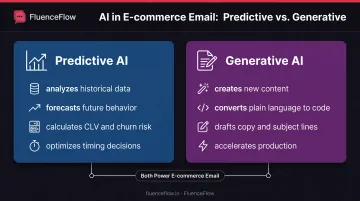
Two types of AI power e-commerce email:
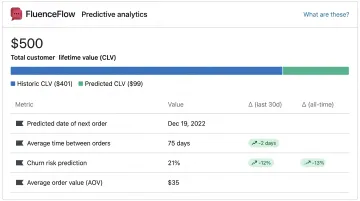
Predictive AI analyzes historical customer data to forecast future behavior. Klaviyo's predictive analytics, for example, calculates expected customer lifetime value, churn risk, and optimal reorder timing based on purchase frequency and order patterns. Brands use these scores to build segments and trigger flows when someone is most likely to buy.
Generative AI creates new content from data or instructions. Klaviyo's Segments AI converts a plain-language request like "customers who bought twice in the last 60 days" into the actual segment logic, reducing setup time. The same class of tools can turn a short brief into subject line options and draft email copy.
How AI Differs from Traditional Automation
Traditional email automation executes predefined rules: if a customer abandons a cart, send an email after one hour. AI-enhanced systems learn from patterns across your entire customer base. They might discover that high-AOV customers respond better to a three-day cart abandonment delay, while lower-value items convert faster with a one-hour trigger. Then they adjust timing automatically.
For e-commerce specifically, AI delivers:
- Product recommendations based on collaborative filtering (what similar customers bought)
- Cart abandonment optimization with personalized timing and product suggestions
- Churn prediction that identifies at-risk customers before they disengage
- Lifecycle stage identification that segments customers by predicted value and behavior
Top AI Capabilities Every E-commerce Brand Should Use
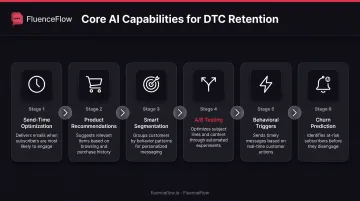
AI capabilities matter most when they change when you send, what you recommend, who you target, and how you recover revenue. Use the six below as a checklist against your Klaviyo setup, not a mandate to turn every toggle on day one.
Predictive Send-Time Optimization
AI analyzes when individual subscribers open and click, then schedules campaigns for each person’s highest-engagement window. Klaviyo’s Smart Send Time works in two phases: exploratory sends across 24 hours in the recipient’s local time zone, then focused sends that validate the winning time.
Your list spans time zones and habits (late-night browsers, lunch-break shoppers, early scrollers). One manual send time is a compromise; AI times each subscriber separately.
Data requirements: Klaviyo needs at least 12,000 active profiles and campaigns that reach 12,000+ recipients before Smart Send Time unlocks.
Dynamic Product Recommendations
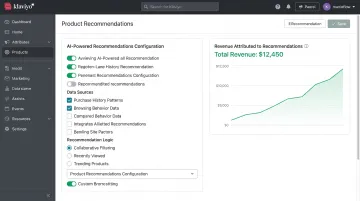
AI uses purchase history, browsing behavior, and patterns from similar customers to suggest products in flows and campaigns. When personal data is thin, it falls back to bestsellers or category-level picks.
Revenue impact: Every Man Jack (personal care, on Klaviyo) reports predicted-reorder flows drive 12.4% of its Klaviyo-attributed revenue, fully automated from AI-calculated reorder dates. Collaborative filtering finds “bought X also bought Y” patterns in your order data and applies them per subscriber.
Smart Segmentation and Audience Building
AI builds micro-segments from many behavioral signals at once, including:
- Purchase frequency and average order value
- Product categories and browsing patterns
- Engagement history and churn risk
Klaviyo’s predictive analytics can build segments like “high predicted LTV” or “at risk of churning” without hand-built rule trees. A marketer might maintain 5–10 obvious segments; AI surfaces more nuanced groups and refreshes them as behavior changes.
Automated A/B Testing and Optimization
AI runs ongoing tests on subject lines, content blocks, CTAs, send times, and layout, then surfaces winners faster than a single manual test cycle. Klaviyo supports tests across subject lines, content blocks, and send times.
Manual A/B tests often need one to two weeks for significance. AI can read results in real time and run multiple experiments at once, so learning compresses from weeks into days.
Behavioral Trigger Refinement
Standard lifecycle flows still start from fixed rules:
- Welcome series
- Browse abandonment
- Cart abandonment
- Post-purchase
AI improves them by learning which delays, creative variants, and product suggestions work for different segments. For example, carts over $400 may convert better with a 24-hour first reminder and educational content, while sub-$50 carts may need a discount-led email within an hour, and the system can apply those rules automatically.
Churn Prediction and Win-Back Optimization
AI flags disengagement risk from weaker open rates, longer gaps between orders, and lighter browse activity. Klaviyo scores churn risk from order count and purchase frequency, and retrains at least weekly as new data lands.
Instead of waiting for 90 days of silence, trigger win-back when early warning signs show up. You recover more customers with less discounting because you act before the relationship goes cold.
How to Choose AI Email Marketing Tools for Your Store
Start by auditing your current email platform. Many Shopify stores already use Klaviyo but haven't activated its native AI capabilities: predictive analytics, smart send time, and personalized product feeds are often available within your existing subscription.
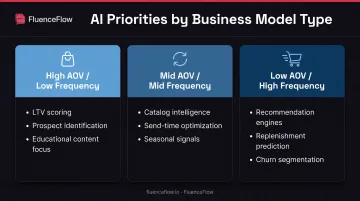
Evaluate Based on Your Business Model
Your unit economics determine which AI features deliver the highest ROI:
High AOV / Low Frequency Brands (premium products, long purchase cycles):
- Prioritize AI that scores high-intent prospects and predicted LTV inside your existing list
- Use predictive analytics to identify customers most likely to convert after extended nurture
- Focus on personalized education content rather than replenishment triggers
Mid AOV / Mid Frequency Brands (large catalogs, seasonal products, tight margins):
- Prioritize AI catalog intelligence that surfaces the right SKUs from deep inventories
- Use send-time and frequency optimization so you protect margins instead of over-emailing
- Lean on seasonal demand signals and cross-category recommendations
Low AOV / High Frequency Brands (consumables, CPG, subscription):
- Prioritize AI product recommendation engines that cross-sell and bundle effectively
- Use replenishment prediction to time reorder reminders from usage patterns, not arbitrary 30-day intervals
- Implement churn-risk segmentation to retain high-frequency buyers before they switch brands
Integration and Data Requirements
Feature fit only matters if the tool can learn from your real data. Choose platforms that connect natively to your existing stack: Shopify, Klaviyo, your review platform, and your loyalty program.
Data silos break AI models. If your product catalog, order history, and customer profiles live in separate systems that don't sync, the AI can't learn accurate patterns.
Minimum data thresholds matter:
- Klaviyo predictive analytics needs roughly 500 ordering customers, 180 days of order history, a purchase in the last 30 days, and buyers with 3+ orders
- Smart Send Time needs 12,000+ active profiles
- Product recommendation models typically take 2-7 days to train after implementation
Evaluate by Specific Capability
Decide what you need most:
- AI copywriting for subject lines, body copy, and CTA variations
- Predictive segments for high-value customers, churn risk, and optimal timing
- Forecasts for next purchase date, lifetime value, and product affinity
Don't add tools for capabilities you already have. If Klaviyo provides segmentation AI, test that thoroughly before subscribing to a standalone segmentation platform.
AI Tools That Work Best with Klaviyo
Klaviyo includes native AI features built for e-commerce data patterns. Shopify stores should maximize these first:
Klaviyo's Native AI Features:
- Predictive analytics: Estimates CLV, churn risk, time between orders, and predicted gender (models retrain at least weekly)
- Smart Send Time: Optimizes campaign delivery for individual engagement patterns with detailed hour-by-hour open and conversion reporting
- Personalized product feeds: Uses collaborative filtering based on purchase history, browsing behavior, and similar customer patterns
- Segments AI: Converts plain-language instructions into segment logic (requires paid account)
Why Klaviyo's e-commerce focus matters: Its AI models are trained on e-commerce purchase behavior, not generic B2B marketing data. Predictions improve as the platform learns your specific customer patterns.
Complementary AI Tools
Once you've maximized Klaviyo's capabilities, consider adding:
- AI copywriting assistants like Jasper or Copy.ai for generating email body copy and subject line variations
- AI image generators for creating product lifestyle images and email creative assets
- General-purpose LLMs (ChatGPT, Claude) for flow outlines, segment ideas, and campaign briefs you refine in Klaviyo
These tools draft content faster than manual writing, but require human review for brand voice, factual accuracy, and promotional compliance.
When to Pair AI Tools with Email Marketing Expertise
AI excels at execution speed and processing massive datasets. It can analyze thousands of customer records to find patterns, test dozens of subject lines at once, or personalize send times across 50,000 subscribers. But it cannot replace strategic expertise.
What AI cannot do:
- Understand your unique value proposition and how to communicate it persuasively
- Develop a cohesive brand voice that differentiates you from competitors
- Determine the right strategic approach for your specific unit economics
- Decide whether your business model needs aggressive conversion tactics or extended educational nurture
- Diagnose why deliverability dropped or why a segment isn't converting
According to a 2023 Salesforce survey, 66% of marketers said successful generative AI use requires human oversight. Klaviyo explicitly assigns responsibility for final AI-generated segment definitions to the user, not the algorithm.
The Highest-Performing Approach
The strongest results come from pairing AI tools with retention marketers who understand e-commerce unit economics and customer psychology.
FluenceFlow builds custom email and SMS systems around each brand's margins, buying cycle, and customer behavior, not generic AI templates. AI speeds up testing, personalization, and optimization; retention specialists own the strategy.
That mix has delivered an average 10.6x ROI in the first 90 days for clients, with email and SMS driving 41% of total store revenue on average.
The difference matters because AI can tell you what is happening (open rates dropped, churn risk increased, this segment converted) but not why it's happening or what strategic shift will fix it. That requires human judgment.
Best Practices for AI Email Marketing in E-commerce
Start with clean, accurate data. AI learns from the information you feed it. Audit your Shopify-to-Klaviyo integration so customer profiles, order history, product catalog data, and behavioral tracking sync correctly.
Klaviyo excludes canceled, refunded, and zero-value orders from predictive analytics. Verify data hygiene before you expect accurate predictions.
Set revenue-focused success metrics. Track:
- Attributed revenue from AI-optimized campaigns and flows
- Customer lifetime value impact
- Email and SMS contribution to total store revenue
- Revenue per recipient
Don't measure AI success solely by engagement metrics like open rates. A 50% open rate means nothing if it doesn't drive purchases.
Test AI recommendations before full automation. Review AI-generated segments, product recommendations, and content first. Confirm they match your brand positioning and won't create awkward misfires.
Klaviyo's product recommendations can surface irrelevant items when a customer lacks enough browsing or purchase history.
Monitor AI performance over time. Models improve as they collect more data, but they can also learn from anomalies. A BFCM spike or supply chain disruption may look like normal behavior to the model if you never correct it.
Review predictions quarterly. Retrain or adjust when patterns stop matching reality.
Keep a human in the loop on brand-critical content. Someone who knows your voice, legal requirements, and customer sensitivities should approve AI-generated copy and segments before anything sends.
Frequently Asked Questions
How can I use AI for email marketing?
AI can personalize content, optimize send times, automate segmentation, draft subject lines and body copy, and predict behavior like churn risk or next purchase date. Start with AI features already in your email platform. Klaviyo, for example, includes predictive analytics and smart sending for qualifying accounts at no extra cost.
How can I tell if an email is from AI?
As a marketer, you'll know because you deployed the tools. For recipients, strong AI should feel personal and relevant, not generic copy, awkward phrasing, or off-base product recommendations that signal missing human oversight.
What AI email marketing tools work best with Klaviyo?
Klaviyo’s built-in AI covers predictive analytics, smart send time, and personalized product feeds for e-commerce. Pair it with copy assistants like Jasper or Copy.ai for draft variations, plus AI image tools for creative assets. Max out Klaviyo’s native features before adding external tools.
Can AI replace an email marketing agency or strategist?
AI excels at execution speed and data processing but cannot replace strategic expertise. It doesn't understand your unit economics, competitive positioning, or customer psychology. The best results come from combining AI tools with human strategists who design the overall retention system, interpret performance data, and refine strategy based on business goals.
How much does AI email marketing cost for e-commerce brands?
Many AI features ship with platforms like Klaviyo at no extra charge beyond your standard subscription. Dedicated third-party tools typically run $50 to $500+ per month. Judge cost by ROI: effective AI email marketing should return far more revenue than it costs.
What's the ROI of using AI in email marketing?
ROI depends on implementation quality and fit with your model. Klaviyo reports Every Man Jack generates 12.4% of email-attributed revenue from AI predicted-reorder flows, and Ministry of Supply saw campaign revenue rise 47.3% year-over-year with predictive gender segmentation. Your results hinge on data quality, list size, and unit economics fit.