Yet most DTC brands struggle to move beyond promotional blasts. They miss critical opportunities to recover abandoned carts, build relationships with new subscribers, and drive repeat purchases through strategic nurturing sequences that respond to real customer behavior.
This guide explains what email nurturing is, how it works through automated sequences, and where it creates the most measurable impact for e-commerce businesses.
TL;DR
- Email nurturing uses behavior-triggered sequences to build trust and drive conversions over time
- Nurture emails personalize content from actions like signups, purchases, and cart abandonment, not mass blasts
- Core pieces: segmentation, behavioral triggers, multi-email sequences, and performance tracking
- Highest impact on welcome, abandoned cart, post-purchase, and win-back flows
- Wins come from tight segments, relevant content, smart timing, and ongoing optimization
What Is Email Nurturing?
Email nurturing is the practice of sending automated, behavior-triggered email sequences that guide subscribers through the customer journey, from initial awareness to purchase and beyond. It solves the challenge of maintaining personalized relationships at scale by bridging the gap between one-time promotional emails (too generic) and manual one-to-one communication (not scalable).
Email nurturing is NOT:
- Mass promotional blasts sent to your entire list
- One-off campaign announcements
- Generic weekly newsletters
- Random discount emails
Instead, it's a strategic system where each email responds to specific customer behaviors and moves recipients toward defined goals like first purchase, repeat order, or re-engagement.
Email still delivers the highest ROI of any marketing channel: roughly $36 or more for every $1 spent. Consumers also prefer it for brand communication. 64% want discounts and offers by email, 53% want new product announcements, and 44% want advice and reviews.
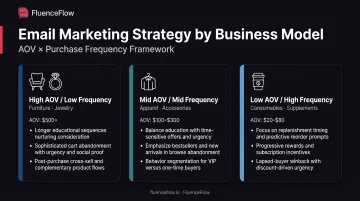
How you nurture should match how customers buy:
- High AOV/low frequency brands (furniture, jewelry) need longer education sequences that build trust over weeks
- Mid AOV/mid frequency brands (apparel, accessories) balance education with timely promotional offers
- Low AOV/high frequency brands (consumables, CPG) focus on replenishment timing and subscription conversion
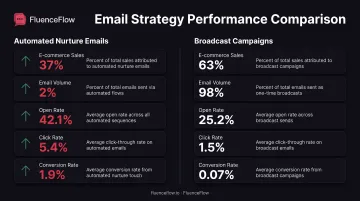
That distinction shows up in the numbers. Automated emails generated 37% of e-commerce email sales in 2024 while making up only 2% of total email volume. Triggered sequences carry far more weight per send than broadcast campaigns.
How Email Nurturing Works
Email nurturing operates through defined stages, each triggered by customer behavior and designed to move recipients closer to conversion or retention goals.
Initiation: Behavioral Triggers
Nurture sequences begin based on specific customer actions:
- Signing up for your email list
- Making a first purchase
- Abandoning a cart
- Browsing specific product categories
- Reaching anniversary dates
- Becoming inactive for defined periods
Triggers fall into four types:
- Manual: marketer-initiated sends
- Automated: behavior-based in platforms like Klaviyo or Mailchimp
- Time-based: set delays between emails
- Condition-based: customer meets specific criteria in your database
Operational dependencies at this stage:
- Proper tracking implementation between your e-commerce platform and email service provider
- Clean data integration
- Clearly defined trigger conditions aligned with business goals
Core Operation: Segmentation and Sequencing
Once triggered, customers enter multi-email sequences where each message builds on the previous one. Content is tailored to segment characteristics including purchase history, engagement level, product preferences, and lifecycle stage.
What happens during execution:
- Customers receive 3-8 emails spaced over days or weeks
- Each email has one job: educate, handle objections, prove value, or drive action
- Sequence progression is determined by engagement (opens, clicks) or time delays
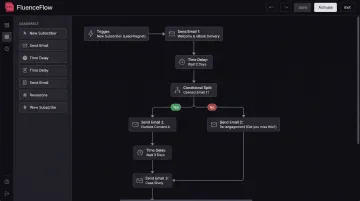
Platforms like Klaviyo support this with visual workflow builders. Marketers set trigger conditions, time delays, conditional splits, and dynamic content blocks in one place.
Agencies like FluenceFlow build these systems around unit economics instead of generic templates. High-ticket premium products get a different sequence design than consumable replenishment models.
Optimization: Continuous Refinement
Email nurturing maintains effectiveness through ongoing monitoring of:
- Open rates (subject line and sender reputation)
- Click rates (content relevance and CTA effectiveness)
- Conversion rates (desired action completion)
- Unsubscribe rates (audience fatigue signals)
- Revenue attribution at both sequence and individual email level
Marketers refine sequences by:
- A/B testing subject lines and send times
- Adjusting frequency based on engagement patterns
- Updating content from performance data
- Adding or removing emails to strengthen conversion paths
Output: Customer Actions and Revenue
Well-executed email nurturing produces:
- Converted first-time customers
- Recovered abandoned carts
- Increased repeat purchase rates
- Reactivated dormant customers
- Measurable revenue attribution (often 30-40% of total e-commerce revenue)
These results feed the rest of your marketing system. Nurture flows warm leads, support retention, and lower acquisition costs by getting more value from traffic you already paid for. The behavioral data also informs product and inventory decisions.
Types of Email Nurture Campaigns
E-commerce businesses typically run 5-10 concurrent nurture sequences targeting different customer behaviors and lifecycle stages.
Welcome Series
A welcome series typically sends 3-5 emails over 7-14 days. It introduces your brand story, sets expectations, highlights best-sellers, and often includes a first-purchase incentive to turn subscribers into buyers.
Klaviyo's 2025 benchmarks show welcome emails achieve a 51.26% average open rate, 1.97% placed-order rate, and $2.35 revenue per recipient. Send the first message immediately after signup, then space later emails at least one day apart.
Abandoned Cart Recovery
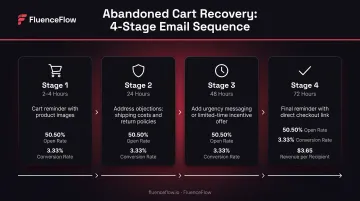
These sequences send 2-4 emails over 24-72 hours to shoppers who added items but never checked out.
Typical sequence includes:
- Cart reminder with product images (2-4 hours after abandonment)
- Addressing common objections like shipping costs or return policy (24 hours)
- Adding urgency or incentive (48 hours)
- Final reminder with easy checkout link
Across 143,000 abandoned cart flows analyzed in 2023, averages were 50.50% open rate, 6.25% click rate, 3.33% placed-order rate, and $3.65 revenue per recipient.
Post-Purchase Engagement
After someone buys, the flow usually covers:
- Order confirmation (transactional)
- Shipping updates
- Delivery confirmation
- Product education/usage tips
- Review request
- Cross-sell recommendations for complementary products
This sequence raises customer lifetime value and drives repeat purchases. Brands like Callie's Hot Little Biscuit use post-purchase loyalty flows to trigger escalating rewards after second and third orders, resulting in 157.8% year-over-year growth in flow revenue.
Browse Abandonment and Product Education
These sequences target customers who viewed specific products or categories but never added anything to cart. Messages typically include:
- Educational content about product benefits
- Customer reviews and social proof
- Use-case examples
- Gentle purchase encouragement
Re-engagement for Inactive Customers
These campaigns target customers who haven't opened emails or purchased in 60-90+ days. Common tactics include:
- Subject lines designed to recapture attention
- Special "we miss you" offers
- Highlights of new products or improvements
The sequence also cleans your list by removing persistently unengaged subscribers, which improves deliverability for active customers.
Where Email Nurturing Is Used in E-commerce
In e-commerce, nurturing sequences map to each stage of the customer journey:
Awareness: Welcome series introduce new subscribers to your brand and set up future purchases.
Consideration: Product education and social proof help browsers decide whether to buy.
Conversion: Abandoned cart and browse abandonment flows recover shoppers already close to purchasing.
Retention: Post-purchase flows, replenishment reminders, loyalty rewards, and win-back campaigns grow lifetime value.
How Effectiveness Varies by Business Model
High AOV / low frequency (furniture, jewelry, items over $400) means decision cycles that last weeks, 8–15 research touchpoints, and cart abandonment near 80%. Priorities include:
- Longer educational sequences that build trust
- More sophisticated cart-abandonment messaging
- Post-purchase cross-sell systems
Mid AOV / mid frequency (apparel, accessories) usually means large catalogs and tight first-order margins. Sequences should balance education with timely offers, emphasize bestsellers, segment on behavior, and turn first-time buyers into repeat customers.
Low AOV / high frequency (consumables, CPG) puts weight on the second and third order. Focus on strong initial-conversion tactics, replenishment reminders timed to product usage, progressive rewards, and lapsed-buyer winbacks; the first order matters mainly because it starts the repeat cycle.
What Makes Nurturing Work Operationally
Those sequences only perform when your stack can act on behavior in real time:
- Integrated with e-commerce platforms (Shopify, WooCommerce, BigCommerce) for real-time behavioral data
- Connected to a customer data platform for a single customer profile
- Coordinated with SMS and other channels for omnichannel nurturing
Supporting Specific E-commerce Objectives
Beyond direct sales, nurturing supports:
- Reducing customer acquisition costs by converting more existing traffic
- Increasing average order value through strategic cross-sells and upsells
- Building brand loyalty that generates word-of-mouth referrals
- Gathering customer feedback and reviews for future marketing
Best Practices for Effective Email Nurturing
Segment Beyond Demographics
Segmented campaigns drive 760% higher revenue compared to one-size-fits-all emails, even if that oft-cited figure is thinly documented. Segment by purchase history, engagement level, product preferences, and lifecycle stage, not only age or location.
Personalize Beyond First Names
Personalized subject lines can increase open rates by 26%. Effective personalization goes well beyond the inbox preview:
- Dynamic product recommendations based on browsing history
- Email timing based on individual engagement patterns
- Content matched to each customer’s journey stage
- Offers and messaging informed by purchase history
Optimize Email Frequency and Timing
Welcome emails sent immediately on signup earn significantly higher engagement than delayed messages. Klaviyo recommends sending right away, then waiting at least one day between follow-ups.
For abandoned cart sequences, a common three-message cadence is:
- 2-4 hours after abandonment
- 24 hours later
- 48 hours later
Test those intervals against your own audience. General nurture emails usually land 2-7 days apart so you stay present without overwhelming subscribers.
Design for Mobile
Most emails are opened on mobile, so layout has to hold up on a small screen:
- Use templates that adapt to screen sizes
- Keep subject lines under 40 characters
- Make CTAs prominent and thumb-friendly
- Optimize images to load quickly on mobile connections
Mobile opens also change how you read the data. Apple Mail Privacy Protection now obscures about 55% of opens, which inflates open-rate metrics; treat clicks and conversions as the more reliable engagement signals.
Measuring Email Nurturing Success
Key Performance Metrics
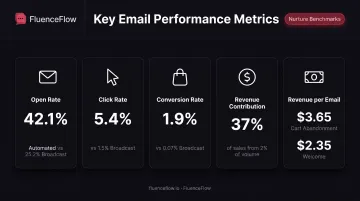
Open rates indicate subject line effectiveness and sender reputation. Automated emails achieved 42.1% opens in 2023, versus 25.2% for broadcast campaigns.
Click-through rates measure content relevance and CTA effectiveness. Automations averaged 5.4% clicks compared to just 1.5% for campaigns.
Conversion rates track the percentage of recipients who complete desired actions. Triggered emails converted at 1.9% versus 0.07% for broadcasts, a 2,361% difference.
Revenue per email directly attributes sales to specific nurture sequences, with abandoned cart flows averaging $3.65 per recipient and welcome emails generating $2.35.
Benchmark Guidance
E-commerce benchmarks vary widely by message type. Skip universal ranges like 15-25% opens or 2-5% clicks. Compare each email against others in the same category instead.
Nurture sequences typically beat broadcast campaigns by 2-3x on opens and clicks, and by a much wider margin on conversions.
Track Holistically
Judge the full sequence, not each email in isolation. Track:
- Full-sequence conversion rates across the nurture path
- Time-to-conversion by sequence type
- Customer lifetime value by acquisition source
- Attribution across touchpoints (first-click, last-click, linear, or time-decay)
Automated messages generated 37% of email-driven sales in 2024 despite representing only 2% of email volume. Triggered nurture sequences carry far more revenue weight than their send volume suggests.
Frequently Asked Questions
What is an email nurture campaign?
An email nurture campaign is a series of automated emails triggered by specific customer behaviors like signing up, making a purchase, or abandoning a cart. Each message guides recipients through a journey with relevant content designed to build trust and drive conversions over time.
How do you nurture leads in sales?
In e-commerce, lead nurturing pairs behavior-triggered email sequences with timely follow-up. Start with educational content that addresses shopper pain points, add social proof, then time next touches off engagement signals like opens, site visits, and downloads.
What is a nurture email?
A nurture email is a single message within a larger automated sequence, designed to move the recipient one step closer to a specific goal: purchase, repeat order, or re-engagement. It provides value through educational content, social proof, personalized recommendations, or strategic offers rather than simply promoting products.
What are some lead nurturing strategies?
Effective strategies include:
- Segmenting by behavior and lifecycle stage
- Building multi-touch sequences that mix education and conversion
- Personalizing with dynamic fields and product recommendations
- Timing sends from real engagement patterns
- Testing subject lines, content, and offers on an ongoing basis
What are some examples of lead nurturing emails?
Common examples include:
- Welcome series with brand intro and a first-purchase offer
- Abandoned cart reminders with product images and checkout links
- Post-purchase tips with relevant cross-sells
- Browse abandonment emails for products shoppers viewed
- Win-back campaigns for inactive customers
What are some examples of lead nurturing activities?
Core activities include:
- Building segments from customer behavior
- Setting up automated workflows on key actions
- Creating educational content for each journey stage
- A/B testing email elements and reviewing engagement metrics
- Coordinating email with SMS for omnichannel nurturing