Introduction: SMS Marketing for Small Business in 2026
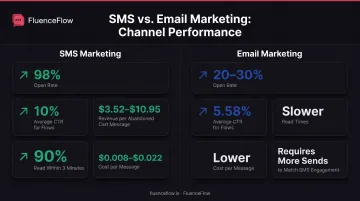
While email marketing remains essential, SMS messages deliver 98% open rates, with 90% read within three minutes. That engagement crushes email, where even well-optimized campaigns rarely break 30% opens.
Yet most small businesses hesitate: the setup feels technical, compliance sounds intimidating, and costs seem unpredictable.
SMS works when you focus on the right use cases, obtain proper consent, and coordinate messaging with email rather than treating text as a standalone broadcast channel. This guide covers strategy, compliance, platform selection, and when specialized support outperforms DIY tools for brands doing $50K+ monthly revenue.
Key Takeaways
- SMS delivers 98% open rates with most messages read within minutes, far above typical email engagement
- Explicit subscriber consent and TCPA compliance are mandatory before sending any promotional texts
- Retention results improve when SMS runs with email, not as a standalone channel
- Start with cart abandonment and post-purchase flows: the highest-converting SMS use cases
- Cost-per-message is low, but profitability depends on your product margins and repeat-purchase behavior
What is SMS Marketing for Small Business?
SMS marketing is permission-based text messaging to customers for promotional, transactional, or service purposes. Subscribers opt in explicitly, you send relevant content to their mobile phones, and they can opt out anytime.
Two message formats:
- SMS (Short Message Service): Text-only messages up to 160 characters per segment (70 with emojis or other Unicode). Longer texts split into 153-character segments.
- MMS (Multimedia Messaging Service): Supports images, video, audio, and contacts. Carriers typically handle files up to 300 KB, though reliability varies.
What you need to get started:
- Opt-in subscriber list built through website popups, checkout forms, QR codes, or keyword campaigns
- Dedicated business number: a 10DLC or toll-free number registered for A2P (application-to-person) messaging
- Regulatory compliance with TCPA (US), CASL (Canada), and the ePrivacy Directive (EU)
Why SMS Marketing Works in 2026: Statistics & Benefits
SMS bypasses email spam folders, social media algorithms, and ad blockers. When you send a text, it lands in the recipient's primary inbox. You own the channel: no platform can throttle your reach or change the rules mid-campaign.
That access matters because 91% of US adults own smartphones, and most check them throughout the day. Texts hit lock screens, trigger notifications, and earn attention email rarely gets.
Higher Engagement, Stronger ROI
According to Klaviyo's 2026 benchmarks, SMS flows approach 10% click-through rates, nearly double SMS campaign performance. Email flows average 5.58% CTR versus 1.69% for campaigns. Behavior-triggered messages beat broadcast blasts, and SMS widens that gap.
Message costs stay low at roughly $0.008–$0.022 per SMS and $0.022–$0.045 per MMS, plus carrier fees. Postscript's 2026 data shows abandoned cart SMS generating $3.52–$10.95 in revenue per message at the 25th–75th percentiles.
Where SMS Wins on Timing
SMS fits messages that need fast action:
- Flash sales ending in hours
- Appointment reminders 24-48 hours out
- Shipping notifications with tracking links
- Abandoned cart nudges within 1-4 hours
Getting Started: Building Your SMS Marketing Strategy for Small Business
Lock in use cases, tools, list growth, cadence, and metrics before you send a single campaign. Work through the steps below to build a practical SMS foundation.
Determine Your Primary Use Cases
Match SMS to your business model:
E-commerce stores:
- Abandoned cart recovery with direct cart links
- Order confirmations and shipping updates
- VIP early access to new products or sales
- Back-in-stock alerts for high-demand items
Service businesses:
- Appointment reminders and confirmations
- Booking confirmations with calendar integration
- Service completion updates
- Review requests post-service
Set Up Your Infrastructure
Choose your platform approach:
- DIY SMS platforms (Postscript, Klaviyo SMS, Attentive): Simple campaigns and lists under 5,000 if you prefer self-service
- Integrated marketing systems (Klaviyo, Shopify + SMS app): Email+SMS flows, advanced segmentation, and behavioral triggers
- Done-for-you specialists (agencies like FluenceFlow): Best when SMS should drive 15%+ of revenue and strategy must follow unit economics, not generic templates
Build Your Subscriber List Ethically
Proven opt-in tactics:
- Website popups trading a first-purchase discount for a phone number and explicit SMS consent
- Checkout opt-ins with clear checkboxes on message frequency and content
- QR codes in-store or on packaging that start text-to-join flows
- Keyword campaigns ("Text DEALS to 12345 for 15% off")
- Post-purchase requests after a customer's first order
Postscript's 2026 data shows popup SMS opt-in rates of 2.1%-8.6% across the 25th-90th percentiles. State what subscribers get, how often you'll text, and how to opt out.
Plan Frequency and Cadence
Start conservatively to avoid opt-outs while learning what resonates:
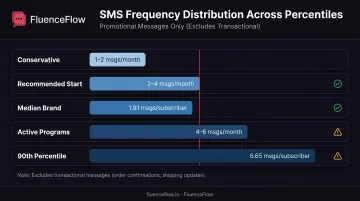
- 2-4 messages per month for most promotional programs
- Transactional messages (order updates, appointment reminders) don't count toward promotional limits
- Frequency by segment using purchase history, browsing behavior, or engagement level
Postscript's distribution shows 1.91 messages per subscriber at the median and 6.65 at the 90th percentile. Test frequency against unsubscribe rates and revenue per message to find your optimal range.
Create a Coordinated Content Calendar
Use SMS for urgent, high-value messages and email for longer content:
SMS is best for:
- Same-day or 24-hour flash sales
- Cart abandonment within 1-4 hours
- Shipping updates and delivery notifications
- Appointment reminders
Email is best for:
- Detailed product stories and education
- Long-form content with multiple images
- Weekly newsletters
- Complex comparisons or buying guides
Coordinate both channels: If you email about a sale Monday morning, send an SMS reminder Tuesday afternoon highlighting urgency. Avoid sending identical messages simultaneously across both channels.
Establish Success Metrics
Track these KPIs:
- Opt-in rate: Percentage of website visitors or customers who subscribe
- Delivery rate: Messages successfully delivered versus sent
- Click-through rate: Percentage of recipients who click links
- Conversion rate: Percentage who complete purchases
- Revenue per message: Total attributed revenue divided by messages sent
- Unsubscribe rate: Opt-outs as a percentage of active subscribers
SMS Compliance & Legal Requirements: What Small Businesses Must Know
Compliance is the cost of entry for SMS, not an afterthought. Get consent, disclosures, and registration wrong, and you risk fines, filtered messages, and lost trust.
TCPA and FCC Regulations
The Telephone Consumer Protection Act governs commercial texting in the US. Key requirements:
- Obtain express written consent before sending promotional texts. Consent must be clear, conspicuous, and separate from other agreements (not buried in terms of service).
- Provide clear opt-out instructions in every marketing message, typically "Reply STOP to unsubscribe."
- Honor unsubscribe requests immediately and send no further promotional messages after opt-out.
- Include business identification so recipients know who is texting them.
- Respect quiet hours by limiting marketing texts to 8 a.m.–9 p.m. in the recipient's local time.
Most FCC consent-order provisions became enforceable April 11, 2025, with additional requirements phasing in through April 2026.
A2P 10DLC Registration
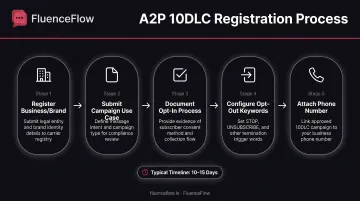
Application-to-person (A2P) messaging requires sender registration to ensure delivery:
Registration steps:
- Register your business/brand with The Campaign Registry
- Submit your campaign use case with representative messages
- Describe your opt-in process and consent mechanisms
- Document your opt-out keywords and automated responses
- Attach your 10-digit phone number to the approved campaign
Current campaign reviews may take 10-15 days, though brand verification sometimes completes faster. Your messaging provider (Klaviyo, Postscript, Twilio) typically handles the technical submission, but you must provide accurate business information.
Required Message Disclosures
Every opt-in form and marketing message must include:
- Business name and identification
- Purpose of messages (promotional offers, updates, etc.)
- Frequency estimate ("Up to 4 msgs/month")
- Standard rate disclaimer ("Message and data rates may apply")
- Terms and privacy policy links at point of opt-in
- Clear opt-out instructions ("Reply STOP to unsubscribe")
State-Specific and International Rules
Federal rules are the baseline. Some states and countries add their own requirements if you text residents there.
Florida: Automated sales texts require prior express written consent. Stop texting immediately when recipients request it.
Canada (CASL): Commercial SMS requires consent, sender identification, and a functioning unsubscribe mechanism. Express consent remains valid until revoked but must be honored within 10 business days.
EU (ePrivacy Directive): Prior consent is required for electronic direct marketing, with a limited existing-customer exception for similar products. Sender identity cannot be concealed.
UK (PECR): Unsolicited marketing texts generally require consent or the defined existing-customer soft opt-in.
SMS Marketing Use Cases & Examples for Small Business
SMS performs across the full customer lifecycle, from recovery to loyalty. These are the highest-ROI use cases for small ecommerce brands, with benchmarks and sample copy you can adapt.
Abandoned Cart Recovery
Performance: Per Postscript's 2026 data, abandoned cart SMS benchmarks (25th–75th percentile) include:
- Click-through rate: 9.53%–17.28%
- Conversion rate: 3.97%–7.84%
- Revenue per message: $3.52–$10.95
Implementation:
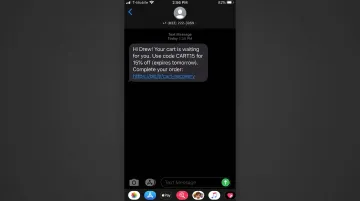
- Trigger 1-4 hours after cart abandonment
- Include customer's first name when possible
- Provide a direct cart link (no login required)
- Consider adding a limited-time discount code to create urgency
Example message: "Hey Sarah! Your cart misses you 👋 Complete your order in the next 2 hours and save 15% with code BACK15: [link]"
Post-Purchase Flows
Use cases:
Welcome new customers with brand story and next-purchase incentives
Confirm orders with tracking information
Request reviews 7-10 days after delivery
Cross-sell complementary products based on purchase history
Send replenishment reminders timed to your product’s typical repurchase window
Keep messages concise. According to Attentive, messages over 240 characters converted 8.5% lower than those in the 160–240 character range.
VIP and Loyalty Programs
Reward your best customers with SMS-exclusive benefits:
- Early access to new product launches (24-48 hours before email list)
- VIP-only discount codes
- Birthday messages with special offers
- Points-balance updates for loyalty programs
Exclusive texts make top customers feel recognized and pull repeat orders from your highest-LTV segment.
Booking Reminders and Confirmations
Brands that book consultations, fittings, or demos can cut no-shows significantly with automated SMS reminders:
- Send 24-48 hours before the scheduled time
- Include time, location or video link, and a cancellation/reschedule link
- Add calendar integration when possible
- Follow up after the visit with a review or next-step offer
Flash Sales and Limited-Time Offers
Create urgency with same-day or short-window promotions:
- Announce 4-6 hour flash sales to drive immediate traffic
- Send restocked-item alerts to waitlist subscribers
- Share exclusive "SMS-only" codes that expire within 24 hours
Limit flash-sale frequency. Overuse trains subscribers to wait for discounts instead of buying at full price.
Choosing the Right SMS Marketing Approach for Your Business
Match your SMS setup to list size, revenue goals, and how much time you can spend running it. Most small businesses start simple, then move to integrated tools or specialists as volume grows.
DIY Platforms vs. Integrated Solutions
Start with DIY platforms when:
- Your subscriber list is under 5,000
- You're testing SMS for the first time
- Your needs are simple (occasional campaigns, basic flows)
- You're comfortable with self-service setup and troubleshooting
Consider integrated systems when:
- You want coordinated email+SMS automation
- Advanced segmentation and behavioral triggers are priorities
- Your list exceeds 5,000 subscribers
- You need detailed analytics and attribution
When to Bring in Specialists
When SMS becomes a real revenue channel, DIY tools often hit a ceiling on strategy and execution time.
Evaluate specialized SMS agencies when:
- SMS will drive more than 15% of total revenue
- Your business does $50K+ monthly revenue
- You need strategy based on unit economics, not generic templates
- Time spent on retention marketing is taking focus away from product and operations
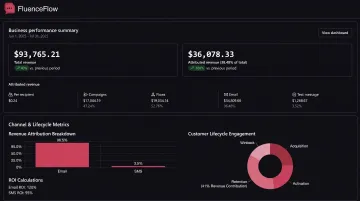
Agencies like FluenceFlow build custom email+SMS systems around your margins, purchase cycles, and customer behavior rather than generic templates. Clients average 41% of total store revenue from combined email and SMS channels, with an average 10.6x ROI in the first 90 days.
Platform Integration Requirements
Either path only works if your SMS platform connects cleanly with the rest of your stack:
E-commerce platform:
- Shopify, WooCommerce, or BigCommerce integration
- Real-time order sync and customer data flow
- Checkout opt-in functionality
CRM and marketing tools:
- Email marketing platform (preferably unified like Klaviyo)
- Customer data platform for segmentation
- Analytics tools for attribution tracking
Compliance infrastructure:
- Automated suppression list management
- Consent timestamp recording
- Opt-out keyword handling (STOP, UNSUBSCRIBE, etc.)
Frequently Asked Questions
What does SMS stand for in marketing?
SMS stands for "Short Message Service" and refers to text message campaigns sent to customers who have explicitly opted in to receive them. In marketing contexts, SMS includes both promotional messages (sales, offers) and transactional messages (order updates, appointment reminders).
How much does text message marketing cost?
Typical cost structure includes platform fees ($20-100/month for DIY tools) plus per-message costs. Twilio charges $0.0083/SMS and $0.022/MMS, plus carrier fees of $0.0035-$0.010 per message. A business sending 5,000 texts monthly would pay roughly $65-90 total including platform and message costs.
Can you give me an example of SMS marketing?
A clothing brand texts subscribers: "Hey Sarah! Your cart misses you 👋 Complete your order in the next 2 hours and save 15% with code BACK15: [direct cart link]." This message includes personalization, creates urgency with a time limit, offers an incentive, and provides one-click access to complete the purchase.
How do I get customers to opt in to SMS marketing?
Use checkout checkboxes with clear consent language, popups with a first-purchase discount, text-to-join keywords in-store or on packaging, QR codes to opt-in forms, and post-purchase requests. Always say what subscribers get, how often, and how to opt out.
What's the best time to send SMS marketing messages?
Send between 10am-8pm in the recipient's timezone, avoiding early mornings and late nights. Klaviyo applies quiet-hour restrictions using phone-number area codes, and some states enforce stricter windows. Tuesday-Thursday typically see best engagement for promotional messages, though optimal timing varies by industry and audience.
How is SMS marketing different from email marketing?
SMS works best for short, urgent messages with immediate CTAs such as abandoned carts, flash sales, shipping updates, and appointment reminders. Email suits longer content, visuals, and storytelling like newsletters, product education, and comparison guides. Coordinate both: SMS for time-sensitive nudges, email for depth.