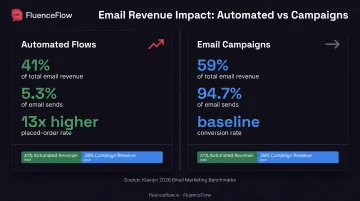
Klaviyo's 2026 benchmarks reveal the cost of this gap: automated flows generate nearly 41% of email revenue from just 5.3% of sends, yet most brands run on bare-bones automation or generic templates that never capitalize on this leverage. For DTC brands, where retention marketing drives long-term profitability, hiring the right email expert can transform email from an afterthought into a primary revenue channel, one that delivers repeatable, scalable growth.
Key Takeaways
- Prioritize automation depth over campaign volume: flows drive 41% of email revenue from 5% of sends
- Email marketing delivers a 45:1 ROI for e-commerce and retail brands
- Match the hire to the job: freelancers for projects, agencies for buildouts, full-time for strategy
- Require Klaviyo (or core platform) skill, flow architecture, and e-commerce metrics fluency
- Vet candidates on flow strategy, segmentation logic, and diagnostic problem-solving
What Does an Email Marketing Expert Do?
Email marketing experts design, execute, and optimize campaigns and automation flows to drive customer acquisition, retention, and revenue. For e-commerce brands, they turn website traffic into repeat buyers with personalized messages across the full customer lifecycle.
Core responsibilities include:
- Plan promotional calendars, product launches, and engagement sequences
- Segment audiences by behavior, purchase history, engagement, and lifecycle stage
- Write subject lines, body copy, and CTAs that convert
- Build automated flows in platforms like Klaviyo
- Run A/B tests on subject lines, offers, timing, and creative
- Track revenue attribution and campaign performance, including ESP and Shopify integrations
Strategic vs. Execution Skills
The best candidates balance strategic thinking with technical execution.
Strategic skills involve understanding the entire customer journey:
- Campaign planning tied to business goals
- Customer journey mapping across touchpoints
- Testing roadmaps that prioritize high-impact experiments
- Lifecycle strategy that maximizes customer lifetime value
Execution skills cover the technical build:
- ESP platform proficiency (Klaviyo, Braze, HubSpot, Mailchimp)
- HTML/CSS for custom email templates
- Integration management with Shopify, CRMs, and CDPs
- Data troubleshooting when events stop firing or segments break
A specialist focused on a retention marketing role should own both; they need to diagnose why a flow underperforms and how to rebuild it.
When to Hire an Email Marketing Expert
Three signals usually mean it's time to bring in dedicated expertise:
- Essential flows are missing or underperforming. Abandoned-cart, welcome, or post-purchase flows don't exist or generate minimal revenue.
- Your team keeps passing on revenue opportunities. Campaigns get skipped, flow updates slip, and segmentation stays backlog because no one has the bandwidth.
- Whoever owns email is burned out. They're juggling it with three other channels and can't give it real attention.
Quantifying the Opportunity
Estimate the revenue stronger email performance could add, then compare it to the cost of hiring.
Simple calculation:
- Current monthly email revenue: $10,000
- Mature-program benchmark: 30-40% of total store revenue
- Expected email revenue on a $100,000/month store: $30,000-$40,000
- Monthly gap: $20,000-$30,000
- Annual opportunity: $240,000-$360,000
If an expert closes even half that gap, the ROI usually justifies the hire.
Klaviyo data shows flows drive 41% of email revenue despite making up only 5.3% of sends, with a 13x higher placed-order rate than campaigns. If your flows are missing or generic, most of that gap sits in automated revenue you never turned on.
When NOT to Hire
If your store does under $50K/month, training your current team or using an agency for initial setup is often more cost-effective than a dedicated hire. At that scale, the revenue ceiling limits ROI, so build foundational flows before adding ongoing payroll.
Freelance vs. Full-Time vs. Agency: Which Is Right for You?
The right hiring model depends on your program maturity, budget, and internal resources.
Freelance Email Marketers
Pros:
- Fast to hire (days, not months)
- Flexible for short-term projects or seasonal campaigns
- Cost-effective for specific tactical work (flow buildouts, audits, strategy docs)
- Bring fresh perspectives from working with multiple brands
Cons:
- Limited availability and continuity: they juggle multiple clients
- May lack deep brand knowledge or institutional memory
- Can churn quickly after project completion
- Typically better for execution than ongoing strategic ownership
Pricing: Upwork reports general email marketing freelancers charge $15-$40/hour, with project-based flow buildouts ranging from $400-$1,600 for a 3-5 email sequence and $1,500-$5,000 for full strategy and initial campaign builds. Rates vary by experience, location, and scope.
Agency Partners
Pros:
- Immediate team bandwidth with multiple specialists (strategists, designers, developers)
- Bring benchmarks and best practices from working across diverse client portfolios
- Can handle complex projects requiring multiple skill sets simultaneously
- Ideal for brands that need comprehensive email program buildouts without internal headcount
Specialized agency example: Retention-focused partners like FluenceFlow work only on email and SMS for DTC e-commerce. As a Klaviyo- and Shopify-certified partner, FluenceFlow builds flow systems around each brand's unit economics rather than generic templates.
Engagements are month-to-month with custom performance guarantees, and clients keep 100% ownership of flows, segments, and creative in their Klaviyo account. Across 30+ DTC brands, FluenceFlow has generated $7.5M+ in attributed revenue with an average 10.6x ROI in the first 90 days.
Cons:
- Higher monthly investment than an individual freelancer
- May have slower response times when balancing multiple clients
- Less suitable for brands in highly regulated industries requiring specialized compliance knowledge
Full-Time Employee
Pros:
- Deep brand knowledge and institutional memory
- Readily available for urgent needs and cross-functional collaboration
- Can own the entire customer lifecycle strategy, not just email
- Better for companies with consistent high-volume email needs and complex tech stacks
Cons:
- Lengthy hiring process. SHRM reports a 39-day median time-to-fill for nonexecutive roles
- Higher total compensation including benefits. BLS data shows total compensation averages 1.43x base salary in the US private sector
- Requires management overhead and onboarding time
- May have narrower experience than freelancers or agencies who work across multiple brands
Salary: PayScale reports US Email Marketing Manager salaries average $81,013, with total pay ranging from $51,000-$116,000 depending on experience and location.
Decision Framework
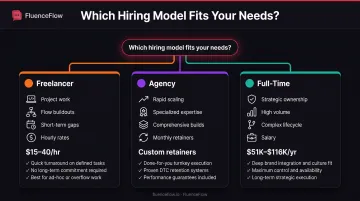
Choose a freelancer for:
- Project-based work (building out 5-10 flows, auditing your current setup)
- Testing new strategies or channels before committing long-term
- Filling short-term gaps while you hire full-time
Choose an agency for:
- Rapid scaling when you need a complete program built in 30-60 days
- Specialized expertise you don't have in-house (advanced segmentation, SMS integration)
- Comprehensive program builds without adding headcount
Choose full-time for:
- Ongoing strategic ownership and deep integration with internal teams
- High email volume requiring daily management
- Complex lifecycle strategies spanning multiple channels and touchpoints
How to Write an Effective Email Marketing Job Description
A strong job description attracts qualified candidates and filters out mismatches early. The key is prioritizing must-have skills based on your existing team's strengths and the specific gaps you need to fill.
Use a job title that reflects the role's scope and matches how candidates search:
- Lifecycle Marketing Manager - Strategy-focused roles that own the entire customer journey
- Email Marketing Manager or Email Marketing Specialist - Execution-focused roles centered on campaign and flow management
- Retention Marketing Manager - E-commerce/DTC contexts emphasizing repeat purchase and customer lifetime value
Job Description Components
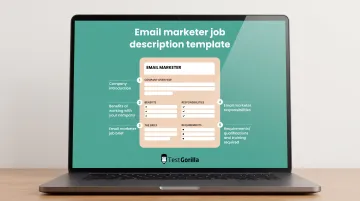
Structure your posting around four essential sections:
- Company overview - Your brand story, verticals, growth stage, and what makes you unique
- Role overview - Specific goals, KPIs, and day-to-day responsibilities
- Required skills and experience - Must-have technical and strategic capabilities
- Nice-to-have qualifications - Bonus skills that add value but aren't deal-breakers
Must-Have Skills for E-commerce Email Marketing
Platform proficiency:
- Klaviyo for DTC brands (or equivalent ESPs like Braze, HubSpot, Mailchimp)
- Shopify data integration and event tracking
- Basic HTML/CSS for template customization
E-commerce fluency:
- Understanding of CLV (customer lifetime value), purchase frequency, and AOV (average order value)
- Experience with segmentation and personalization based on behavior and purchase history
- Familiarity with e-commerce metrics like placed-order rate, revenue per recipient, and flow performance
Analytical skills:
- Ability to track campaign performance, diagnose issues, and optimize based on data
- Experience with A/B testing and systematic experimentation
- Reporting on revenue attribution and ROI
Writing Tips
Avoid rigid years-of-experience requirements. Skills matter more than tenure. A candidate with 2 years of deep Klaviyo experience may outperform someone with 5 years on generic platforms.
Use common keywords for searchability:
- Email marketing, marketing automation, lifecycle marketing, retention marketing
- Klaviyo, Shopify, e-commerce, DTC, flows, segmentation
- Customer lifecycle, CRM, ESP
Include actual goals:
- "Increase email revenue by 25% in the first six months"
- "Build out 10 automated flows covering welcome, cart abandonment, post-purchase, and win-back"
- "Improve flow click rates by 15% through systematic A/B testing"
Provide context about your tech stack, team structure, and growth opportunities. Candidates want to know what tools they'll use, who they'll work with, and how the role can evolve.
Where to Find and How to Evaluate Email Marketing Talent
Sourcing Candidates
Leverage your professional network first. Ask for referrals from other marketing leaders, especially those in e-commerce or DTC brands. Personal recommendations often yield higher-quality candidates than cold sourcing.
Use specialized platforms:
- Upwork and Contra for freelancers with email marketing portfolios
- LinkedIn and Built In for full-time roles
- Klaviyo's partner directory for certified agencies with proven e-commerce experience
Search for candidates with relevant certifications:
- Klaviyo Practitioner Certificate (5-hour official course covering core platform features)
- HubSpot Email Marketing Certification (strategy, metrics, and A/B testing)
- Google Analytics literacy for tying email performance to on-site behavior
Certifications signal platform expertise, but practical experience matters more; prioritize candidates who can demonstrate results.
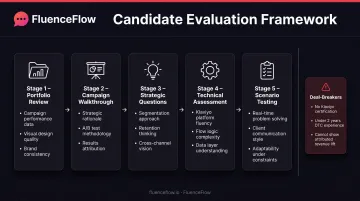
Once you have a shortlist, shift from credentials to proof. Portfolio work shows how they think, not just which tools they know.
Evaluating Candidates: Portfolio Review
Request portfolio examples and look for:
- Promotional, lifecycle, win-back, and seasonal campaigns, not one template reused everywhere
- Before/after metrics tied to revenue, click rates, or conversion lift
- Strategic choices: segmentation logic, test hypotheses, and what they optimized next
Have candidates walk through a specific campaign:
- What was the goal?
- What was their hypothesis or strategy?
- How did they segment and target the audience?
- What did they test, and why?
- What were the results, and what did they learn?
A strong walkthrough sets up the interview. Use questions that test judgment under real constraints, not just tool familiarity.
Interview Questions
Strategic questions:
- "What email campaigns or flows should be priorities for a business like ours?"
- "How would you approach building an email program from scratch?"
- "How do you balance email frequency with subscriber fatigue?"
Technical questions:
- "Walk me through how you would set up a post-purchase flow."
- "What metrics do you track to evaluate email performance, and how do you use them?"
- "Describe a time you diagnosed and fixed a flow that suddenly stopped performing."
Scenario-based questions:
- "A flow's performance has dropped 30% month-over-month. How would you diagnose and fix it?"
- "Our welcome flow has a 20% click rate but only a 2% conversion rate. What would you test first?"
For agencies specifically:
- "Can you share case studies from similar brands in our vertical or business model?"
- "What does your onboarding process look like, and how quickly can we see results?"
- "How do you handle underperformance relative to agreed goals?"
Red Flags to Watch For
Be cautious of candidates who:
- Focus only on design or aesthetics without mentioning metrics or revenue impact
- Can't articulate a clear testing philosophy or framework
- Lack platform-specific expertise relevant to your business (e.g., no Klaviyo experience for a Shopify brand)
- Make unrealistic promises about immediate results without understanding your current setup
Frequently Asked Questions
What does an email marketing specialist do?
Email marketing specialists develop strategy and customer journey mapping, execute campaigns and automation flows using platforms like Klaviyo, and analyze performance data to optimize results. They focus on driving acquisition, retention, and revenue.
How much do freelance email marketers charge?
Upwork reports freelance email marketers charge $15-$40/hour depending on experience and location. Project-based work ranges from $400-$1,600 for a 3-5 email sequence and $1,500-$5,000 for comprehensive strategy and initial builds.
Is email marketing still worth it in 2026?
Yes. Email remains one of the highest-ROI marketing channels. Litmus reports a 45:1 ROI for retail and e-commerce brands, with 35% of marketers seeing $10-$36 returned per dollar spent. Klaviyo data shows flows alone generate 41% of email revenue, making it essential for DTC growth.
What's the difference between an email marketing specialist and a lifecycle marketing manager?
Email marketing specialists focus on execution and campaign management within the email channel. Lifecycle marketing managers take a strategic approach to the entire customer journey across multiple channels, including email, SMS, push, and loyalty programs. Titles vary by company.
What qualifications should I look for in an e-commerce email marketer?
Prioritize platform expertise (especially Klaviyo for Shopify brands), understanding of e-commerce metrics like CLV and purchase frequency, experience with segmentation and personalization, and a portfolio demonstrating measurable revenue results. Certifications are a plus but secondary to proven outcomes.
Should I hire before or after implementing an email marketing platform?
Have your platform selected and basic setup complete before hiring a specialist. This allows them to hit the ground running and focus on strategy and optimization rather than platform selection. However, experienced candidates can guide platform decisions if hired early enough in the process.