Yet most e-commerce brands face the same challenge: intense competition, rising customer acquisition costs, discount fatigue, and the struggle to stand out when every inbox and social feed floods with offers. The brands that win BFCM don't just chase a weekend sales spike; they build strategic frameworks that balance acquisition with long-term retention, turning one-time shoppers into repeat customers.
This guide delivers actionable BFCM strategies across three pillars: early planning and preparation, high-impact campaign tactics across email and SMS, and post-event retention systems that maximize customer lifetime value.
Key Takeaways
- Plan Black Friday as a week-long event, with strategy work starting in September or October
- Email and SMS deliver the highest BFCM ROI when paired with behavioral segmentation and coordinated send timing
- Mobile drives 57-70% of BFCM purchases, so mobile optimization is non-negotiable
- Balance acquisition spend with retention systems that maximize customer lifetime value
- Post-BFCM retention turns one-time sales spikes into sustainable revenue growth
Why Black Friday Marketing Matters for E-commerce Brands
Adobe recorded $41.1 billion in US online Cyber Week sales (Thanksgiving through Cyber Monday 2024), up 8.2% year-over-year. Black Friday alone generated $10.8 billion, a 10.2% increase from 2023. Globally, Salesforce estimated $74.4 billion in Black Friday online sales, up 5%, and $314.9 billion across the full Cyber Week period.
Why Sitting Out Isn't an Option
For e-commerce brands, BFCM is the year's largest customer acquisition window. An NRF survey (October 1-7, 2024) found that 45% of consumers planned to start shopping before November. Top drivers included:
- Budget spreading (59%)
- Avoiding last-minute stress (45%)
- Can't-miss promotions (42%)
With 57% planning to shop online, brands that skip BFCM hand market share to competitors during the season's highest-intent period.
BFCM also lets you acquire customers at scale and build longer relationships. Most brands still lose 70%+ of those shoppers after the first purchase; they chase the sale weekend and ignore the 90-day retention window that determines real profitability.
When to Start Planning Your Black Friday Campaign
Start Black Friday/Cyber Monday (BFCM) planning in September or October, not November. A National Retail Federation survey found 45% of consumers browse or buy before Thanksgiving, so list-growth, segmentation, and teaser campaigns need to be live well before Black Friday.
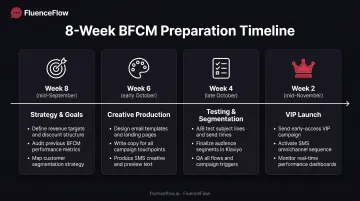
The 8-Week Pre-Launch Timeline
8 weeks out (mid-September):
- Set revenue goals, discount strategy, and key performance indicators
- Develop offer structure: tiered discounts, VIP access windows, bundle deals
- Brief creative team on email/SMS design direction and campaign themes
6 weeks out (early October):
- Produce email templates, SMS copy, and campaign assets
- Build and test automated flows (cart abandonment, browse abandonment, post-purchase)
- Launch early list-growth campaigns with lead magnets and opt-in incentives
4 weeks out (late October):
- Begin teaser campaigns: hint at upcoming offers, build anticipation
- Segment lists by customer lifetime value, purchase history, and engagement level
- Test website load capacity and checkout flow under simulated traffic
2 weeks out (mid-November):
- Launch VIP early access campaigns for high-value customers
- Finalize email/SMS send calendar and coordinate cross-channel messaging
- Staff customer service teams and prepare inventory allocation
Infrastructure Preparation
Peak weekend volume exposes weak spots fast. Lock these systems down before the first teaser send:
- Pre-build email/SMS segments, test automation triggers, and verify deliverability
- Run load tests at 3-5x normal traffic and confirm checkout holds up
- Add customer service capacity for the 48-hour Black Friday–Cyber Monday peak
- Allocate inventory so bestsellers don’t oversell mid-campaign
Essential Black Friday Marketing Strategies That Drive Results
Winning BFCM takes more than a sitewide code. The strategies below help DTC brands protect margins, build real urgency, and convert through email, SMS, and on-site experiences.
Create Tiered VIP Access Programs
Exclusivity drives loyalty and urgency. VIP access rewards your best customers while building anticipation across your entire list.
Implementation structure:
- Loyalty members: Access 48-72 hours early with exclusive product drops or deeper discounts
- Email subscribers: Access 24 hours early with a special code
- General public: Standard Black Friday access
Segmentation strategy: Tier offers by customer value, not just membership status. A customer who spent $2,000 last year deserves better treatment than someone who made one $50 purchase. Use purchase history, average order value, and engagement level to create truly differentiated experiences.
Develop a Multi-Day Event Strategy
Black Friday is no longer a single day. Extending your event from Black Friday through Cyber Monday, or across a full week, captures more revenue without training customers to wait for deeper discounts.
How to structure offers across multiple days:
- Thursday (Thanksgiving): VIP early access, exclusive bundles
- Friday: Black Friday headline offer, category flash sales
- Saturday-Sunday: Mid-event reminders, "surprise" limited-time deals
- Monday: Cyber Monday finale with final-hours urgency
Messaging strategy: Use countdown timers in emails, "last chance" subject lines, and surprise extensions ("We're keeping this deal live for 3 more hours!") to maintain momentum without diluting urgency.
Implement Smart Discount Strategies
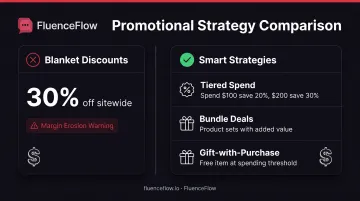
Blanket 30% off sitewide offers destroy margins and train customers to never buy at full price. Smart discount strategies protect profitability while still delivering compelling value.
Alternatives to blanket discounts:
- Tiered spend thresholds: Spend $100 save 20%, spend $200 save 30%
- Bundle deals: "Complete the look" sets priced below individual purchase totals
- Gift-with-purchase: Free product at $X threshold preserves perceived value without slashing prices
Dynamic discounting by segment:
Klaviyo's 2024 platform report found that 10-15% and 20-25% offers drove the highest conversion and spend. New customers may need 25% off to convert, while VIPs who already trust your brand often buy at 15% off, or even full price with early access.
Strategic timing of reveals: Mystery discounts, spin-to-win wheels, and progressive reveals (discount increases each day) keep engagement high throughout the event.
Optimize for Mobile-First Shopping
Adobe reported 57% of Cyber Monday sales came from mobile devices in 2024: $7.6 billion, up 13.3% year-over-year. Salesforce data showed mobile produced 70% of Cyber Week orders globally, up from 67% in 2023.
Mobile optimization requirements:
- Load times under 3 seconds: Every additional second costs conversions
- Thumb-friendly navigation: Buttons sized for easy tapping, forms minimized
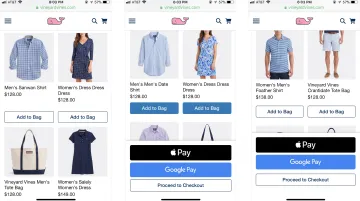
- One-click checkout: Apple Pay, Google Pay, Shop Pay integration
- Mobile-optimized email templates: Single-column layouts, large CTAs, minimal scrolling
Mobile-specific tactics:
SMS marketing becomes critical during BFCM. Omnisend's platform data (November 24-December 2, 2024) showed campaign SMS converting at 3.64% and automated SMS at 2.04%. Those sends work best for time-sensitive flash sales and cart abandonment reminders when shoppers are already on their phones.
Use Social Proof and User-Generated Content
A PowerReviews 2024 holiday survey of 11,000+ respondents found 75% relied on customer reviews when making purchase decisions; among Gen Z, that figure jumped to 86%. That trust gap widens when shoppers spend more and try unfamiliar brands.
Social proof tactics:
- Feature reviews prominently: Display ratings and review counts on product pages, in emails, and on landing pages
- Create UGC campaigns: Launch branded hashtags encouraging customers to share photos and videos
- Showcase customer content: Use real customer photos in paid social ads and email campaigns
Strategic placement: PowerReviews' 2023 analysis of 1.5 million product pages found visitors who interacted with ratings and reviews had 108.6% higher conversion than those who didn't. Place reviews where decision-making happens: product pages, checkout flow, and email product grids.
Plan Cross-Channel Integration
BFCM success requires coordinated messaging across email, SMS, social media, paid ads, and your website. Customers don't experience channels in isolation. They get your email, see your Instagram ad, receive an SMS reminder, then hit your site.
Coordination requirements:
- Unified theme: Visual identity and messaging should be consistent across every touchpoint
- Consistent offers: Don't advertise 30% off in email and 25% off on social
- Strategic sequencing: Teaser email → social reminder → SMS flash sale → retargeting ad
Measurement strategy: Track customer journeys across touchpoints rather than crediting a single channel. Use multi-touch attribution modeling to understand which combinations drive conversions, and analyze channel performance to optimize future campaigns.
Email and SMS Marketing Strategy for Black Friday Success
Build and Segment Your List Before BFCM
September and October should focus on list growth and segmentation. The larger and better-organized your list, the more revenue BFCM generates.
List growth tactics:
- Lead magnets: Early-bird signup bonuses ("Be first to know: get 10% off when we launch BFCM")
- Quiz funnels: Gift-finder quizzes that collect emails and zero-party data
- Exit-intent pop-ups: Capture abandoning visitors with exclusive preview access
- Multi-step forms: Capture both email and SMS with progressive disclosure
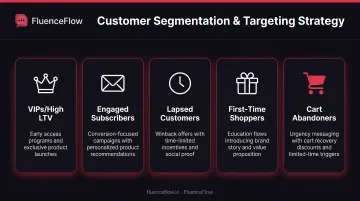
Key segmentation criteria:
- VIPs/high LTV customers: Deserve early access and exclusive treatment
- Engaged subscribers: Recently opened or clicked: prime for conversion
- Lapsed customers: Haven't purchased in 90+ days: strong winback opportunity
- First-time BFCM shoppers: Need different nurture than repeat customers
- Cart abandoners: High-intent audience ready for targeted follow-up
Data hygiene: Clean your list before BFCM by removing inactive subscribers (no opens in 6+ months), updating preferences, and suppressing recent purchasers to avoid discount-training your best customers.
Create a Strategic Email Campaign Calendar
Omnisend analyzed 1.13 billion campaign emails sent November 24–December 2, 2024. Average open rates hit 27.94%, with 8.22% click-to-conversion.
Automated emails (24.9 million sent) performed better: 45.43% open rate and 26.45% click-to-conversion. They generated 30% of November email orders from just 3% of sends.
Full email sequence:
- Teaser campaign (3-4 weeks out): Build anticipation, grow list, hint at offers
- Early access announcements (1 week out): VIP and subscriber-exclusive windows
- Launch day emails: Main Black Friday offer, bestsellers, gift guides
- Mid-event reminders: "Still available," flash sales, limited inventory alerts
- Last chance messages: Final hours, countdown timers, "don't miss out" urgency
Optimal timing and frequency: Omnisend's data showed Black Friday email-driven orders peaked 7 a.m.–noon (with 8 a.m. about one-third above the next hour). Cyber Monday peaked noon–3 p.m.
Test send times for your audience. With strong segmentation and clear value, 1–2 emails daily on peak days is usually sustainable without a spike in unsubscribes.
Subject line strategy:
- Create urgency: "4 hours left: 30% off everything"
- Personalize: "Sarah, your early access starts now"
- Optimize for mobile: Keep under 40 characters
- A/B test: Try question vs. statement, emoji vs. plain text
Design High-Converting Email Creative
Visual design directly impacts conversion. Your emails should be instantly scannable on mobile, with one clear action per message.
Essential elements:
- Strong hero image: Product-focused, benefit-driven, mobile-optimized
- Clear value proposition: What's the offer? Why should they care? What's the urgency?
- Prominent CTA buttons: High-contrast, action-oriented ("Shop Now," "Claim 25% Off"), thumb-friendly size
- Mobile-responsive design: Single-column layout, large text (14px+ body, 22px+ headlines)
Showcase offers effectively:
- Countdown timers: Create real-time urgency directly in emails
- Product grids: 2-column layout with "Shop Now" under each product
- Dynamic content: Show different products based on browsing or purchase history
Template best practices:
- Leave white space so the layout stays scannable
- Use bullets for features or benefits
- Make the CTA unmissable
- Optimize image file sizes for fast load times
Implement SMS Marketing for Real-Time Urgency
SMS delivers immediacy that email can't match. It's ideal for flash sales, cart abandonment, and last-chance alerts when customers are already on their phones.
SMS campaign strategy:
- VIP early access: "Your exclusive 48-hour window starts now: [link]"
- Flash sale alerts: "Next 2 hours only: 40% off boots [link]"
- Cart abandonment: "You left $85 in your cart. Complete checkout now and save 20%"
- Back-in-stock notifications: "It's back! [Product name] just restocked [link]"
Compliance and best practices: The FCC requires written consent for autodialed commercial texts under TCPA rules, and consumers may revoke consent at any time. Include clear opt-out instructions ("Reply STOP to unsubscribe").
Respect quiet hours (no texts before 8 a.m. or after 9 p.m. local time), and cap frequency at 3–5 messages per week maximum during BFCM.
Set Up Automated Flows for Key Moments
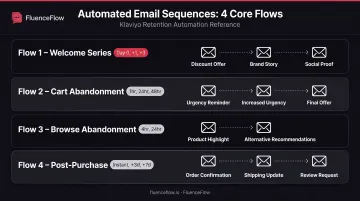
While campaigns generate 40-70% of BFCM email revenue, automated flows contribute 30-60%. They run 24/7 without extra send effort.
Essential BFCM flows:
Welcome series: New subscribers captured during BFCM should immediately receive:
- Discount code or exclusive access (immediate)
- Brand story and bestsellers (24 hours)
- Social proof and reviews (48 hours)
Cart abandonment: With BFCM urgency angle:
- "You left [product] in your cart. Offer ends in 6 hours" (1 hour delay)
- "Still interested? Here's 5% off to complete your order" (6 hours)
- "Final reminder: your cart expires tonight" (24 hours)
Browse abandonment: Catch high-intent visitors who didn't add to cart:
- "Still thinking about [product]? Here's what others love about it" (4 hours)
- "Here's why shoppers choose [product]" plus reviews, benefits, and a limited-time incentive (24 hours)
Post-purchase: BFCM buyers need immediate follow-up:
- Order confirmation with related product recommendations (immediate)
- Shipping updates with next-purchase incentive (as shipped)
- "How's your [product]?" + cross-sell (3-5 days post-delivery)
Personalization tactics: Use dynamic product recommendations based on browsing or purchase history, include customer names, and segment messaging by lifecycle stage (first-time buyer vs. repeat customer).
Partner with Retention Marketing Experts
BFCM execution is complex: multiple campaigns, tight timelines, high stakes, and technical setup across popups, flows, segments, and integrations. Many brands lack the in-house capacity or Klaviyo expertise to execute at this level.
FluenceFlow builds custom email and SMS retention systems for DTC brands around unit economics, not generic playbooks. That work covers strategic BFCM planning, campaign design and copywriting, Klaviyo flow setup, behavioral segmentation, and real-time optimization during the event.
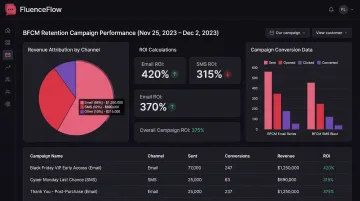
FluenceFlow clients average 41% of total store revenue from combined email and SMS. One documented case saw a 25% increase over the previous BFCM; another generated $1.5M+ in attributed revenue with 48.6% email share.
The agency's average 10.6x ROI in the first 90 days comes from performance guarantees and retention systems built for each brand's economics.
Creative Black Friday Campaign Ideas That Stand Out
Launch Exclusive Limited-Edition Products or Bundles
BFCM-only products create unique value beyond discounts. Exclusivity appeals to collectors and loyal fans who want something unavailable any other time of year.
Bundle strategy:
- Curate complementary products: "Complete the routine" skincare set, "Winter essentials" apparel bundle
- Create gift-ready packaging: Premium boxes, branded wrapping, gift messages included
- Show savings clearly: "Valued at $150, yours for $99 (save $51)"
Promotion tactics:
- Tease the exclusive drop 2–3 weeks out via email and SMS without revealing full details
- Use countdown timers: "Exclusive bundle launches in 3 days"
- Add scarcity: "Only 500 bundles available; once they're gone, they're gone"
- Give list subscribers first access 24 hours before the public launch
Run Strategic Flash Sales Throughout the Event
Flash sales create multiple traffic spikes across BFCM weekend rather than relying on a single Friday launch.
Flash sale structure:
- Hourly deals: Different product or category each hour (9 a.m.: boots 40% off, 10 a.m.: jackets 35% off)
- Category-specific days: Friday: outerwear, Saturday: accessories, Sunday: footwear, Monday: everything
- Rotating throughout Cyber Week: Creates urgency without devaluing products through extended discounts
Promotion methods:
- Send email/SMS alerts 15-30 minutes before flash sale starts
- Use Instagram/Facebook Stories with countdown stickers
- Display prominent website banners that update in real-time
- Send push notifications via mobile app if available
Logistics checklist:
- Pre-allocate inventory for each flash window
- Load test the site before traffic spikes hit
- Brief support on the full schedule so they can answer “When will X be on sale?”
Gamify the Shopping Experience
Gamification increases engagement, time on site, and conversion through interactive experiences that feel fun rather than transactional.
Gamification tactics:
- Spin-to-win: Pop-up wheel offering 5-30% off, free shipping, or mystery gift
- Mystery boxes: "Spend $100+ and add a mystery gift box for $10, valued up to $50"
- Tiered rewards: Spend $50 unlock 10% off next order, $100 unlock 15%, $150 unlock 20%
- Scratch-off coupons: Email or SMS with digital scratch-off revealing discount code
Implementation tips:
- Build games in tools you already use (Klaviyo forms, Privy, OptinMonster)
- Optimize every step for mobile
- State rules and redemption clearly in the email, SMS, or popup
- Guarantee a minimum reward (even “losers” get 5% off) so the experience never feels empty
Create Gift Guides and Content Marketing
Gift guides help decision-fatigued shoppers, showcase your product range, and give you value-first content to send, not only another discount blast.
Gift guide formats:
- "Gifts Under $50" (budget-conscious shoppers)
- "Gifts for Him / Her / Kids" (demographic targeting)
- "Best Sellers" (social proof)
- "New Arrivals" (highlight latest inventory)
- "Outdoor Enthusiast Gifts" (interest-based)
How to put guides to work:
- Publish dedicated landing pages linked from site nav and BFCM banners
- Feature one guide per email campaign with deep links to each pick
- Send SMS with a single clear CTA to the most relevant guide
- Segment sends (e.g., past buyers of kids’ products get the kids’ guide)
Run VIP Early Access and Segmented Offers
Your highest-intent buyers already sit on your list. Treat them like VIPs and BFCM feels exclusive without another sitewide slash.
Who gets in early:
- VIPs and loyalty tiers (top 10% by LTV or order count)
- Engaged subscribers (clicked or purchased in the last 60–90 days)
- High-AOV or category superfans pulled from purchase data
How to run it:
- Open the sale 12–48 hours early for VIP segments only
- Pair email + SMS so the drop isn’t buried in a crowded inbox
- Use unique codes or gated landing pages per segment to track lift
- Follow with a public launch send that references “VIP access is closed”
What to measure:
- Revenue and conversion rate: VIP window vs. public window
- List-driven share of BFCM revenue
- Unsubscribe and complaint rates on early-access sends (keep frequency tight)
Post-Black Friday Retention: Turning BFCM Shoppers Into Lifelong Customers
Most brands celebrate BFCM revenue, then watch 70%+ of acquired customers fade after the first order. Retention is where real profitability lives, and where most brands still fail.
The Immediate Post-Purchase Experience
BFCM buyers should receive:
Thank you emails (immediate):
- Order confirmation with clear next steps
- Cross-sell: "Customers who bought [product] also love [complementary product]"
- Set delivery expectations and build excitement
Shipping updates (as shipped):
- Tracking information with branded tracking page
- Use delivery confirmation as an opportunity to drive the next purchase: "Your [product] has arrived! Here's 15% off your next order"
The New Customer Welcome Series
BFCM customers need different treatment than organic signups. They've already purchased, so focus on product education and a clear path to the second order.
Email 1-2 days post-delivery:
- "How to get the most out of your [product]"
- Include setup tips, care instructions, usage ideas
- Introduce brand story and values
Email 3-5 days post-delivery:
- Request review or photo submission
- Share UGC from other customers
- Provide additional product education or styling ideas
Email 7-10 days post-delivery:
- Offer next-purchase incentive: "Enjoyed your first order? Here's 10% off when you come back"
- Highlight bestsellers or complementary products
- Invite to loyalty program or brand community
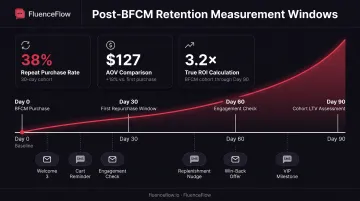
Track BFCM Customer Cohorts Separately
Don't blend BFCM customers into your general database. Tag them as a distinct cohort and measure:
- 30/60/90-day repeat purchase rate: share of cohort that buys again in each window
- Average order value on repeat purchase: full price vs. discount-driven
- True BFCM ROI: total revenue including retention, not only the first sale
Retention specialists like FluenceFlow build email and SMS systems around long-term customer value, with average client retention of 1.7 years. Strategy is organized by unit economics rather than generic playbooks.
A $45 consumable brand with 30-day replenishment cycles needs different retention flows than a $500 premium product with an 18-month purchase cycle. Brands that win BFCM over the long term run those systems before, during, and after the event.
Frequently Asked Questions
How to market for Black Friday?
Start planning 8–10 weeks out with tiered offers and VIP access windows. Build and segment email/SMS lists in September–October, then run coordinated campaigns across email, SMS, social, and paid. After the sale, shift to retention with welcome series, post-purchase flows, and cohort nurture.
What is the best Black Friday marketing campaign?
It depends on your brand, audience, and goals. Strong campaigns share early teasers, clear value props, multi-day timing, mobile-first creative, and a post-purchase plan that turns one-time buyers into repeat customers.
What are some creative marketing ideas for Black Friday?
Skip blanket discounts for gamified experiences (spin-to-win), limited-edition drops, influencer codes, and useful gift guides. Tiered spend rewards, mystery boxes, and hourly flash sales keep shoppers engaged without training them to wait for deep cuts.
How to advertise for Black Friday?
Launch retargeting early for past visitors and cart abandoners, and use dynamic product ads for items they viewed. Put spend on high-intent audiences, optimize creative for mobile, and coordinate paid with email, SMS, and social instead of running channels in isolation.
What are the different types of Black Friday ads?
Common types include social ads (Meta, TikTok, Pinterest), search and Shopping ads, display/retargeting, video, and native ads. The strongest BFCM results come from coordinating paid formats with owned channels like email and SMS.