Double opt-in is a two-step verification process that requires new subscribers to confirm their email address before they're officially added to your list. While it adds friction to signup, it also eliminates fake addresses, spam traps, and typos, protecting your deliverability and ensuring you're only sending to people who actually want your emails.
For most DTC brands, especially those focused on retention revenue and long-term customer relationships, double opt-in delivers stronger engagement, better inbox placement, and cleaner compliance documentation. But the right choice depends on your business model, growth goals, and how you balance list quality against acquisition speed.
Key Takeaways
- Double opt-in requires a verification click before join; single opt-in adds subscribers immediately
- GetResponse's 2024 study of 2.76B emails found 35.72% open rates for double opt-in vs 27.36% for single
- Most DTC brands benefit from double opt-in due to stronger engagement and reduced deliverability risk
- Single opt-in grows lists faster; double opt-in grows more engaged, higher-value lists
- SMS often requires double opt-in for specific use cases like abandoned-cart messages
What Is Double Opt-In?
Double opt-in is a two-step subscription process where subscribers must click a confirmation link in an email before being officially added to your email list. It's a verification gate that ensures the person who submitted the form actually owns the email address and wants your content.
The Step-by-Step Process
- Subscriber submits form: A visitor enters their email address in a popup, landing page, or checkout form
- Confirmation email is sent: An automated email arrives immediately with a verification link
- Subscriber clicks the link: They confirm their subscription by clicking the button in the email
- Welcome email is triggered: Once verified, they're officially added to your list and receive your welcome series
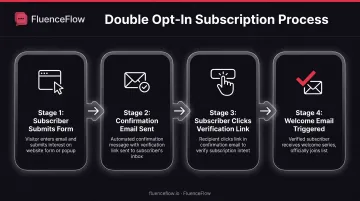
If the subscriber never clicks the verification link, they don't join your list and won't receive marketing emails.
What the Confirmation Email Contains
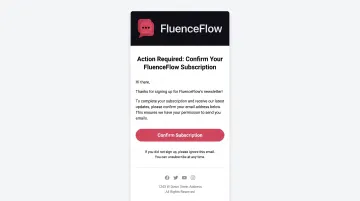
A well-designed confirmation email includes:
- Clear subject line indicating action is needed (e.g., "Please confirm your subscription")
- Prominent verification button with direct language like "Confirm Subscription" or "Yes, Subscribe Me"
- Branded design that matches your store's look and feel
- Mobile-responsive format since many subscribers will confirm on their phones
The email should set expectations about what they'll receive and how often, and remind them why they signed up.
Confirmation Link Validity
Most ESPs set expiration windows for confirmation links. Klaviyo's confirmation emails remain valid for 72 hours, after which the link expires. Other platforms may use different timeframes, so check your ESP's documentation.
What happens if subscribers don't confirm:
- They remain in a "pending" state in your ESP
- They won't receive marketing emails or be counted toward your billable contacts
- Some platforms automatically remove unconfirmed subscribers after 30-60 days
Double Opt-In for Email vs SMS
Double opt-in applies to both email and SMS marketing, but SMS requirements are often stricter due to carrier regulations and compliance frameworks.
For email:
- Double opt-in is best practice but not universally required by law
- It's the safest approach for GDPR compliance and provides clear proof of consent
For SMS:
- Mailchimp requires double opt-in for abandoned-cart SMS messages
- Klaviyo notes that carriers often require double opt-in, particularly for abandoned-cart messages
- Carriers enforce stricter consent rules to cut spam and protect consumers
Single Opt-In vs Double Opt-In: Understanding the Difference
Single opt-in adds subscribers to your list immediately when they submit a form. There's no verification step. Hit submit, and they're on your list.
Double opt-in requires subscribers to confirm their email address via a verification link before they're added.
Subscriber Experience Comparison
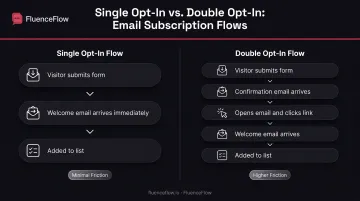
Single opt-in flow:
- Visitor submits form
- Welcome email arrives immediately
- They're now on your list
Friction: Minimal. One step and done.
Double opt-in flow:
- Visitor submits form
- Confirmation email arrives
- Subscriber opens email and clicks verification link
- Welcome email arrives
- They're now on your list
Friction: Higher. Requires checking email and taking a second action.
Impact on List Growth Speed
Single opt-in captures more subscribers because there's no second step where people drop off. Litmus reports that single opt-in can generate faster growth and higher total response because everyone who submits the form joins your list immediately.
Double opt-in grows your list more slowly. Not everyone who submits a form will complete verification. Some forget, some get the confirmation buried in spam, and others simply lose interest. The result is a smaller but more engaged list.
Deliverability Implications
Single opt-in risks:
- Typos in email addresses (someone@gmial.com instead of someone@gmail.com)
- Fake or disposable email addresses
- Spam traps planted to catch senders with poor list hygiene
- Invalid domains and abandoned inboxes
Double opt-in advantages:
- Eliminates typos and fake addresses automatically
- Confirms the email is active and deliverable
- Proves the subscriber can receive and interact with your emails
GetResponse's 2024 analysis of 2.76 billion newsletters found double opt-in lists achieved:
- 35.72% open rate vs 27.36% for single opt-in
- 4.19% click-through rate vs 2.36% for single opt-in
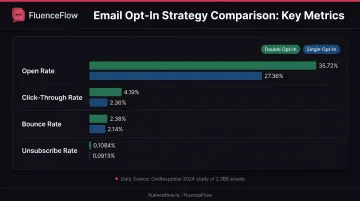
The same study also found slightly higher bounce (2.38% vs 2.14%) and unsubscribe rates (0.1084% vs 0.0913%) on double opt-in lists. It isn't a guaranteed win on every deliverability metric.
Sender Reputation Differences
Those list-quality differences show up in the metrics ISPs use to decide inbox vs. spam:
- Bounce rates: how many emails are undeliverable
- Spam complaints: how often recipients mark your emails as spam
- Engagement signals: opens, clicks, replies, and forwards
Single opt-in exposes you to more invalid addresses, which pushes bounce rates up. Send enough mail to addresses that don't exist and ISPs notice.
Double opt-in filters out those addresses before you ever hit send. Subscribers who finish verification also tend to open and click more, which sends the positive signals that protect sender reputation.
Comparison Table
| Factor | Single Opt-In | Double Opt-In |
|---|---|---|
| Ease of signup | One step, immediate | Two steps, requires verification |
| List quality | Lower: typos, fakes, disengaged | Higher: verified, deliverable, engaged |
| Engagement rates | Lower open/click rates | Higher open/click rates |
| Compliance level | Legal in most regions with caveats | Strongest proof of consent |
| Deliverability impact | Higher risk of invalid addresses | Lower risk, cleaner list |
| Setup complexity | Simple toggle on/off | Requires confirmation email design |
Benefits and Drawbacks of Each Opt-In Method
Double Opt-In Advantages
Subscribers who finish two-step verification have shown intent twice. That self-selection shows up in performance:
- Higher open rates (35.72% vs. 27.36% in GetResponse's study)
- Higher click-through rates (4.19% vs. 2.36%)
- Stronger conversion rates from people more likely to buy
- Lower unsubscribe rates as casual signups fall away
Double opt-in also filters bad addresses before they hit your list:
- Typos like "johndoe@gmial.com" never confirm
- Throwaway addresses such as "test@test.com" fail verification
- Spam traps and abandoned inboxes don't make it through
- Invalid domains bounce at confirm time, not on your first campaign
You get fewer bounces, fewer spam complaints, and a stronger sender reputation.
GDPR expects clear proof of consent, and double opt-in leaves an audit trail: form submit, confirmation email sent, link clicked, and affirmative join. If consent is ever questioned, you have documentation.
Single Opt-In Advantages
Single opt-in wins on speed. Without a confirm step, nobody drops off because they missed an email or forgot to click, so raw list growth is usually higher.
You can also start nurturing right away. The welcome series can fire within minutes, which matters for time-sensitive offers, gated downloads, and any flow where delayed value hurts conversion.
Double Opt-In Drawbacks
The confirm step creates drop-off. People who never verify never join, which means:
- Slower list growth than single opt-in
- Lost subscribers whose confirmation email landed in spam
- Missed high-intent signups who filled the form but never clicked confirm
For most DTC brands that care about retention revenue, lifetime value, and long-term list health, that quality tradeoff is still worth it.
Single Opt-In Drawbacks
Litmus notes that single opt-in brings more invalid addresses, abuse risk, and weaker proof the inbox owner actually subscribed. Over time that can hurt:
- Sender reputation, as ISPs react to bounces and spam complaints
- Inbox placement, so fewer subscribers ever see your mail
- List health, when disengaged contacts drag down engagement metrics
Single opt-in is a better fit when you're adding existing customers from other channels (in-store or phone orders) or running short campaigns where speed matters more than long-term deliverability.
How to Implement Double Opt-In in Your Email Marketing
Most major ESPs have built-in double opt-in features. The process is similar across platforms:
- Access list or audience settings in your ESP dashboard
- Enable the double opt-in toggle (may be called "confirmed opt-in" or "two-step opt-in")
- Customize the confirmation email with your branding, copy, and call-to-action
- Set the confirmation page URL where subscribers land after clicking the verification link
- Test the full flow by submitting a test signup and confirming it works end-to-end
Key Elements to Customize
Confirmation email:
- Sender name and from address: Use a recognizable name, not a generic "noreply" address
- Subject line: Make it clear action is required ("Confirm your subscription to [Brand]")
- Email copy: Remind them why they signed up and what they'll receive; keep it brief and scannable
- Confirmation button: Place it above the fold with direct language like "Confirm Subscription" or "Yes, I Want In"
- Design: Match your brand's visual identity and use a mobile-responsive layout
Confirmation landing page:
- Thank-you message confirming they're now subscribed
- Expectation-setting copy about what they'll receive and when
- Next-step CTA like browsing your products or following you on social
- Optional welcome offer to drive immediate engagement
Litmus also recommends telling users at signup that confirmation is required, and sending a reminder after one day if they still haven't confirmed.
ESP Implementation
Here's how double opt-in works on popular platforms:
- Klaviyo: List-level setting for email and SMS; 72-hour confirmation validity
- Mailchimp: Audience-level setting; email double opt-in limited to Mailchimp forms; abandoned-cart SMS requires double opt-in
- HubSpot: Built-in confirmation step to verify addresses
- ActiveCampaign: Form-level double opt-in with editable confirmation emails
Retention agencies like FluenceFlow tune these confirmation flows around a brand's unit economics and customer journey. That means customizing design, copy, timing, and follow-up to lift confirmation rates without sacrificing list quality.
Choosing the Right Opt-In Strategy for Your Business
For most DTC e-commerce brands, double opt-in is the better choice. If you rely on retention revenue and repeat purchases, list quality and deliverability usually matter more than raw signup speed.
When to Use Double Opt-In
- DTC brands focused on retention: Higher engagement and cleaner lists support lifecycle marketing
- High AOV/low frequency products: Premium or considered purchases benefit from engaged, qualified subscribers
- EU/UK audiences: GDPR's consent requirements make double opt-in the safest approach
- Brands with deliverability issues: If you're struggling with spam placement, double opt-in helps rebuild sender reputation
- SMS programs: Carriers often require it, especially for abandoned-cart messages
When Single Opt-In Makes Sense
- Existing customers from other channels: In-store signups, phone orders, or post-purchase email capture where you already have a relationship
- Gated content downloads: E-books, guides, or resources where immediate delivery is expected
- Brands with other verification methods: If you have a separate process to confirm identity or purchase history
- Short-term campaigns: Limited-time offers where speed matters more than long-term list health
Decision Framework by Business Model
High AOV/low frequency brands (premium products, $400+ AOV, 8-month+ sales cycles): Use double opt-in. You need engaged subscribers who will stay through longer nurture cycles. Quality beats volume when conversion depends on trust and education, not impulse.
Mid AOV/mid frequency brands (large catalogs, seasonal products, tight margins): Test both approaches. Balance growth speed with engagement quality, and judge results by revenue per subscriber, not list size alone.
Low AOV/high frequency brands (consumables, CPG, replenishment products): Single opt-in can work if frequent purchases and strong engagement keep deliverability healthy. Double opt-in still offers better long-term protection for sender reputation.
How to Test and Optimize
- Split traffic between single and double opt-in for 30–60 days across comparable segments
- Track what share of double opt-in signups complete confirmation
- Compare post-signup open, click, and conversion rates between groups
- Calculate revenue per subscriber (attributed revenue ÷ list size) for each group
- Watch bounce rates, spam complaints, and inbox placement over time
Aim for profitable growth: subscribers who reach the inbox and actually engage.
Legal and Compliance Considerations
Double opt-in is not always required by law, but consent rules differ by region. Here’s how the major frameworks treat it, and where the two-step process still helps.
GDPR (EU and UK)
GDPR requires "clear affirmative action" for consent. Pre-ticked boxes, silence, and inactivity don't count. While GDPR doesn't explicitly mandate double opt-in, it's the safest approach because it provides:
- Clear proof the subscriber took affirmative action
- Documentation of when consent was given
- Evidence that the email owner (not someone else) subscribed
For EU/UK audiences, use double opt-in.
CAN-SPAM (United States)
CAN-SPAM doesn't require prior consent for marketing emails. Single opt-in is legally permissible. However, you must:
- Provide a clear opt-out mechanism
- Keep the opt-out link functional for at least 30 days
- Honor unsubscribe requests within 10 business days
- Include your physical mailing address
- Avoid misleading subject lines
Single opt-in is legal, but double opt-in still protects your deliverability.
CASL (Canada)
CASL requires express or implied consent for commercial electronic messages. Express consent means proactive opt-in, and you must be able to prove it. While CASL doesn't prescribe double opt-in, it does require:
- Clear identification of who's sending the message
- Contact information
- Unsubscribe mechanism in every email
- Documentation of consent
Double opt-in provides stronger proof if you're ever audited.
Country-Specific Requirements
Germany, Austria, and Switzerland do not explicitly mandate double opt-in by law. Official guidance requires prior consent or opt-in, with existing-customer exceptions, but does not prescribe a two-step confirmation process.
Key rules by country:
- Germany: Advertising requires prior express consent, with an existing-customer exception
- Austria: Direct-advertising email and SMS require prior consent, with similar-product exceptions
- Switzerland: Explicit, free, informed, active opt-in required; pre-ticked boxes are not enough
Best practice: Use double opt-in for EU/DACH audiences to ensure compliance with consent requirements, even if the law doesn't explicitly require the two-step process.
SMS Compliance
SMS has stricter opt-in requirements than email in most jurisdictions. In the US, automated marketing texts fall under the TCPA, which requires prior express written consent, including a disclosure that consent is not a condition of purchase.
Carrier and ESP requirements:
- Mailchimp requires double opt-in for abandoned-cart SMS
- Klaviyo notes carriers often require double opt-in, particularly for abandoned-cart messages
These are operational rules set by ESPs and carriers, not universal legal mandates, but you must follow them to send SMS through those platforms.
Frequently Asked Questions
What does double opt-in mean?
Double opt-in is a two-step subscription verification process where subscribers must confirm their email address via a verification link before being added to your email list. It ensures the person who submitted the form actually owns the address and wants your content.
Should I enable double opt-in?
Yes, for most DTC e-commerce brands. It improves list quality, protects deliverability, and strengthens compliance proof, benefits that usually outweigh slower list growth when retention revenue matters.
What is the difference between single opt-in and double opt-in?
Single opt-in adds subscribers immediately when they submit a form, with no verification step. Double opt-in requires subscribers to click a confirmation link in an email before being added. The tradeoff: single opt-in grows your list faster, while double opt-in grows a more engaged, deliverable list.
Which countries require double opt-in for emails?
No official source lists countries that mandate a two-step confirmation. Germany, Austria, and Switzerland require prior consent, but not necessarily double opt-in. Under GDPR, clear affirmative action and proof of consent make double opt-in the safest approach for EU/UK audiences.
Are newsletters still relevant in 2026?
Yes. Litmus's 2025 survey found newsletters were the highest-return email type for DTC brands, and top programs still lean on them for strong ROI. Email remains an owned channel that isn't subject to social algorithm shifts.