Too many brands assume that owning a customer's phone number equals permission to text. It doesn't. Without proper consent, every promotional message exposes your business to statutory damages, carrier blocking, and reputational harm that can permanently damage customer trust.
This guide explains exactly what SMS consent means under U.S. law, how to collect it compliantly, what disclosure language you must include, and how proper consent builds stronger, more profitable customer relationships.
Key Takeaways:
- SMS consent requires documented, affirmative written permission, not just having a phone number
- TCPA mandates prior express written consent for marketing texts, with $500-$1,500 penalties per violation
- Compliant disclosure must include company name, message frequency, opt-out instructions, and rate warnings
- Double opt-in protects list quality and meets carrier requirements for cart-abandonment messages
- Pre-checked boxes, purchased lists, and implied consent all fail TCPA compliance
What is SMS Consent and Why It Matters for Your Marketing Strategy
SMS consent is explicit, documented permission from a subscriber to receive marketing text messages from your brand. Having a customer's phone number, even from a completed purchase, does not constitute consent.
The FCC defines prior express written consent as a signed written agreement clearly authorizing your company to send promotional messages to a specific telephone number. This agreement must state that consent is not required to make a purchase, and it must be obtained before you send the first marketing text.
Why this standard differs from email:
- Email marketing generally operates under CAN-SPAM, which allows messages until someone opts out
- SMS falls under TCPA, which prohibits messages until someone explicitly opts in
- TCPA sets a higher consent bar, stricter documentation rules, and much larger penalties
Business Impact of Proper Consent
Consented subscribers drive measurably better outcomes. Klaviyo's 2025 U.S. benchmarks show that SMS flows generate nearly 10% average click rates and produce approximately 8x the revenue per recipient compared to campaigns. SMS represented just 7.6% of total sends but delivered 45.2% of SMS revenue for brands using the platform.
Those numbers only hold when every recipient opted in on purpose; consented subscribers buy more often, engage more consistently, and unsubscribe less.
Consequences of Non-Compliance
Operating without proper consent creates four major risks:
- Legal liability: 47 U.S.C. § 227 allows $500 per violation, tripled to $1,500 for knowing or willful cases; one bad send to 10,000 numbers can mean $5 million in exposure
- Carrier filtering: Carriers must block texts from numbers named in an FCC Notification of Illegal Texts, and high unsubscribe rates can trigger limits or full blocks
- Trust damage: Unsolicited texts brand you as a spammer faster than most other channel mistakes, and recovery is slow
- Wasted spend: Blocked or instantly unsubscribed messages return no ROI while you still pay platform and carrier fees
Legal Requirements: Understanding TCPA and SMS Compliance
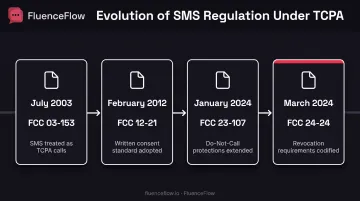
The Telephone Consumer Protection Act (TCPA) was enacted in 1991 to restrict unwanted telemarketing calls. The FCC extended these protections to SMS in its July 2003 ruling, treating text messages to wireless numbers as "calls" subject to TCPA restrictions.
Evolution of SMS regulation
| Date | Ruling | Impact |
|---|---|---|
| July 2003 | FCC 03-153 | Text messages to wireless numbers treated as TCPA "calls" |
| February 2012 | FCC 12-21 | Adopted prior express written consent standard for marketing texts |
| January 2024 | FCC 23-107 | Extended National Do-Not-Call protections to marketing texts |
| March 2024 | FCC 24-24 | Codified revocation requirements, recognized STOP keywords, mandated 10-day processing |
Four Core TCPA Requirements
1. Obtain prior express written consent before sending
FCC regulations define prior express written consent as a signed written agreement that:
- Identifies your company
- Specifies the telephone number you're authorized to contact
- Clearly states the subscriber is authorizing promotional messages
- Discloses that consent is not required to purchase
Electronic signatures qualify under E-SIGN standards.
2. Use clear, compliant disclosure language
Your consent form must include:
- Your company name
- The phone number being registered
- Explicit authorization for marketing/promotional texts
- Message frequency (or "recurring messages" if variable)
- "Message and data rates may apply"
- Instructions for opting out (STOP, HELP, etc.)
- Links to Terms of Service and Privacy Policy
- Statement that consent is not a purchase condition
3. Limit messages to the disclosed program and purpose
CTIA industry standards prohibit using one opt-in to enroll consumers in multiple programs. If a customer consents to receive order updates, you cannot use that permission to send promotional offers. Separate programs require separate consent.
4. Honor revocation requests immediately
Current FCC rules recognize STOP, QUIT, END, REVOKE, OPT OUT, CANCEL, and UNSUBSCRIBE as valid revocation keywords. You must process these requests within 10 business days and may send only one non-promotional confirmation text after opt-out.
What counts as "written consent"
Affirmative actions that qualify:
- Checking an unchecked box on a website form
- Responding "YES" to a confirmation text
- Typing a keyword (such as "JOIN") into a short-code number
- Submitting a form that includes all required disclosures
- Signing a paper agreement with full disclosure language
Invalid consent methods:
- Pre-checked boxes (not valid consent)
- Implied consent from a past purchase
- Oral permission without written documentation
- Bundled consent buried in unrelated terms
Carrier Requirements Beyond TCPA
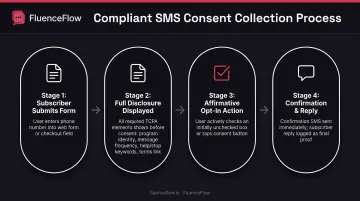
Mobile carriers enforce network-level standards through CTIA guidelines:
- Double opt-in for cart abandonment: U.S. carriers require confirmation via reply text for abandonment messages
- Confirmation messages: All recurring-message programs must send one opt-in confirmation containing program identity, frequency, rate disclosure, and opt-out instructions
- Quiet hours: FCC regulations restrict telephone solicitations to 8 a.m.–9 p.m. recipient local time, now extended to marketing texts
- Message frequency limits: No universal cap exists, but carriers monitor complaint rates and may throttle or block programs generating excessive unsubscribes
Transactional vs. Promotional Messages
Promotional messages include sales, discounts, product announcements, or any content encouraging a purchase. These require prior express written consent.
Transactional messages cover order confirmations, shipping updates, appointment reminders, and account notifications. FCC consumer guidance indicates these may use oral consent, though platforms often recommend written consent for all messages.
Critical rule: You cannot use transactional consent to send promotional content. A customer who opts in for shipping updates has not consented to receive sale announcements.
Types of SMS Consent You Need to Know
SMS consent is not one-size-fits-all. What you collect determines which messages you can send and how defensible your program is if it is ever challenged.
Marketing Consent vs. Transactional Consent
Marketing consent authorizes promotional messages including:
- Product announcements and launches
- Sales, discounts, and limited-time offers
- Cross-sell and upsell campaigns
- Abandoned-cart recovery with promotional language
- Replenishment reminders that include offers
This requires prior express written consent under TCPA, with full disclosure and opt-out mechanisms.
Transactional consent covers operational messages:
- Order confirmations
- Shipping and delivery updates
- Appointment reminders
- Account security alerts
- Password resets
These messages have a lower consent threshold but must remain purely informational. Adding "Shop our new collection" to a shipping update converts the message to promotional and requires written marketing consent.
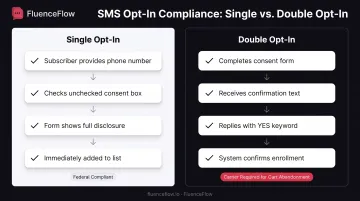
Single Opt-In vs. Double Opt-In
Single opt-in process:
- Subscriber provides phone number
- Subscriber checks an unchecked consent box
- Form includes all required disclosure language
- Subscriber is immediately added to SMS list
Single opt-in satisfies federal written-consent requirements when properly documented, and it maximizes list growth with less friction.
Double opt-in process:
- Subscriber completes initial consent form
- System sends confirmation text with keyword instructions
- Subscriber replies with "YES," "CONFIRM," or similar keyword
- System confirms enrollment and activates subscription
Double opt-in provides stronger proof that the phone number belongs to the person who submitted the form. It reduces erroneous signups, protects against malicious submissions, and meets carrier requirements for specific use cases.
When Double Opt-In Is Required
U.S. carrier guidance requires double opt-in for:
- Cart-abandonment messages (per Attentive and Klaviyo carrier summaries)
- High-volume promotional programs with elevated complaint risk
- Programs recovering previously unsubscribed numbers
Why Double Opt-In Should Be Your Default
Use double opt-in as your standard for all promotional programs. While single opt-in is federally compliant, double opt-in delivers three advantages:
- Improves list quality by limiting enrollment to people who control the number
- Strengthens compliance with reply-based confirmation as proof of consent
- Protects carrier standing by reducing complaint rates
FluenceFlow helps DTC brands implement compliant SMS consent flows during initial setup, integrating capture forms, disclosure language, and confirmation logic into Klaviyo-based retention systems from day one.
How to Collect SMS Consent: Methods and Best Practices
You can collect SMS consent through website forms, keyword campaigns, QR codes, and tap-to-text links. Every method still needs clear disclosure, an affirmative opt-in, and records you can produce later.
Website Form Opt-In
On-site forms remain the most common collection method:
Popup forms:
- Triggered by time on site, scroll depth, or exit intent
- Capture both email and SMS in a single interaction
- Must use unchecked boxes for SMS consent (pre-checked boxes weaken your ability to prove consent)
- Should offer an incentive (discount, exclusive access, early product drops)
Embedded forms:
- Placed in footer, homepage, or dedicated landing pages
- Allow visitors to subscribe without interruption
- Work well for educational content and blog traffic
Checkout checkboxes:
- Added to cart or checkout pages
- Must be unchecked by default
- Should clearly separate SMS consent from email consent and purchase confirmation
Required Disclosure Language
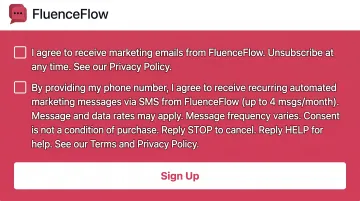
Every consent form must include:
- Company name: "Sign up to receive texts from [Your Brand]"
- Message frequency: "Recurring promotional messages" or "Approx. 4 msgs/month"
- Rate disclosure: "Msg & data rates may apply"
- Opt-out instructions: "Reply STOP to unsubscribe, HELP for help"
- Terms and Privacy links: Hyperlinked access to full policies
- No-purchase-required statement: "Consent is not a condition of purchase"
Compliant example:
"By checking this box, you agree to receive recurring promotional text messages from [Brand Name] at the number provided. Msg frequency varies. Msg & data rates may apply. Reply STOP to unsubscribe or HELP for help. View Terms and Privacy Policy. Consent is not required to make a purchase."
Keyword-Based Opt-In Campaigns
Keyword campaigns work best for:
- Social media promotions (Instagram, TikTok bios)
- Paid advertising (Facebook, Google, YouTube)
- In-store signage and events
- QR codes with mobile-first landing experiences
How it works:
- Promote a short-code number and keyword (e.g., "Text JOIN to 12345")
- Subscriber sends keyword to your number
- System responds with required disclosure and confirmation request
- Subscriber replies "YES" to complete double opt-in
Automated confirmation example:
"Welcome to [Brand]! Reply YES to receive exclusive offers & updates (approx. 4/month). Msg & data rates may apply. Reply STOP to opt out, HELP for help. Terms Privacy"
QR Code and Tap-to-Text Methods
Mobile-first consent uses:
- QR codes: Print on packaging, receipts, signage, or mailers; scan opens pre-filled SMS with keyword
- Tap-to-text links: Mobile web links that auto-populate SMS app with consent keyword
Both methods make mobile enrollment faster, but they still require full disclosure and confirmation.
Record-Keeping Requirements
Capture and retain for every subscriber:
- Telephone number
- Exact consent language and disclosure version shown
- Timestamp and timezone of opt-in
- Source (URL, keyword, QR code ID)
- IP address and user agent (when available)
- Confirmation response (for double opt-in)
- Opt-out timestamp (when applicable)
CTIA recommends retaining records from initial opt-in until at least six months after opt-out. The four-year federal limitations period suggests treating four years as a minimum retention standard for TCPA defense.
FluenceFlow builds these consent methods into Klaviyo SMS and list-growth setups for DTC brands, so compliant opt-ins, disclosures, and records sit alongside email lifecycle flows instead of getting bolted on later.
Common SMS Consent Mistakes to Avoid
Even experienced DTC teams trip over consent rules. These three mistakes create the most TCPA and CTIA exposure, and they’re easy to fix once you know what to look for.
Mistake #1: Pre-Checked Consent Boxes or Bundled Consent
The error: Using a pre-checked box for SMS consent, or combining SMS consent with email consent in a single checkbox.
Why it fails: Pre-checked boxes don’t prove affirmative action. In Sliwa v. Bright House/Hot Topic, a court denied summary judgment when the consumer disputed checking the box; passive acceptance is weak evidence.
Bundling SMS with email also violates CTIA rules that require program-specific opt-in. Agreeing to email newsletters is not consent for promotional texts.
Correct approach: Use separate, unchecked boxes for email and SMS. Label each clearly, and put full disclosure language on the SMS box.
Mistake #2: Purchasing Phone Lists or Assuming Past Customers Are Consented
The error: Buying a list of phone numbers, renting subscriber data, or assuming that customers who purchased from you in the past have consented to SMS marketing.
Why it fails: CTIA advises against rented, sold, or shared opt-in lists. A purchased number doesn’t prove the consumer signed a written agreement authorizing your company to text them. A past purchase alone is not prior express written consent for marketing messages.
Correct approach: Build your list through compliant opt-in only. Don’t message a number unless you can show a documented, affirmative consent record tied to your brand.
Mistake #3: Unclear Disclosure Language and Ignored Opt-Outs
The error: Using vague or incomplete disclosure language, failing to honor STOP requests promptly, or texting outside quiet hours.
Why it fails:
- Missing required disclosure elements (company name, frequency, rate warning, opt-out instructions) creates TCPA exposure
- FCC rules now mandate processing opt-outs within 10 business days and recognize standard keywords (STOP, QUIT, END, etc.)
- Texting before 8 a.m. or after 9 p.m. recipient local time violates FCC telephone solicitation restrictions extended to marketing texts
Correct approach:
- Include every required disclosure element in your opt-in forms and confirmation messages
- Automate STOP keyword recognition and process unsubscribes immediately (same-day when possible)
- Configure your SMS platform to respect quiet hours automatically, suppressing sends outside 8 a.m.–9 p.m. recipient time
Frequently Asked Questions
Is SMS marketing legal in the USA?
Yes, SMS marketing is legal when you follow TCPA requirements, including obtaining prior express written consent before sending commercial texts. FCC consumer guidance confirms that promotional messages require written authorization, with clear opt-out mechanisms and respect for quiet hours.
What does SMS consent mean?
SMS consent is documented permission from a subscriber authorizing your company to send marketing text messages to their phone number. It requires a signed written agreement (electronic signatures qualify), not just possession of the number from a purchase or past interaction.
What is an example of an SMS consent message?
"By checking this box, you agree to receive recurring promotional texts from [Brand Name] at the number provided. Approx. 4 msgs/month. Msg & data rates may apply. Reply STOP to opt out, HELP for help. Terms & Privacy. Consent is not required to purchase."
Why would someone use SMS messaging for marketing?
SMS delivers faster reach and stronger engagement than email. Klaviyo's 2025 benchmarks show SMS flows at nearly 10% average click rates and about 8x campaign revenue per recipient, with combined email and SMS often driving 41% of store revenue for DTC brands.