The stakes extend beyond lost revenue. Hiring the wrong consultant means wasted budget, lost months while competitors optimize, and opportunity costs that compound as your acquisition costs rise. This guide covers what CRO consultants actually do, when you need one, how to evaluate candidates, and which red flags signal trouble ahead.
Key Takeaways
- CRO consultants raise the share of visitors who buy, sign up, or take other key actions through testing and optimization
- Hire when traffic is steady but conversions are flat, or rising acquisition costs force more value from existing visitors
- Judge candidates on methodology, case studies, statistical rigor, and clear pricing, not vague promises
- Reject anyone who guarantees a lift without your baseline or skips testing for generic best practices
- Plan on 3+ months; most tests need 2–4 weeks for significance, and patterns show up across multiple cycles
What is a CRO Consultant?
A conversion rate optimization (CRO) consultant helps you turn more of the traffic you already have into customers. They study how people move through your site, find where the funnel breaks, and ship tested changes so a higher share of visitors complete actions you care about, such as checkout, signup, or demo request.
Optimizely frames CRO as raising that completion rate through systematic hypothesis validation and UX improvement, not one-off redesign guesses.
Core Activities
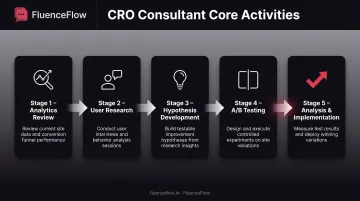
CRO consultants perform five primary functions:
- Review analytics, funnel drop-offs, and conversion metrics to see where visitors exit
- Run user tests, session recordings, surveys, and heatmaps to learn why they leave
- Turn those findings into testable hypotheses about what will lift conversion
- Design and run A/B tests that compare a variation against current performance
- Check statistical significance, segment results, then implement, iterate, or kill the change
VWO's 2025 methodology emphasizes that credible consultants combine quantitative data from Google Analytics or similar tools with qualitative behavioral evidence before prioritizing which tests to run.
How CRO Differs from Other Marketing Roles
CRO consultants focus on improving what happens after visitors arrive on your site. SEO specialists and PPC managers drive traffic; CRO consultants convert that traffic into customers. You need both: traffic with a weak funnel wastes ad spend, and a strong funnel with no traffic never gets a chance to convert.
When You Need a CRO Consultant
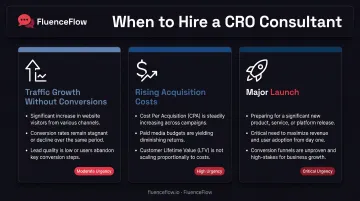
Three scenarios signal it's time to bring in specialized CRO help:
Traffic Growth Without Conversion Improvement
Your monthly visitors are climbing, but conversion rates remain flat or decline. This bottleneck means you're attracting an audience but failing to convert it.
Adobe's 2023 analysis reports average e-commerce conversion rates around 3.65% for any desired action, though that figure varies by industry, product type, and traffic source.
Rising Customer Acquisition Costs
When your customer acquisition cost (CAC) keeps climbing, extracting more value from existing traffic usually beats pouring more money into ads. Per Shopify's 2024 definition, CAC is total acquisition-related sales and marketing costs divided by new customers acquired in the period.
A 20% lift in conversion rate delivers the same revenue as a 20% traffic increase, without the matching acquisition cost.
Major Launch or Market Expansion
You're preparing a website redesign, launching new product lines, or entering new markets. Optimizing the experience from day one beats launching first and fixing friction later. Early-stage CRO protects your investment in new traffic sources and products from conversion leaks.
What to Consider When Choosing a CRO Consultant
The right CRO consultant should move metrics that matter: revenue per visitor, average order value, and customer lifetime value. Work through the factors below before you sign.
Proven Methodology and Process
Ask whether the consultant follows a documented, repeatable process that includes discovery, data analysis, hypothesis prioritization, testing, and post-test analysis. Look for evidence they use frameworks like ICE (Impact, Confidence, Ease) or similar prioritization methods rather than choosing tests based on gut feeling.
Red flag: Consultants who can't articulate a clear process or prioritization framework likely lack methodological rigor and may be learning on your dime.
What to ask:
- "Walk me through your process from initial discovery to implementing winning tests."
- "How do you decide which hypotheses to test first when you have limited time and budget?"
- "What happens when a test produces inconclusive results?"
Industry Experience and E-commerce Expertise
Determine whether you need deep vertical experience, which offers faster ramp-up and a relevant playbook of ideas, or a fresh perspective that questions assumptions and brings novel approaches.
Request case studies from similar business models. If you operate a subscription e-commerce business with high average order value and low purchase frequency, case studies from consumables brands with opposite characteristics may not demonstrate relevant expertise.
What to ask:
- "Have you worked with [subscription/high-AOV/consumables] brands before?"
- "What did you learn from those engagements that would apply to our business model?"
- "Can you share specific examples of hypotheses that worked in our vertical?"
Transparent Pricing and ROI Expectations
Understand pricing structures upfront. While no authoritative US market data exists for consultant retainers, pricing models typically fall into three categories:
- Monthly retainers: Fixed monthly fees for ongoing optimization work
- Project-based fees: One-time charges for specific deliverables like audit reports or initial test setup
- Performance-based arrangements: Fees tied to measured improvements, which often need tight tracking setup and clear attribution rules
Ask how long before you should expect measurable results. Responsible consultants will say 3-6 months minimum.
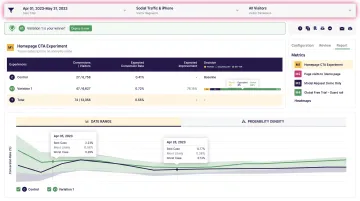
Optimizely's analysis of 127,000+ experiments found that only 12% of tests significantly improved the primary metric. Healthy programs still only reach 35-40% conclusive results (wins plus losses). Most tests take 2-4 weeks to hit statistical significance, so real patterns show up across multiple cycles, not a single test.
What to ask:
- "What's your pricing model, and what's included versus additional costs?"
- "When should I expect to see the first measurable improvements?"
- "What's a realistic win rate for our traffic levels and conversion baseline?"
Case Studies and Client References
Request case studies that show methodology, not just results. Look for evidence of how they identified problems, what hypotheses they tested, why certain changes worked, and what they learned from losing tests.
Ask to speak with current or past clients about how the consultant handled setbacks, communicated results, and integrated with internal teams. A consultant who delivers only winners either has an unrealistically small sample size or isn't being transparent. Optimizely's data shows even high-performing programs experience losses.
What to ask references:
- "How did the consultant communicate when tests didn't produce the expected results?"
- "What was the weekly or monthly time commitment required from your team?"
- "Did they leave you with systems and knowledge you could maintain after the engagement ended?"
Testing Philosophy and Statistical Rigor
Understand their approach to controlled testing. According to Optimizely's 2025 guidance, 95% statistical significance is an accepted standard, though the required sample size depends on your baseline conversion rate and the minimum detectable effect you're targeting.
Optimizely recommends running tests for at least one full business cycle (minimum seven days). Smaller expected effects and lower baseline conversion rates need substantially more traffic.
Tests stopped too early risk false positives. VWO warns that repeatedly checking results and stopping after favorable fluctuations inflates apparent uplift and creates unreliable conclusions.
What to ask:
- "What statistical significance threshold do you use, and how do you calculate required sample sizes?"
- "What's your quality assurance process for ensuring tests don't break functionality across devices?"
- "How do you handle post-test analysis and segmentation to understand why something worked?"
Tools and Technology Stack
Confirm the consultant has experience with your existing tools, such as Google Analytics, Shopify, and specific A/B testing platforms, or can recommend cost-effective alternatives. Google sunset Optimize and Optimize 360 on September 30, 2023, so consultants still referencing those tools may not be current.
Understand what additional tool costs you should budget beyond consulting fees. For example, Convert's platform starts at $399/month, while VWO uses quote-based pricing tied to monthly active users and request quotas. These costs add up quickly and should be transparent from the start.
What to ask:
- "What testing platform do you recommend for our traffic levels and budget?"
- "What's the total monthly tool cost beyond your consulting fees?"
- "Do you have partnerships or preferred pricing with any platforms?"
How FluenceFlow Complements Your CRO Strategy
While CRO consultants optimize the path to first purchase, FluenceFlow optimizes what happens after conversion: turning one-time buyers into repeat customers through retention marketing.
The most profitable e-commerce strategies combine front-end CRO (improving conversion rates on paid traffic) with back-end retention optimization.
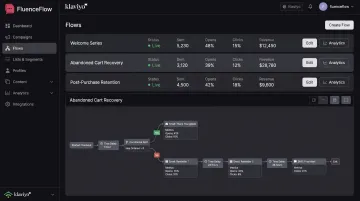
FluenceFlow builds custom email and SMS systems in your Klaviyo account, including welcome flows, abandoned-cart recovery, post-purchase sequences, replenishment reminders, and win-back campaigns. These systems average 41% of total store revenue for clients, with a 10.6x average ROI in the first 90 days.
FluenceFlow's unique approach:
- Custom performance guarantees based on your unit economics (if targets aren't met, you get a refund)
- Month-to-month engagement with no long-term contracts
- 100% client ownership of every flow, email, segment, and popup built in Klaviyo
- Strategy organized by business model (high-AOV/low-frequency, mid-AOV/mid-frequency, low-AOV/high-frequency) rather than generic templates
Your CRO consultant can focus on converting first-time visitors while FluenceFlow maximizes customer lifetime value through systematic retention.
Red Flags to Avoid When Hiring a CRO Consultant
Certain warning signs indicate a consultant lacks the expertise or integrity to deliver results:
Guaranteed Specific Percentage Increases
Skip anyone who promises a fixed lift like "20% conversion rate increase" before they know your baseline, traffic quality, or business constraints.
Optimizely's statistical guidance notes that every experiment carries false-positive risk. At 95% significance, you still face a 5% chance the win is noise, and testing multiple variations or goals raises that exposure. Conversion optimization has too many variables for unconditional guarantees.
Over-Reliance on Best Practices Without Testing
Avoid consultants who ship changes from industry best practices and heuristics without a testing framework. What works on other sites may not work for your audience.
Optimizely provides an example where a variation improved product-page conversion while overall submissions stayed flat: site-wide assumptions fail without validation.
Lack of Process Documentation
If a consultant can't explain how they handle research, hypothesis development, test prioritization, and post-test analysis, treat that as a warning. Missing process usually means ad-hoc work and inconsistent results.
Unrealistic Timeline Promises
Treat "results in 30 days or less" promises with skepticism. Optimizely recommends running each test for at least one full business cycle (minimum seven days) to reach statistical significance.
Most meaningful programs need multiple test cycles over several months. Quick wins exist, but sustainable conversion gains take time.
Conclusion
Choosing the right CRO consultant is about finding a partner who combines analytical rigor, relevant expertise, and a proven methodology that aligns with your business goals. Higher conversion rates only matter when they produce sustainable revenue growth through better user experiences and data-driven decisions.
CRO is an ongoing optimization process, not a one-time project. The best consultants build internal capability and frameworks that deliver compounding returns over time, not a temporary lift that fades when the engagement ends.
When you hire, keep these realities in mind:
- Budget for inconclusive tests
- Expect losses alongside wins
- Prioritize partners who communicate transparently about both
Frequently Asked Questions
What is conversion rate optimization consultancy?
CRO consultancy is a service where specialists analyze your website's user experience, identify barriers to conversion, and systematically test improvements to increase the percentage of visitors who complete desired actions like purchases or sign-ups.
What is the difference between SEO and CRO?
SEO focuses on driving more qualified traffic to your website through search engine rankings, while CRO focuses on converting more of the traffic you already have. Both are essential and work together to maximize revenue per marketing dollar.
Is a 20% conversion rate good?
"Good" conversion rates vary significantly by industry, traffic source, product type, and how conversion is defined. Adobe reports e-commerce averages around 2-3% for purchases, though the figure changes by vertical: food and beverage averages 4.6% while electronics averages 1.9%. The more important question is whether your conversion rate is improving over time and beating your own baseline.
How long does it take to see CRO results?
Expect 3-6 months for meaningful results. Individual tests typically need 2-4 weeks to reach statistical significance. Only 12% of tests significantly improve the primary metric, so multiple cycles are needed to find winning patterns.
What should I budget for CRO tools and consulting?
Tool costs vary widely. Platforms like Convert start at $399/month, while enterprise solutions require custom quotes. Consultant fees depend on scope, but separate tool costs, research, testing, QA, analytics, and labor in your budget. Always get itemized proposals showing exactly what's included versus additional costs.
Should I hire a consultant or build an in-house CRO team?
Consultants make sense when you need specialized expertise without full-time overhead, while in-house teams work better for ongoing high-volume testing. Many businesses start with consultants to build processes and capability, then transition to hybrid models where consultants advise internal teams.