Effective email marketing isn't about vanity metrics. It's about building a retention system based on your unit economics, average order value, purchase frequency, and margin, that drives 10-37% increases in total store revenue. This guide walks you through the unit-economics-based approach that helps DTC brands average 30-41% of revenue from email and SMS combined.
Key Takeaways
- Set real revenue targets: top DTC brands generate 30-41% of store revenue from email and SMS
- Match strategy to unit economics: high-AOV brands need different flows than consumable businesses
- Automated flows drive 70-80% of email revenue from just 5% of sends
- Revenue per Recipient (RPR) and conversion rate by segment matter more than open rates
- Choose platforms with native Shopify integration and behavioral segmentation
Set Clear Revenue Goals (Not Vanity Metrics)
Email should carry a real revenue target: a percentage of total store revenue, not a vanity metric like open rate. Klaviyo's 2026 benchmark data shows flows generate nearly 41% of email revenue from just 5.3% of sends.
Why revenue targets matter:
- Open rates don't pay bills. Attributed revenue does
- Revenue targets force you to build flows and segments that convert, not just engage
- They align email strategy with business outcomes across paid, organic, and retention channels
- They create accountability and make testing decisions easier
Quick wins vs. meaningful growth:
- 30-day impact: New flows, stronger popups, and higher campaign output go live, and you start capturing revenue you were missing
- 60-90 day building: List growth, mature flows, sharper segments, and compounding tests drive 10-37% total store revenue lifts
Calculate your email revenue target:
- Find your current email revenue percentage: Divide attributed email revenue by total store revenue for the last 90 days
- Compare to benchmark: Top DTC brands average 30-41% of revenue from email and SMS combined
- Set a realistic 90-day target: If you're at 10%, aim for 20-25%. If you're at 25%, push toward 35%
- Back into monthly revenue: Multiply your target percentage by projected monthly store revenue
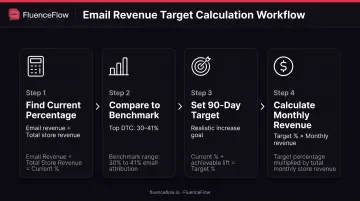
For example, a brand doing $200,000/month with email currently at 15% ($30,000) might target 30% within 90 days, or $60,000/month in email revenue.
How email goals relate to other channels:
Email revenue doesn't cannibalize paid or organic. It extends the value of traffic you've already acquired. When paid acquisition costs rise, email becomes the margin-protection channel that turns one-time buyers into repeat customers without additional ad spend.
Understand Your Customer Unit Economics First
Your unit economics, average order value (AOV), purchase frequency, and margin, should determine your entire email strategy. Generic industry templates fail because they ignore what actually makes your business profitable.
Three DTC Business Models and Their Email Strategies
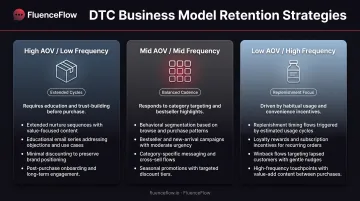
High AOV / Low Frequency (Premium Products)
- Customers take weeks to decide, research 8-15 touchpoints, abandon carts at nearly 80%
- Email strategy: Extended nurture, education, post-purchase reassurance, and value-led cross-sells, not heavy discounting
- Example flows: Multi-email welcome series, 10-14 day cart recovery, post-purchase education, VIP loyalty
Mid AOV / Mid Frequency (Big Catalogs)
- Large product selection, seasonal turnover, tight first-order margins, many one-time buyers
- Email strategy: Behavioral segmentation toward bestsellers and high-margin products; convert first-time buyers before they churn
- Example flows: Category browse abandonment, bestseller showcases, replenishment for consumable sub-categories
Low AOV / High Frequency (Consumables)
- First order requires aggressive conversion because profitability depends on the rebuy
- Email strategy: Usage-timed replenishment, progressive loyalty rewards, and lapsed-buyer winbacks
- Example flows: 21-30 day replenishment reminders, subscribe-and-save offers, usage-based reorder triggers
Calculate Customer Lifetime Value (CLV)
Once you know your model, quantify what a customer is worth. Shopify's CLV guide defines CLV as (AOV × purchase frequency) × average customer lifespan. For profit-focused analysis, use: gross margin per customer lifespan × retention rate / (1 + discount rate − retention rate).
Why CLV matters more than single campaign ROI:
- A $50 campaign that acquires a customer worth $500 over 12 months is wildly profitable, even if immediate ROAS looks modest
- CLV guides how much you can afford on welcome offers and first-purchase incentives
- It shows which segments deserve VIP treatment and exclusive access
Identify Your Most Valuable Segments
CLV only helps if you act on it. Segment by value, not just demographics:
- VIP repeat buyers: High AOV, frequent purchases, strong margins; lead with exclusive previews and loyalty rewards
- One-time buyers with high AOV: Bought once, never returned; use relevant cross-sells and education
- Browse abandoners on high-margin products: Intent on profitable items; extend nurture and add social proof
- Replenishment candidates: Consumables purchased 30-60 days ago; time reorder reminders to depletion
Match flows to these economics instead of a generic playbook. That is how FluenceFlow clients average 41% of total store revenue from email and SMS.
Build and Segment Your List Strategically
List quality matters more than list size. The right capture tactics bring in subscribers who are more likely to engage and buy, not just grow a vanity count. Omnisend's 2025 study of 1.24 billion popup displays found a 2.1% average conversion rate, with discount offers reaching 2.4% and wheel formats achieving 3.5%.
Proven List-Building Tactics for DTC
Popup timing and offers:
- Delay popups 6-10 seconds for 2.4% conversion (vs. immediate display)
- Discount offers convert at 2.4% vs. 1.7% for no incentive
- Multi-step forms reach 2.3% vs. 2.0% for single-step
Exit-intent triggers:
- Capture visitors about to leave with last-chance offers
- Average 1.8% conversion but cost nothing to deploy
Gated content:
- Size guides, buying guides, recipe books in exchange for email
- Works best for high-consideration products
Quiz funnels:
- Personalized product recommendations based on preferences
- Builds zero-party data for segmentation
Post-purchase opt-ins:
- SMS capture at checkout or thank-you page
- "Get order updates via text" converts at higher rates than promotional requests
Behavioral Segmentation Beyond Demographics
Segment by action and intent, not age and location:
- Browse abandoners: Viewed products but didn't add to cart. Send targeted product emails with social proof.
- Cart abandoners: Added to cart but didn't purchase. Prioritize with urgency and reassurance.
- One-time buyers: Purchased once 30-90 days ago. Focus on second-purchase conversion with cross-sells.
- Repeat customers: Bought 2-3 times. Nurture with loyalty rewards and early access.
- VIP segments: Top 10-20% by revenue. Treat with exclusive perks and dedicated communication.
Behavioral segments power triggered flows. For campaigns, map a few lifecycle segments to your customer journey.
Create 3-5 Core Segments Mapped to Your Journey
Start with these and refine over time:
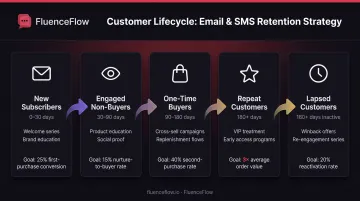
- New subscribers (0-30 days): Welcome series, brand education, first-purchase incentives
- Engaged non-buyers (30-90 days): Product education, social proof, urgency-driven offers
- One-time buyers (90-180 days): Cross-sell, replenishment, loyalty invitations
- Repeat customers (180+ days, 2+ purchases): VIP treatment, early access, referral requests
- Lapsed customers (180+ days, no recent purchase): Winback offers, "we miss you" campaigns
Email Deliverability Protects Your Revenue
List hygiene practices:
- Remove hard bounces immediately
- Suppress unengaged contacts after 6-12 months of no opens
- Monitor spam complaints and unsubscribe rates weekly
Double opt-in considerations:
- Single opt-in maximizes list size but may reduce engagement
- Double opt-in filters out fake emails and improves deliverability
- Test both approaches against your revenue goals, not just list growth
Design High-Converting Campaigns and Flows
The 80/20 rule applies: automated flows drive 70-80% of email revenue for most DTC brands, despite representing just 5% of sends.
Flow Performance Benchmarks
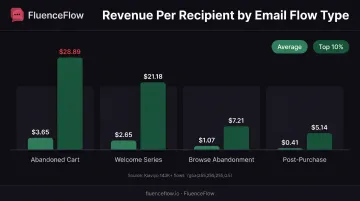
Klaviyo's 2023 data across 143,000+ cart flows shows:
| Flow Type | Average RPR | Top 10% RPR |
|---|---|---|
| Abandoned cart | $3.65 | $28.89 |
| Welcome series | $2.65 | $21.18 |
| Browse abandonment | $1.07 | $7.21 |
| Post-purchase | $0.41 | $5.14 |
RPR means revenue per recipient, the clearest read on what each flow earns. Cart flows also hit a 3.33% placed-order rate on average, with top performers reaching 7.69%.
Structure Campaigns vs. Flows
Flows (automated, behavior-triggered):
- Welcome series: Introduce brand, set expectations, drive first purchase
- Abandoned cart: Recover lost sales with urgency and reassurance
- Browse abandonment: Re-engage product viewers who didn't add to cart
- Post-purchase: Thank customers, request reviews, cross-sell complementary products
- Replenishment: Remind consumable buyers to reorder based on usage cycle
Pair those always-on automations with scheduled sends:
Campaigns (scheduled, promotional):
- Product launches and seasonal promotions to create demand spikes
- Flash sales and limited-time offers that reward engaged segments
- Engagement and content emails that keep the list warm between buys
- Holiday and event-based messaging tied to real shopper moments
Campaigns support flows, not replace them. Flows run 24/7 turning behavior into revenue. Campaigns add incremental lift around promotions and launches.
Email Design and Copywriting Best Practices
Mobile-first design:
- 50-70% of email opens happen on mobile
- Single-column layouts that scroll cleanly
- Tap targets at least 44×44 pixels
- Body text at 16px or larger
CTAs need the same restraint:
Clear CTAs:
- One primary CTA per email
- Action-oriented button copy ("Shop Now," "Get 20% Off," "Complete Your Order")
- High-contrast buttons that stand out from the layout
Match content type to the job:
Product-focused vs. brand-focused:
- Product-focused: items, prices, and benefits for cart recovery and browse abandonment
- Brand-focused: stories and values in welcome series and engagement campaigns
Then test the variables that move revenue:
Testing frameworks:
- Subject lines: urgency vs. curiosity, personalization vs. generic, emoji vs. text-only
- Send times: morning vs. evening, weekday vs. weekend by segment
- Content formats: single product vs. multiple, image-heavy vs. text-heavy
- CTA placement: above the fold vs. below, one button vs. several
Choose the Right Platform and Tools
Not all email platforms are built for DTC eCommerce. Look for native Shopify integration, behavioral segmentation, automation builders, and revenue attribution.
What to Look for in an Email Platform
Essential DTC capabilities:
- Native Shopify sync for orders, customers, and catalog in real time
- Behavioral segmentation based on purchase history, browse behavior, and engagement
- Visual flow builder for complex automation without coding
- Revenue attribution showing which emails drive sales and how much
- SMS coordination for omnichannel retention programs
- Deliverability monitoring and reputation management
Why Most DTC Brands Use Klaviyo
Klaviyo has become the category standard for ecommerce email marketing, serving over 193,000 customers with more than 350 integrations. Its Shopify partnership provides shared commerce data, real-time campaign insights, and localized catalog support for international brands.
Klaviyo advantages for DTC:
- Real-time behavioral triggers (viewed product, added to cart, started checkout)
- Predictive analytics for send-time optimization and product recommendations
- RFM segmentation (recency, frequency, monetary value)
- Built-in A/B testing with statistical significance calculation
- Comprehensive revenue attribution with customizable windows
Platform choice is only half the decision. Who builds and runs the system determines how much revenue you actually capture.
DIY vs. Agency-Managed Strategy
DIY platform use makes sense when:
- You have dedicated in-house email expertise
- Your store does less than $50K/month and needs to minimize fixed costs
- You're comfortable with technical setup, flow building, and ongoing optimization
Agency-managed strategy makes sense when:
- You lack time or expertise to build flows, design emails, and optimize performance
- You need flows and campaigns built around your unit economics, not generic templates
- You need accountability with performance guarantees tied to revenue outcomes
FluenceFlow, a Klaviyo Certified Partner, runs done-for-you email and SMS systems for DTC brands doing $50K+/month. Clients average 41% of store revenue from email and SMS, keep month-to-month terms, and retain full ownership of everything built in their Klaviyo account.
Test, Measure, and Optimize for Revenue
Open rates and click rates alone won’t tell you if email is paying for itself. Track attributed revenue, conversion by segment, and email’s share of total store revenue instead.
Revenue-Focused Metrics
Revenue per Recipient (RPR):
- Attributed revenue divided by delivered messages (Klaviyo RPR definition)
- Compare flow RPR against benchmarks (cart $3.65, welcome $2.65, browse $1.07)
- Track RPR trends over time to measure optimization impact
Attributed revenue:
- Total revenue assigned to email under your platform's attribution model
- Klaviyo’s default is last-touch with 5-day click and open windows
- Document your attribution settings before comparing brands or benchmarks
Conversion rate by segment:
- Measure converters divided by delivered recipients for each segment
- Reveals which audiences respond best to specific offers and content
- Guides budget allocation and content prioritization
Email revenue as % of total store revenue:
- Your primary strategic metric
- Top DTC brands average 30-41% from email and SMS combined
- Track monthly and quarterly to measure long-term program health
A/B Testing Frameworks
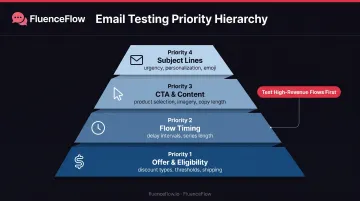
Once those metrics are in place, run tests in this priority order so effort lands on the highest-revenue levers first:
- Offer and eligibility: Discount vs. free shipping, percentage-off vs. fixed-dollar, threshold requirements
- Flow timing: 1-hour vs. 4-hour cart delay, 2-email vs. 4-email series length
- CTA and content: Product selection, image vs. lifestyle shot, long vs. short copy
- Subject lines: Urgency vs. curiosity, personalization, emoji usage
How to structure tests:
- Test one variable at a time to isolate impact
- Use at least 50 recipients per version and 90%+ win probability before declaring a winner
- Wait 3-5 days before judging cart recovery tests on purchase conversion
- Prioritize tests on high-revenue flows (cart, welcome, promotional campaigns)
Quarterly Review Process
Individual test wins only stick if you review the full program on a fixed cadence. Each quarter, dig into:
- Flow performance vs. benchmarks so you can fix underperformers and scale top performers
- Segment revenue contribution, then shift resources toward high-value audiences
- Campaign frequency and fatigue (adjust send cadence if unsubscribe rates rise)
- List growth and engagement trends that keep deliverability strong
What to change:
- Pause or rebuild flows below 50th percentile benchmarks
- Expand successful flows (e.g., 2-email cart series to 4-email series)
- Test new segments based on emerging customer behaviors
- Refresh creative every 60-90 days to combat banner blindness
How to scale what's working:
- Increase email frequency to engaged segments (test 2x/week vs. 3x/week)
- Expand high-performing flows with additional emails or triggers
- Apply winning subject line formulas across more campaigns
- Replicate successful automation logic to new product categories
Frequently Asked Questions
Is email marketing still worth it in 2026?
Yes. Omnisend reports paid-plan ecommerce merchants averaged $79 ROI per $1 spent in 2025. Email remains an owned channel with no platform algorithm risk, making it essential for DTC brands seeking predictable, profitable revenue.
What is the most effective email marketing strategy?
Automated flows built around customer behavior and unit economics drive the most revenue. Flows generate 70-80% of email revenue from just 5% of sends by targeting high-intent actions like cart abandonment, product browsing, and replenishment timing.
What are the best practices for email marketing in 2026?
Focus on behavioral segmentation, mobile-first design, automated lifecycle flows, and regular A/B testing. Revenue attribution and deliverability monitoring are foundational. Match your flow strategy to your unit economics rather than copying generic templates.
What are the 5 C's of email?
No single industry-standard "5 Cs" framework exists. A practical operating model is: Consent and deliverability → Customer segmentation → Campaign and flow coordination → Creative optimization → Continuous testing and attribution.