Email list management is the strategic process of building, organizing, maintaining, and leveraging subscriber data to maximize customer lifetime value. It spans permission-based acquisition, behavioral segmentation, hygiene protocols, compliance infrastructure, and ongoing optimization. When executed properly, email generates substantial returns; Litmus 2025 research found that 30% of marketers reported $36–$50 per dollar spent, but only when lists remain clean, engaged, and strategically segmented.
Key Takeaways
- Engaged subscribers drive higher deliverability and revenue than inactive list bulk
- Grow lists through permission-based value exchange; purchased lists damage reputation and break ESP terms
- Segment by purchase behavior, lifecycle stage, and engagement to personalize messages that lift revenue
- Protect sender reputation with bounce removal, engagement monitoring, and inactive suppression
- Treat CAN-SPAM, GDPR, CASL, and CCPA compliance as required infrastructure
What Is Email List Management (And Why It's Your Most Valuable Asset)
Email list management encompasses five interconnected components that determine whether your subscriber base generates revenue or drains resources:
- Permission-based acquisition – Building your list through explicit opt-in, not purchased data
- Data organization – Structuring subscriber information to enable targeted communication
- Segmentation – Grouping subscribers by behavior, lifecycle stage, and value
- Hygiene – Removing invalid addresses and suppressing inactive subscribers
- Compliance – Meeting legal requirements across CAN-SPAM, GDPR, CASL, and CCPA
Why Quality Trumps Quantity
List size means nothing if your messages never reach inboxes. Yahoo explicitly states that sending to recipients who don't read your mail or who report it as spam damages delivery metrics and sender reputation. Gmail's sender guidelines confirm that frequent spam reports increase the likelihood that future messages will be classified as spam.
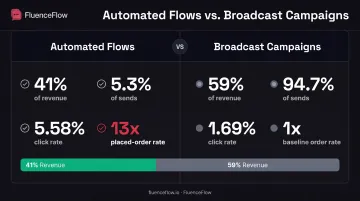
The economic impact is direct. Klaviyo's 2025 benchmark data shows automated flows generated nearly 41% of email revenue from just 5.3% of sends.
That's nearly 18x the revenue per recipient compared to broadcast campaigns. When you send relevant messages to the right segments, revenue concentrates in a small share of your list.
The List Lifecycle: Acquisition Through Decay
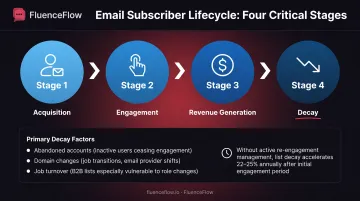
Every subscriber moves through a predictable lifecycle: acquisition → engagement → revenue generation → decay. Poor management accelerates decay and shortens the revenue-generating window.
Decay is constant. ZeroBounce's 2026 report classified 23% of email addresses as invalid across 11 billion+ validation checks in 2025. Addresses go bad for predictable reasons:
- Hard bounces from nonexistent or incorrect addresses
- Soft bounces from full inboxes
- Abandoned accounts, domain changes, and role turnover
Proper list management extends the revenue window: keep people engaged, remove invalid addresses before they hurt deliverability, and re-engage subscribers who show early decay signals.
The Business Case: ROI Depends on Execution
Email's ROI is real, but results vary widely. Litmus's 2025 survey found that 35% of respondents returned $10–$36 per dollar spent, 30% returned $36–$50, and 5% returned more than $50. Another 21% did not measure ROI at all.
The same platform can produce very different outcomes depending on strategy, segmentation discipline, and list health. Brands that segment by behavior, maintain strict hygiene, automate lifecycle messaging, and protect sender reputation land at the top of that range.
Brands that broadcast to unengaged contacts, ignore bounces, and skip segmentation watch returns shrink as inbox providers route their mail to spam.
Building Your Email List: Acquisition Strategies That Work
Permission-Based Collection: The Only Valid Foundation
Legitimate list growth starts with explicit permission. Subscribers must actively choose to join your list, ideally through double opt-in, a two-step process where users confirm their subscription via email. Mailchimp notes that double opt-in helps maintain higher-quality audiences and reduces spam signups.
High-converting acquisition tactics for e-commerce:
- Signup forms – Klaviyo reports that successful forms commonly achieve 2.75%–3% submit rates (submissions divided by views)
- Popup overlays – Omnisend's 2026 analysis of 2025 activity shows 2.1% average conversion; below 1.5% underperforms, while 5%+ represents strong performance
- Exit-intent popups – Triggered when visitors show abandonment signals, capturing attention at the moment they're leaving
- Post-purchase signup incentives – Capture email and SMS at checkout or in post-purchase flows
- Referral programs – Grow through incentivized sharing from subscribers who already trust you
Lead magnets seal the value exchange. Offer something shoppers actually want:
- First-order discount or gift-with-signup
- Exclusive content or product education
- Early access to drops or sales
Stronger perceived value drives higher opt-in rates. That same permission standard is why shortcuts fail.
Why Buying Email Lists Is Strategic Malpractice
"Can I just buy a list?" is the wrong question. While purchasing email addresses isn't strictly illegal in the US under CAN-SPAM (unlike GDPR jurisdictions), it violates every major ESP's terms of service and delivers zero business value.
Mailchimp explicitly states that purchased lists violate its Terms of Use and raise bounce and abuse rates. Klaviyo's acceptable use policy similarly prohibits third-party and prospecting lists. Beyond terms-of-service violations, purchased lists produce:
- Zero engagement – Recipients never asked to hear from you and will ignore or report your messages
- Deliverability damage – High bounce rates and spam complaints tank your sender reputation across all future sends
- Platform suspension risk – ESPs monitor engagement metrics and will suspend accounts showing purchased-list patterns
- Compliance exposure – GDPR requires explicit consent; purchased lists provide none
Permission-based collection takes longer but builds an asset that generates revenue. Purchased lists provide a shortcut to account suspension.
Email List Segmentation: The Unit Economics Approach
Why Unit Economics Should Drive Segmentation Strategy
Most brands segment by demographics or generic "engagement" buckets. Better performers segment by unit economics: the core metrics that determine how customers buy and how much they're worth.
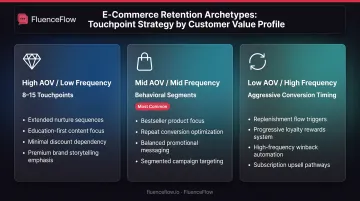
FluenceFlow's framework organizes list management strategy around three business archetypes:
High AOV / Low Frequency (luxury goods, furniture, premium products):
- Longer decision cycles requiring 8–15 touchpoints
- Extended nurture sequences with education-driven content
- Post-purchase cross-sell systems to increase lifetime value
- Minimal reliance on discounts; focus on confidence-building
Mid AOV / Mid Frequency (apparel, general retail, large catalogs):
- Segment by purchase and browsing behavior
- Direct customers toward bestsellers and high-margin items
- Convert first-time buyers into repeat customers
- Balance promotional and content-driven messaging
Low AOV / High Frequency (consumables, CPG, replenishment products):
- Aggressive first-order conversion tactics
- Replenishment flows timed to actual product usage, not arbitrary intervals
- Progressive rewards that make switching costly
- Lapsed-buyer winbacks triggered before customers churn to competitors
This approach recognizes that a furniture brand and a coffee subscription company have different list-management needs, even if both sell direct-to-consumer.
Behavioral Segmentation Tactics That Drive Revenue
Beyond unit economics, segment by observable behavior:
Engagement level:
- Active subscribers (opens, clicks, purchases within recent window)
- Dormant subscribers (engaged previously but inactive recently)
- Never-engaged subscribers (joined but never interacted)
Purchase history:
- First-time buyers (highest churn risk)
- Repeat customers (highest lifetime value)
- VIP customers (top 10% by revenue)
- Lapsed customers (purchased before but not recently)
Engagement and purchase history are the foundation. Next, layer in intent signals from on-site behavior:
Browse behavior:
- Product viewers who didn't purchase
- Category-specific interest
- Cart abandoners
Email interaction patterns:
- Click behavior (what content drives action)
- Device preference (mobile vs. desktop)
- Time-of-day engagement patterns
Then match messaging to where someone sits in the relationship:
Lifecycle stage:
- New subscribers (welcome series)
- Active customers (promotional campaigns)
- At-risk customers (win-back sequences)
Advanced Segmentation: Predictive Models and RFM Analysis
RFM segmentation (Recency, Frequency, Monetary value) stratifies your list by:
- Recency – How recently they purchased
- Frequency – How often they purchase
- Monetary value – How much they spend
This three-dimensional view identifies your best customers (recent, frequent, high-spend), at-risk valuable customers (historically high-value but not recent), and one-time buyers worth re-engaging.
Predictive segments use historical data to forecast:
- Likely to purchase next (high propensity)
- Churn risk (declining engagement signals)
- Product affinity (likely to buy specific categories)
Cohort-based segmentation groups subscribers by acquisition date, allowing you to track how list quality and engagement evolve over time and compare performance across acquisition sources.
Those models pay off when they trigger the right message at the right moment. Klaviyo's 2025 benchmark data shows that flows (automated messages triggered by specific behaviors) generated nearly 41% of email revenue from just 5.3% of sends. Flow click rates reached 5.58% versus 1.69% for campaigns, with 13x the placed-order rate.
That gap exists because flows target specific behaviors at optimal moments, while broadcast campaigns hit entire lists indiscriminately. Segmentation is what makes that personalized, behavior-triggered messaging possible.
FluenceFlow reports that clients average 41% of total store revenue from combined email and SMS, with individual cases showing email share growing from 27% to 38% through strategic segmentation and lifecycle optimization.
List Hygiene and Maintenance: Protecting Your Sender Reputation
The Economics of List Decay
List decay compounds when you ignore it. Invalid addresses raise your bounce rate, engagement drops, and inbox providers start treating your messages as unwanted. Poor metrics push you toward the spam folder, which suppresses engagement further and makes the next send even worse.
ZeroBounce's 2025 data classified 23% of addresses as invalid across 11 billion+ checks, including more than 9% catch-all addresses and 0.01% spam traps. While this cross-industry sample doesn't represent an e-commerce-specific annual decay rate, it establishes that decay is constant and substantial.
What causes decay:
- Hard bounces: Nonexistent or incorrect addresses (permanent failures)
- Soft bounces: Full inboxes or temporary server issues
- Abandoned accounts: Users stop checking an address without closing it
- Domain changes: Provider switches that invalidate old addresses
- Job changes: Common in B2B, and still a factor for personal inboxes
The Hygiene Framework: Immediate to Quarterly Actions
Immediate (automated):
- Remove hard bounces instantly; these addresses will never work
- Klaviyo automatically suppresses profiles after one hard bounce or more than seven consecutive soft bounces
Ongoing (monitor weekly):
- Track soft bounces; remove addresses that soft-bounce 3–5 times consecutively
- Monitor spam complaint rates and unsubscribe patterns for campaign-specific issues
Quarterly (systematic validation):
- Run email validation through services like ZeroBounce or NeverBounce
- Review engagement cohorts and flag sustained inactivity
- Execute sunset policies for long-term non-engagers
Sunset Policy Implementation: When to Suppress Inactive Subscribers
Sunset policies suppress subscribers with sustained inactivity across multiple channels, not email opens alone. Apple Mail Privacy Protection artificially inflates opens, so open-only signals mislead your hygiene decisions.
Klaviyo defines sustained inactivity using absence of site visits, purchases, opens, clicks, checkout, and order behavior. The platform's example segment targets profiles created at least 180 days earlier, sent at least five emails, with zero email, site, product-view, checkout, or order activity.
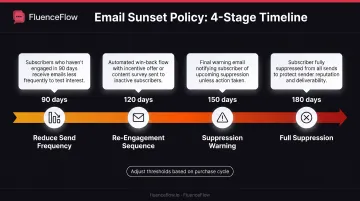
Sample sunset framework:
- 90 days of inactivity → Reduce send frequency; move to less-frequent campaign segments
- 120 days of inactivity → Trigger re-engagement sequence (exclusive offer, "We miss you" messaging)
- 150+ days of sustained inactivity → Suppress from regular campaigns; consider final win-back attempt
- 180+ days with no multichannel activity → Full suppression from active list
Adjust thresholds based on your purchase cycle; furniture brands might extend windows and consumables brands might shorten them.
List Health Metrics: Current Standards
Klaviyo's updated deliverability monitoring guidelines define healthy email metrics:
| Metric | Healthy | Needs Improvement | Attention Required |
|---|---|---|---|
| Bounce rate | <1% | 1%–2% | >2% |
| Spam complaint rate | <0.01% | 0.01%–0.05% | >0.05% |
| Unsubscribe rate | <0.3% | 0.3%–1% | >1% |
| Open rate (excluding MPP) | >33% | 25%–33% | <25% |
| Click rate | >1% | 0.5%–1% | <0.5% |
Gmail separately specifies that spam rates should stay below 0.1% and never reach 0.3%. These thresholds apply to bulk senders (5,000+ Gmail messages daily) and directly impact inbox placement.
Open rates alone are weak health indicators once privacy-protection features enter the picture. Pair opens with clicks, site visits, and purchases before you judge list quality or cut a segment.
Email List Management Tools and Platforms
Understanding the Tool Landscape
Email list management tools fall into three categories:
Email Service Providers (ESPs) are full-featured platforms that combine list management, segmentation, automation, and sending infrastructure. Common options include Klaviyo, Omnisend, Drip, Mailchimp, and Attentive.
Validation and hygiene tools verify email validity and flag risky addresses. Widely used options include ZeroBounce, NeverBounce, and BriteVerify.
Strategic implementation partners are agencies that build and manage your email systems inside your ESP. They handle strategy, segmentation, lifecycle flows, and ongoing optimization, not another piece of software.
Key ESP Considerations for E-commerce
When evaluating ESPs for e-commerce list management, prioritize:
Native e-commerce integrations:
- Direct connections to Shopify, BigCommerce, WooCommerce
- Automatic syncing of order data, customer behavior, and product catalogs
- Klaviyo's Shopify integration exposes synced order, delivery, and customer data for segmentation
Segmentation capabilities:
- Support for behavioral, transactional, and predictive segments
- Klaviyo allows up to 100 conditions per segment, enabling complex targeting
- Omnisend and Drip offer dynamic, auto-renewed segments
Automation depth:
- Pre-built e-commerce flows (welcome, cart abandonment, post-purchase, browse abandonment, win-back)
- Conditional logic and branching
- A/B testing within flows
Deliverability track record:
- Authentication support (SPF, DKIM, DMARC)
- Dedicated IP options for high-volume senders
- Proactive deliverability monitoring and guidance
Klaviyo, Omnisend, and Drip all offer strong e-commerce integrations, behavioral tracking, and automation depth. Klaviyo particularly excels with Shopify due to integration maturity and advanced segmentation capabilities.
Why Platform Choice Matters Less Than Implementation
Brands on the same ESP often see very different results. The platform supplies the infrastructure: segmentation engines, automation builders, and sending capacity. Strategy determines the outcomes.
What separates top performers:
- Segmentation discipline – Building and maintaining behavioral segments, not just blasting entire lists
- Lifecycle automation – Deploying welcome, abandonment, post-purchase, replenishment, and win-back flows tailored to unit economics
- Hygiene rigor – Systematically removing bounces, suppressing inactive subscribers, and protecting sender reputation
- Testing cadence – Continuously optimizing subject lines, content, timing, and offers
- Technical health – Proper authentication, list management, and compliance infrastructure
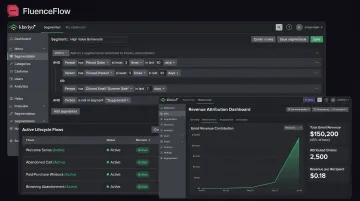
FluenceFlow works exclusively inside clients' Klaviyo accounts as a certified partner. The team builds segmentation around unit economics, stands up lifecycle flows, and runs ongoing optimization. Features get you in the game; disciplined implementation is what puts email at the top of your revenue mix.
Compliance and Best Practices
Email compliance protects deliverability and keeps your brand out of regulatory trouble. For DTC brands, the cost of getting it wrong ranges from spam-folder placement to five- and six-figure fines.
US senders start with CAN-SPAM and CCPA. If you email subscribers in the EU, UK, or Canada, GDPR and CASL apply too.
The Four Major Email Regulations
CAN-SPAM (United States):
- Requires a valid physical postal address in every email
- Honest subject lines and routing information
- Clear opt-out mechanism that processes requests within 10 business days
- Applies to commercial messages; penalties up to $51,744 per violation
GDPR (European Union and UK):
- Requires specific consent for individual email marketing
- Limited prior-customer exception (soft opt-in) under strict conditions
- Right to erasure (deletion of personal data)
- Right to data portability (obtain and reuse data across services)
- Purchased email lists require very specific, documented consent
CASL (Canada):
- Requires consent, sender identification, and unsubscribe mechanism before sending commercial electronic messages
- Express consent requires proactive opt-in; implied consent has limited scope
- Unsubscribe requests must be honored within 10 business days
- Penalties up to CAD $10 million per violation
CCPA/CPRA (California):
- Grants consumers rights to know what personal data is collected, used, and shared
- Right to deletion (with exceptions)
- Right to correction
- Right to opt out of sale or sharing of personal data
- Applies to businesses meeting revenue, data volume, or revenue-from-data thresholds
Must-Have Compliance Infrastructure
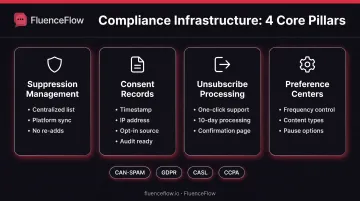
Laws only help if your systems enforce them. Build these four pieces before you scale send volume.
Suppression list management:
- Keep one centralized list of unsubscribes, hard bounces, and spam complainers
- Sync that list across every sending platform
- Never re-add a suppressed address without fresh, explicit consent
Consent records:
- Log when, where, and how each subscriber opted in
- Store IP address, timestamp, and opt-in source
- Keep records ready for audits and platform reviews
Unsubscribe processing:
- Support one-click unsubscribe (required for bulk Gmail and Yahoo senders)
- Honor requests within 10 business days (CAN-SPAM and CASL)
- Confirm on a page; don’t force a second email action
Preference centers:
- Let subscribers set frequency and content types
- Offer pause or digest options before a full opt-out
- Cut unnecessary unsubscribes without ignoring intent
Technical Infrastructure: Authentication and Sending
Inbox providers now treat authentication as a gate, not a nice-to-have.
Gmail requires SPF or DKIM for all senders. Bulk senders (5,000+ Gmail messages per day) need SPF, DKIM, and DMARC. Yahoo applies the same bulk rules. Unauthenticated mail can land in spam or get rejected.
Authentication checklist:
- SPF (Sender Policy Framework) – Authorizes sending servers via DNS
- DKIM (DomainKeys Identified Mail) – Cryptographic signature that proves message authenticity
- DMARC (Domain-based Message Authentication, Reporting & Conformance) – Tells receivers how to handle auth failures
Implementation:
- Configure SPF, DKIM, and DMARC with your ESP
- Monitor DMARC reports for misconfigurations and spoof attempts
- Send from a dedicated subdomain (email.yourbrand.com), not your root domain
Ongoing habits that support compliance:
- Validate the list at least quarterly
- Segment by behavior and lifecycle stage
- Track engagement across email, site, and purchase activity
- Keep consent logs, privacy policy, and data-processing agreements current
Compliance is infrastructure, not a one-time setup. When suppression, consent, and authentication stay current, list growth and campaign work stay safe to scale.
Frequently Asked Questions
How much is a 1000 email list worth?
In e-commerce, an engaged subscriber typically generates $1–$5 per month, so 1,000 engaged subscribers can mean roughly $1,000–$5,000 monthly. Purchased or unengaged emails are worth $0 and hurt deliverability through bounces and spam complaints.
What is the best email list management software?
For e-commerce, choose an ESP with strong Shopify, BigCommerce, or WooCommerce integrations and solid automation. Klaviyo, Omnisend, and Drip are common fits. Results depend more on segmentation, hygiene, and lifecycle flows than on the logo on the login screen.
What is the best way to collect email lists?
Use permission-based collection through value exchange: a clear benefit (discount, content, early access), signup forms, and double opt-in. Targeted popups, exit-intent offers, and post-purchase capture work well; Omnisend reports popups average 2.1% conversion. Skip purchased lists entirely.
Is buying email lists legal?
In the US, buying lists is not strictly illegal under CAN-SPAM, but it usually violates GDPR-style consent rules abroad and breaks ESP terms (Mailchimp, Klaviyo, and others will suspend accounts). You get high bounces, spam complaints, and almost no engagement, so the practice is operationally worthless even when it is technically allowed.
Strong list management turns permission-based subscribers into repeat revenue. Collect with consent, segment by behavior and unit economics, run regular hygiene, and stay compliant. Your list is revenue you've already paid to acquire. Manage it that way.