Introduction
DTC brands face a critical decision: how to reach customers on mobile devices, which now generate nearly 80% of worldwide retail website visits.
Choose the wrong channel and you risk spending thousands on infrastructure that never drives revenue. Choose wisely, and you get a direct line to customers that can generate 30-40% of your total revenue.
The core comparison is simple: push notifications (app-based alerts) versus SMS (text messages). For most e-commerce brands, the choice isn't about which is "better." It's about which is practical given your current business model and customer behavior.
Push notifications require an app ecosystem most brands don't have. SMS works on any phone, reaches customers immediately, and fits into your existing retention stack.
This guide breaks down the technical, financial, and strategic differences so you can make the right call for your brand.
Key Takeaways
- Push needs an app and internet; SMS reaches any phone over the cellular network, no download required
- Open rates: SMS hits ~98%; push averages around 20%
- Building an app costs $90,780 on average before you send a single push
- Most DTC brands under $10M revenue lack sufficient app adoption to justify push investment
- Email + SMS is the proven retention stack for e-commerce brands without high-engagement apps
What is a Push Notification?
Push notifications are app-based or web-based messages that appear on user devices, either as mobile alerts from a native app or as browser notifications from a website. They require either a downloaded app or explicit browser permission before you can send them.
Key Characteristics
- Rich media support: Include images, buttons, action links, and deep links into specific app screens
- Internet dependency: Require an active data connection to deliver
- Permission gates: Users must install your app or grant browser permissions
- Audience limitation: Only reach users who've installed your app or opted into browser alerts, not your full customer base
Use Cases for Push Notifications
Push notifications excel in specific scenarios:
- In-app promotions and feature updates when users already engage with your app daily
- Content recommendations for media apps, social platforms, or content-driven experiences
- Real-time alerts for app-specific activities (order status changes, messages, game events)
Push notifications work best for app-first businesses (mobile games, social apps, daily-use services) where the app is the product.
Most DTC e-commerce brands don't fit that model. Customers shop through mobile browsers or desktop, rarely through a dedicated app. Without daily active users opening your app, push notifications go unseen.
Setup Requirements
Implementing push notifications requires substantial upfront investment:
- App development: Average project cost is $90,780; most projects run $10,000–$100,000+
- Notification infrastructure: Backend systems, push services (Apple Push Notification Service, Firebase Cloud Messaging), and developer time
- Timeline: Average development takes about 11 months from planning to launch
- Ongoing maintenance: App updates, OS compatibility fixes, and feature additions
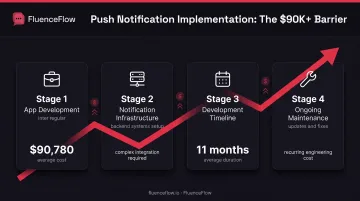
For brands without an app, this is a six-figure barrier before sending your first notification.
What is SMS (Text Message Marketing)?
SMS marketing sends text messages directly to customers' mobile phone numbers via the cellular network, no apps, no internet required. Messages arrive as standard texts in the native messaging app on any phone.
Core Characteristics
- Universal reach: Works on any phone with cellular service
- Character limits: 160 characters for standard SMS (GSM-7 encoding); concatenated messages up to 306 characters for two segments
- Immediate delivery: Messages arrive within seconds via cellular network
- High open rates: Twilio reports 98% open rates, with 90% read within three minutes
- No app required: Customers just need to opt in with their phone number
SMS typically falls into three types:
- Promotional messages: Sales, offers, new product launches, limited-time discounts
- Transactional notifications: Order confirmations, shipping updates, delivery alerts
- Conversational SMS: Two-way customer service, support queries, feedback requests
Use Cases for SMS Marketing
For e-commerce brands, SMS drives retention through these tactics:
- Abandoned cart recovery: Remind shoppers to complete purchases with a direct link back to their cart
- Back-in-stock alerts: Notify customers immediately when waitlisted items return
- VIP exclusive offers: Reward your best customers with SMS-only discounts and early access
- Post-purchase follow-ups: Request reviews, suggest complementary products, check satisfaction
- Loyalty program updates: Share points balances, tier upgrades, and reward redemptions
- Replenishment reminders: Time messages to when consumable products typically run out
SMS keeps your brand top-of-mind with existing customers and drives repeat purchases that cost far less than paid acquisition. According to Attentive's 2023 survey, 22% of marketers said more than 20% of their total revenue came from SMS.
SMS Compliance Requirements
SMS marketing in the US operates under strict TCPA regulations:
- Express written consent required: Customers must explicitly opt in before receiving messages
- Clear opt-in language: Disclose message type, frequency, and purpose at signup
- Easy opt-out mechanism: Every message must include "Reply STOP to unsubscribe"
- Record keeping: Maintain documentation of all consents and opt-outs
Working with compliant platforms like Klaviyo ensures your SMS program meets current FCC requirements while protecting your brand reputation.
Push Notifications vs. SMS: Quick Comparison
Delivery & Requirements
- Push: Requires app installation + notification permission + internet connection
- SMS: Requires phone number + opt-in consent; works on any phone via cellular network
Reach & Adoption
- Push: Limited to app users; only 36% of Android and 33.2% of iOS shopping-app users grant push permissions
- SMS: 98% of US adults own a cellphone; no app download friction
Engagement & Performance
- Push: Roughly 20% average open rate across industries; better for frequent, low-priority updates
- SMS: 98% open rate with 90% read within three minutes; higher perceived urgency
Cost Structure
Push:
- High upfront cost: $90,780 average app development, with projects ranging from $10,000 to $100,000+
- Low ongoing cost per message once infrastructure is built
- Requires continued app maintenance and updates
SMS:
- Low setup cost: Integration with platforms like Klaviyo takes days, not months
- Pay-per-message model: Starting around $0.0083 per segment before carrier fees
- Scales predictably with usage; pay only for what you send
Content & Capabilities
Push:
- Rich media support: images, buttons, action links
- Deep linking directly into app screens
- Flexible character limits and formatting
SMS:
- Text-based (160 characters standard) or MMS for media
- Supports clickable links to mobile-optimized pages
- Works on any device without special software
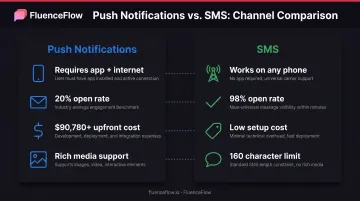
Push Notifications vs. SMS: Which Should You Choose?
Do you have a mobile app with meaningful adoption? If fewer than 10% of your customers actively use your app, push notifications won't reach enough people to justify the investment.
Choose SMS If:
- You're a DTC e-commerce brand under $10M revenue focused on retention marketing
- You want immediate implementation without six-figure app development costs
- Your customers shop via mobile web or desktop, not through a dedicated app
- You need high-urgency communications that get opened within minutes
- You're building or scaling your retention marketing stack
Choose Push Notifications If:
- You're an app-first business (mobile game, social platform, service app)
- Your app has high daily active users: the app is your product
- In-app engagement is already strong and customers open the app regularly
- You need frequent, low-friction updates that don't warrant SMS urgency
The Hybrid Approach
Brands with established apps can use both:
- Push notifications for in-app engagement, content updates, feature announcements, routine notifications
- SMS for critical, high-value communications: cart abandonment, VIP offers, back-in-stock alerts, transactional updates
This hierarchy prevents channel fatigue: reserve SMS for messages that truly matter, and use push for everything else.
Business Model Considerations
Your AOV and purchase frequency also guide channel choice:
- High-AOV, low-frequency brands (furniture, jewelry, premium goods): SMS urgency fits long consideration cycles and infrequent purchases
- Low-AOV, high-frequency brands (consumables, subscriptions): Push works if you have an app; SMS still converts better on time-sensitive offers
- Mid-AOV, seasonal brands: SMS works well for flash sales and inventory updates without requiring app maintenance between seasons
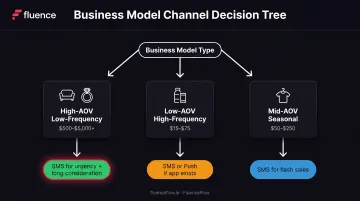
Real-World Examples
DTC E-Commerce: SMS Impact
APL, a luxury fashion brand, implemented SMS marketing and saw 25% of SMS subscribers make at least three purchases, with a 78x ROI and a 32% average conversion rate for triggered messages. For luxury brands with longer consideration cycles, SMS is especially effective at driving repeat purchases, not just one-off conversions.
The FluenceFlow Approach
FluenceFlow builds SMS into a brand's retention stack alongside email in Klaviyo, with frequency and offers set by unit economics: AOV, purchase cycle, and margin structure.
For example:
- High-AOV brands ($400+): educational nurture and post-purchase cross-sells, not discount-heavy texts
- Consumable brands: replenishment reminders timed to real usage cycles
- Mid-AOV seasonal brands: bestsellers and high-margin SKUs during peak windows
Across 30+ DTC clients, combined email and SMS drives an average of 41% of total store revenue, with 10.6x ROI in the first 90 days.
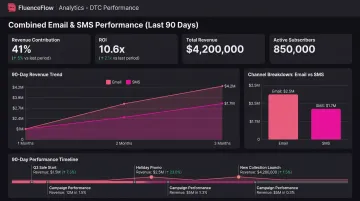
Most clients see quick wins inside 30 days. Stronger revenue lift usually builds over 60–90 days as flows mature and list engagement rises.
App-First Success: Push Notifications
FoodHero, a food-waste-reduction app, uses carefully timed morning push notifications featuring available items. One optimized push increased daily revenue by up to 10%. Push works here because users already open the app on a regular cadence.
For most e-commerce brands, SMS paired with email is the retention combo that pays first. Push usually needs an app investment that only makes sense at later growth stages, if it makes sense at all.
Conclusion
The push notifications vs. SMS decision comes down to infrastructure: push requires an app ecosystem most DTC brands don't have; SMS delivers immediate reach and engagement for mobile-first customer communication.
If you're an e-commerce brand without a high-engagement app, focus on SMS for retention marketing. Combined with email, SMS forms a retention stack that can drive 30-40% of total revenue without a six-figure app investment.
Evaluate your current customer communication strategy. If you're relying solely on email or sporadic promotions, adding SMS can drive meaningful repeat purchase revenue and increase customer lifetime value. Most DTC brands get better results by implementing SMS now and measuring returns within 30-90 days, rather than waiting on an expensive app build.
Frequently Asked Questions
Is push notification better than SMS?
The right choice depends on whether you have an app with strong daily engagement. For most DTC e-commerce brands without apps, SMS delivers better ROI and faster setup. For app-first businesses with high engagement, push becomes more cost-effective at scale.
Can you use push notifications and SMS together?
Yes. Use push for routine in-app updates and reserve SMS for urgent, high-value messages like cart abandonment and VIP offers. That hierarchy limits channel fatigue and keeps SMS feeling important.
Do I need an app to send push notifications?
Mobile push requires a native app. Web push works in browsers but usually underperforms SMS on adoption and engagement. For most e-commerce brands, building an app only for push isn't worth it versus SMS: you're looking at $90,000+ in development before the first send.
What are the compliance requirements for SMS marketing?
SMS requires TCPA compliance including express written consent, clear opt-in language, message frequency disclosures, and an easy opt-out mechanism in every message. Working with a compliant platform like Klaviyo ensures you meet FCC requirements, maintain consent records, and honor opt-outs automatically.
Which is more cost-effective for small e-commerce businesses?
SMS has low setup costs and scales with usage (starting around $0.01 per message segment), while push notifications require $90,000+ in app development upfront. For brands under $5M revenue, SMS delivers faster ROI without the app investment barrier. You can launch SMS in days and see attributed revenue within weeks.
How does SMS work with email marketing for retention?
Email covers longer-form content, education, newsletters, and multi-item promos. SMS handles urgent offers, cart recovery, and back-in-stock alerts. Together they can drive 30-40% of total e-commerce revenue when tied to your unit economics and purchase behavior.