This is an SMS drip campaign, a strategic, automated sequence of text messages that nurtures customers through their journey without requiring your team to manually send each one. According to Klaviyo's 2026 benchmark data, behavior-triggered SMS flows generate 45.2% of total SMS revenue from just 7.6% of sends, delivering roughly 8x the revenue per recipient compared to one-off promotional blasts.
This guide explains what SMS drip campaigns are, why they're essential for DTC brands, how to build them, and provides actionable examples for e-commerce businesses.
Key Takeaways
- SMS drip campaigns automate follow-ups triggered by real customer actions
- Behavior-triggered flows drive 8x more revenue per recipient than promotional blasts
- Send cart recovery texts within 60 minutes for the strongest conversion lift
- Match drip type to lifecycle stage: welcome, cart recovery, post-purchase, win-back
- Build compliance checks and smart send logic into every flow before launch
What Is an SMS Drip Campaign?
An SMS drip campaign is an automated sequence of text messages sent at predetermined intervals or triggered by specific customer actions. Each sequence guides recipients toward a clear outcome, such as completing a purchase, leaving a review, or placing a second order.
The "drip" metaphor reflects the delivery pattern: information arrives gradually over time rather than overwhelming recipients with everything at once. Instead of sending one promotional blast to your entire list, drip campaigns deliver relevant messages based on where each customer is in their journey.
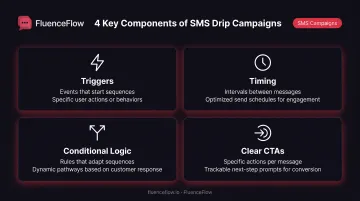
Key components include:
- Triggers: Events that start the sequence (form submission, abandoned cart, purchase completion, product browse)
- Timing: Intervals between messages, often based on customer behavior patterns
- Conditional logic: Rules that adapt the sequence based on responses, purchases, or inactivity
- Clear CTAs: Each message includes one specific action you want the recipient to take
For example, a new SMS subscriber might get an immediate welcome message with a discount code. A bestsellers highlight can follow 24 hours later, then a reminder that the offer expires soon. Each message builds on the last, guiding them toward a first purchase without manual work from your team.
Why Use SMS Drip Campaigns for E-commerce
Channel Performance That Beats Email
Vendor claims about SMS open rates need context. Klaviyo doesn't track SMS opens and recommends measuring clicks instead.
Even so, the engagement gap shows up clearly in click data. Klaviyo's 2026 benchmark report covering more than 183,000 e-commerce customers shows behavior-triggered SMS flows near 10% click rates, with top performers above 16%.
These automated sequences generate 45.2% of total SMS revenue while making up just 7.6% of sends: roughly 8x the revenue per recipient versus promotional campaigns.
Lifecycle Coverage Without Manual Effort
SMS drip campaigns support the entire customer lifecycle, from first website visit through post-purchase engagement and reactivation. A properly configured system automatically:
- Welcomes new subscribers within minutes of opt-in
- Recovers abandoned carts before the customer forgets
- Confirms orders and shares tracking information
- Requests reviews after the product arrives
- Reactivates customers who haven't purchased in 60-90 days
That coverage runs 24/7. Your team does not need to manually segment lists or schedule each message.
Personalization at Scale
Automated drip sequences personalize messages from behavior, purchase history, and segment data without one-off manual work. Triggers can reference the product someone viewed, cart total, past orders, or VIP status straight from your e-commerce platform.
A shopper browsing premium leather jackets should not get the same copy as someone who viewed $30 graphic tees. High-intent buyers may need education that handles objections; casual browsers often respond better to social proof and light urgency.
Revenue Impact and Customer Value
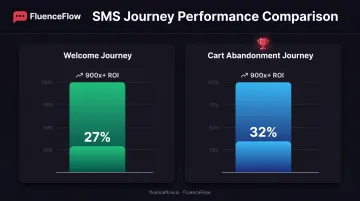
The revenue impact extends beyond individual conversions. Attentive's Cozy Earth case study documents SMS journeys producing 13% click-through rates, 17% conversion rates, and 515x ROI. Their welcome journey achieved 27% conversion and their cart abandonment journey hit 32% conversion, both exceeding 900x ROI.
These are exceptional results, not industry averages. They still show the ceiling well-built SMS drip campaigns can reach.
Maximizing Paid Traffic Investment
SMS drip campaigns lower effective CAC by getting more value from traffic you already paid to acquire. Every paid or organic visit carries real acquisition cost. If the shopper leaves without buying, that spend usually looks wasted.
Drip sequences give you several automated chances to convert the same visitor with no extra ad budget. That is the core retention idea: turn traffic you already funded into repeat revenue instead of one missed session.
How to Build an Effective SMS Drip Campaign
Start with a clear objective: what specific outcome do you want? Purchase completion, appointment booking, review submission, or repeat purchase? The goal determines your entire sequence structure, message content, and success metrics.
Define Your Audience Segments
Different customer segments need different drip sequences. A first-time visitor exploring your brand requires different messaging than a VIP customer who's purchased six times in the past year.
Segment based on:
- Purchase history (first-time vs. repeat customers)
- Customer value (based on total spend or average order value)
- Engagement level (active subscribers vs. dormant contacts)
- Browse behavior (high-intent product viewers vs. casual browsers)
Tailor sequences to unit economics, not just demographics.
High AOV / low frequency: Premium buyers with $400+ orders often research across 8-15 touchpoints and abandon carts near 80%. They need longer nurture sequences built on education and reassurance, not aggressive discount pushes.
Low AOV / high frequency: Consumable brands need a fast first-order conversion, then replenishment flows timed to product usage, progressive rewards, and lapsed-buyer winbacks that build habit.
Map the Customer Journey and Triggers
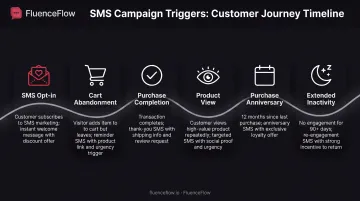
Identify the trigger event that starts each drip campaign: the specific moment the sequence should begin. Common e-commerce triggers include:
- SMS opt-in or form submission
- Cart abandonment (checkout started but not completed)
- Purchase completion
- Product view without adding to cart
- First purchase anniversary
- Extended inactivity (60-90 days without purchase)
Map the path from trigger to desired outcome. How many touchpoints are realistically needed? For e-commerce, this typically ranges from 1-3 messages for time-sensitive sequences like cart abandonment to longer sequences for welcome series or win-back campaigns.
Critical timing constraint: US carrier guidelines limit abandonment programs to one text per event within 48 hours. This means the classic "3-4 message cart recovery sequence" violates carrier rules. Plan accordingly.
Craft Your Message Sequence
Effective SMS drip messages follow these principles:
- Keep it concise: Aim for under 160 characters when possible to avoid multi-segment messages
- Conversational tone: Write like you're texting a friend, not broadcasting an announcement
- Personalization: Reference the customer's name, product viewed, or cart total when relevant
- One clear CTA: Each message should drive one specific action, not multiple competing options
Provide value in each message beyond just pushing for the sale. Include helpful information, social proof, urgency elements, or exclusive offers that give recipients a reason to engage.
Example progression for a welcome series:
- "Thanks for joining! Here's 15% off your first order: CODE15 → [link]"
- "Our bestsellers: [Product 1], [Product 2], [Product 3]. See why customers love them → [link]"
- "Your 15% discount expires tonight! Don't miss out → [link]"
Determine Timing and Frequency
Klaviyo recommends starting at 2-4 sends per month and gradually increasing to 4-7 based on engagement, using recipient-local time zones and avoiding daily sends unless explicitly expected.
Timing should align with your product's typical decision cycle. Impulse purchases warrant faster sequences (minutes to hours), while considered purchases need longer intervals (days to weeks).
Common timing patterns:
- Abandoned cart: Send within 60 minutes for best conversion (and stay inside the 48-hour carrier limit of one text per event)
- Welcome series: Immediate welcome, 10-minute follow-up, 24-48 hour discount reminder
- Win-back campaigns: Start after 45 days of inactivity, with messages spaced 15 days apart
A/B test send times to optimize for your specific audience. Test one variable at a time. If you're testing timing, keep message content constant so you know which factor drove results.
Set Up Compliance and Tracking
SMS compliance isn't optional. Federal regulations require:
- Explicit opt-in consent: Prior express written consent for marketing messages
- Clear brand identification: Recipients must know who's texting them
- Easy opt-out: Honor STOP, QUIT, END, CANCEL, and UNSUBSCRIBE within 10 business days
- Quiet hours: No messages before 8 AM or after 9 PM recipient local time
- 10DLC registration: US carriers require Application-to-Person registration or messages may be blocked
TCPA violations carry penalties of $500 per message, tripled to $1,500 for willful violations.
Track these metrics:
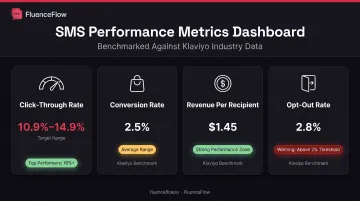
- Click-through rate (primary SMS engagement metric)
- Conversion rate (purchases attributed to the sequence)
- Revenue per recipient
- Opt-out rate (should stay below 2% per Klaviyo benchmarks)
Klaviyo's 2026 data shows flow click rates between 10.9%-14.9% as the operating benchmark, with top performers exceeding 16%. Use these as targets and iterate based on your results.
SMS Drip Campaign Examples for E-commerce
These five SMS drip sequences cover the highest-ROI moments in the e-commerce lifecycle, from first opt-in through win-back. Each example includes timing, sample copy, and compliance notes you can adapt to your brand.
Welcome Series for New Subscribers
A welcome series converts new subscribers into first-time customers by introducing your brand and incentivizing the first purchase. Klaviyo recommends 1-3 messages for SMS welcome flows.
3-message sequence:
- Immediate (triggered on opt-in): "Welcome to [Brand]! Here's 15% off your first order: WELCOME15 → [link]"
- 10 minutes later: "Not sure where to start? Check out our bestsellers: [Product 1], [Product 2], [Product 3] → [link]"
- 48 hours later: "Last chance! Your welcome discount expires tonight at midnight → [link]"
Split first-time subscribers from returning customers. Someone who's already purchased doesn't need a first-order discount. Reserve your largest incentive for message 2 or 3 to maintain momentum rather than giving away margin immediately.
Abandoned Cart Recovery
Cart abandonment represents your highest-intent shoppers. They've selected products and started checkout but didn't finish. Critical constraint: US carriers limit cart abandonment to one text per event within 48 hours.
Single-message sequence (compliant):
- 1 hour after abandonment: "Hey [Name]! You left [Product] in your cart ($[Amount]). Complete your order → [link]. Questions? Reply to this text!"
Send within 60 minutes when possible. Attentive reports this window produces the best conversion rates. Cancel the message if the customer completes their purchase before the text sends.
For additional follow-ups, pair one SMS within the first hour with emails at 24 and 48 hours. That respects carrier limits while keeping the shopper engaged across channels.
Post-Purchase Engagement
Post-purchase sequences build loyalty and encourage repeat purchases. Trigger these flows from order creation and fulfillment events.
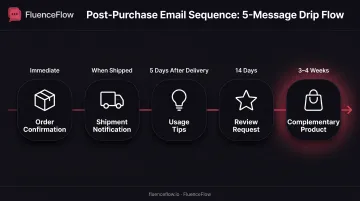
Multi-message sequence:
- Order confirmation (immediate): "Thanks for your order! Track your package → [link]"
- Shipment notification (when shipped): "Your order is on the way! Delivery expected [Date]. Track → [link]"
- Usage tips (5 days after delivery): "Getting the most from your [Product]: [Tip 1], [Tip 2]. Full guide → [link]"
- Review request (14 days after delivery): "How's your [Product] working out? Share your thoughts → [review link]"
- Complementary product (3-4 weeks later): "Customers who bought [Product] also love [Complement]. See the match → [link]"
Space these messages based on your typical delivery time and product usage cycle. A skincare product needs different spacing than a piece of furniture.
Browse Abandonment for High-Intent Shoppers
Customers who view products without adding to cart show interest but aren't ready to commit. Attentive's browse abandonment benchmarks show 21% click-through rates, 2.5% conversion rates, and $2.60 revenue per send.
2-message sequence:
- 1 hour after browse: "Still thinking about [Product]? It's a customer favorite with [X] 5-star reviews → [link]"
- 24 hours later: "Complete the look: Customers pair [Product] with [Related Item]. Shop the combo → [link]"
Limit browse messages to one per 72-hour window to avoid overwhelming shoppers who view multiple products. Cancel if they add the item to cart or make a purchase.
Win-Back Campaign for Inactive Customers
Reactivation sequences target customers who haven't purchased in 60-90 days. Attentive recommends two messages spaced 15 days apart after at least 45 days of inactivity.
2-message sequence:
- Day 60 after last purchase: "We miss you! Here's what's new since your last visit: [New Product 1], [New Product 2] → [link]"
- Day 75: "Come back! Exclusive 20% off just for you: COMEBACK20. Expires in 48 hours → [link]"
Time win-back campaigns based on your typical repurchase cycle. A consumable product with 30-day usage shouldn't wait 60 days to reactivate. A seasonal apparel brand might extend to 90+ days before sending win-back messages.
Frequently Asked Questions
What is a drip texting campaign?
A drip texting campaign is an automated series of text messages sent over time based on triggers or schedules. Each message "drips" to the recipient at strategic intervals, guiding them toward specific actions through multiple touchpoints without manual sending.
What is an example of a drip texting campaign?
Abandoned cart recovery: A customer adds items to cart but doesn't buy. About an hour later, they get a reminder text with their cart link. If they still don't convert, a second text the next day can address objections like shipping costs or returns.
What are some examples of SMS marketing campaigns?
Common SMS campaigns include welcome series, post-purchase tracking updates, abandoned cart recovery, browse abandonment alerts, back-in-stock notices, VIP offers, flash sales, and win-back messages for inactive customers.
How long should a drip texting campaign be?
Most e-commerce SMS drips work best with 1–3 messages over a few days to a couple of weeks. Welcome series often use 1–3 texts; cart abandonment is usually one text per event under carrier rules. Keep it shorter for impulse buys and longer when the purchase decision takes more time.
Does SMS marketing still work?
Yes, SMS marketing remains highly effective when done strategically. Klaviyo's 2026 benchmark data shows behavior-triggered SMS flows generate 8x more revenue per recipient than promotional blasts, with top performers achieving 16%+ click rates and $5+ revenue per recipient.
Is SMS marketing illegal?
No; SMS marketing is legal when you follow the rules. Federal regulations require explicit opt-in, clear brand ID, easy opt-out (STOP), and quiet hours (no texts before 8 AM or after 9 PM local time), plus TCPA and carrier guidelines.